7NXL | pdb_00007nxl

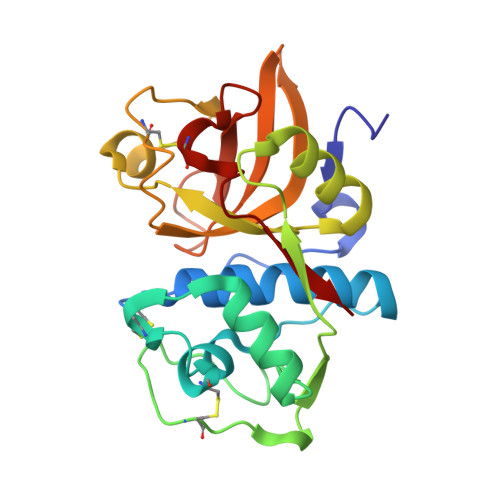
Structure of human cathepsin K in complex with the acrylamide inhibitor Gu3110


Experimental Data Snapshot

  • Method: X-RAY DIFFRACTION
  • Resolution: 1.80 Å
  • R-Value Free: 
    0.209 (Depositor), 0.189 (DCC) 
  • R-Value Work: 
    0.175 (Depositor) 
  • R-Value Observed: 
    0.176 (Depositor) 

Starting Model: experimental
View more details

wwPDB Validation 3D Report Full Report

Validation slider image for 7NXL

Ligand Structure Quality Assessment 


This is version 2.2 of the entry. See complete history

Literature

An Activity-Based Probe for Cathepsin K Imaging with Excellent Potency and Selectivity.

Lemke, C.Benysek, J.Brajtenbach, D.Breuer, C.Jilkova, A.Horn, M.Busa, M.Ulrychova, L.Illies, A.Kubatzky, K.F.Bartz, U.Mares, M.Gutschow, M.

(2021) J Med Chem 64: 13793-13806

  • DOI: https://doi.org/10.1021/acs.jmedchem.1c01178
  • Primary Citation Related Structures: 
    7NXL, 7NXM

  • PubMed Abstract: 

    The cysteine protease cathepsin K is a target for the treatment of diseases associated with high bone turnover. Cathepsin K is mainly expressed in osteoclasts and responsible for the destruction of the proteinaceous components of the bone matrix. We designed various fluorescent activity-based probes (ABPs) and their precursors that bind to and inactivate cathepsin K. ABP 25 exhibited extraordinary potency ( k inac / K i = 35,300 M -1 s -1 ) and selectivity for human cathepsin K. Crystal structures of cathepsin K in complex with ABP 25 and its nonfluorescent precursor 21 were determined to characterize the binding mode of this new type of acrylamide-based Michael acceptor with the particular orientation of the dibenzylamine moiety to the primed subsite region. The cyanine-5 containing probe 25 allowed for sensitive detection of cathepsin K, selective visualization in complex proteomes, and live cell imaging of a human osteosarcoma cell line, underlining its applicability in a pathophysiological environment.


  • Organizational Affiliation
    • Pharmaceutical Institute, Pharmaceutical & Medicinal Chemistry, University of Bonn, An der Immenburg 4, Bonn 53121, Germany.

Macromolecule Content 

  • Total Structure Weight: 24.27 kDa 
  • Atom Count: 1,887 
  • Modeled Residue Count: 216 
  • Deposited Residue Count: 216 
  • Unique protein chains: 1

Macromolecules

Find similar proteins by:|  3D Structure
Entity ID: 1
MoleculeChains  Sequence LengthOrganismDetailsImage
Cathepsin KA [auth AAA]216Homo sapiensMutation(s): 0 
Gene Names: CTSKCTSOCTSO2
EC: 3.4.22.38
UniProt & NIH Common Fund Data Resources
Find proteins for P43235 (Homo sapiens)
Explore P43235 
Go to UniProtKB:  P43235
PHAROS:  P43235
GTEx:  ENSG00000143387 
Entity Groups
Sequence Clusters30% Identity50% Identity70% Identity90% Identity95% Identity100% Identity
UniProt GroupP43235
Sequence Annotations
Expand
Reference Sequence

Small Molecules

Ligands 2 Unique
IDChains Name / Formula / InChI Key2D Diagram3D Interactions
UUK
(Subject of Investigation/LOI)

Query on UUK


Download:Ideal Coordinates CCD File
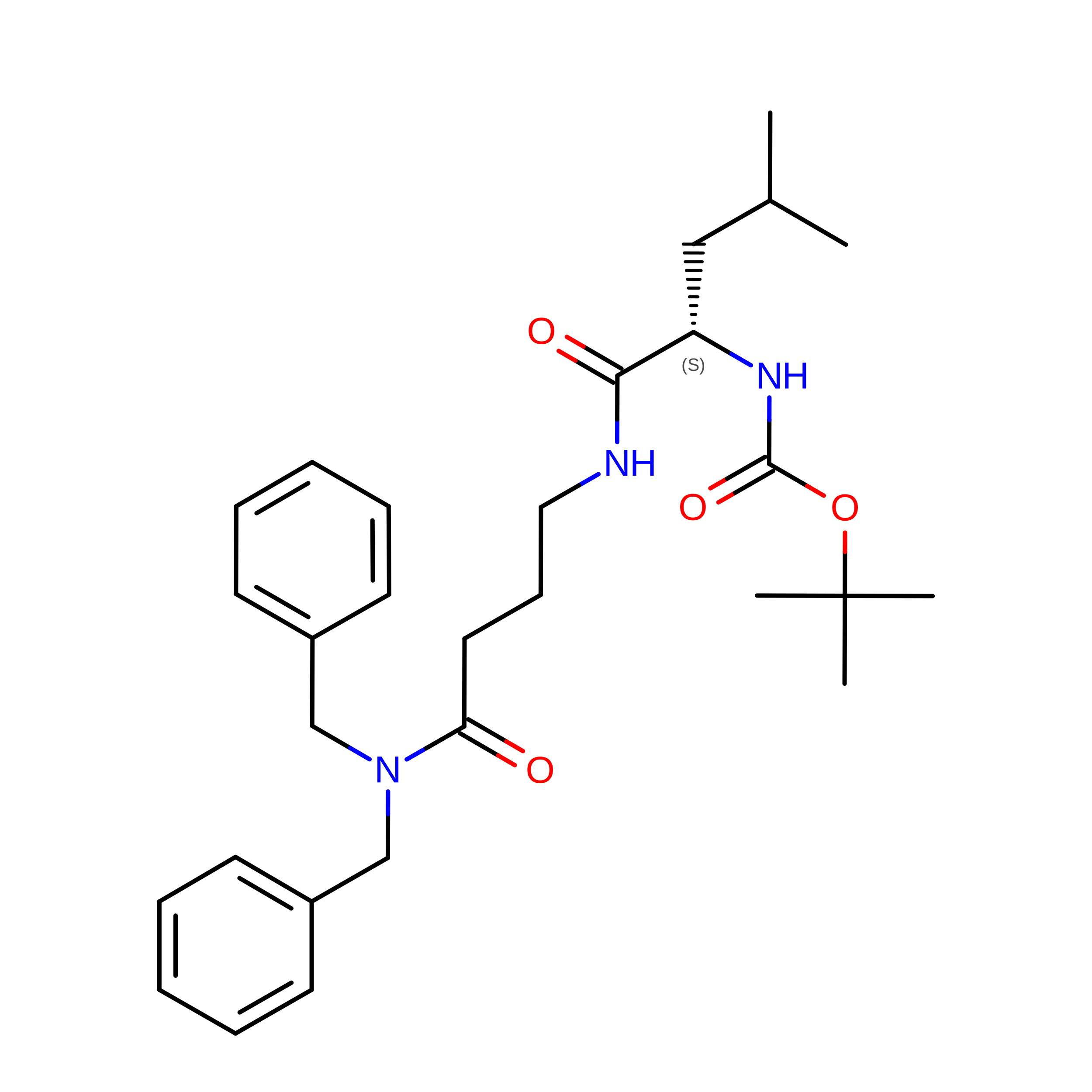
C [auth AAA]tert-butyl (1-((4-(dibenzylamino)-4-oxobutyl)amino)-4-methyl-1-oxopentan-2-yl)carbamate
C29 H41 N3 O4
RIIFVLHFONFLOV-VWLOTQADSA-N
SO4

Query on SO4


Download:Ideal Coordinates CCD File
B [auth AAA]SULFATE ION
O4 S
QAOWNCQODCNURD-UHFFFAOYSA-L

Experimental Data & Validation

Experimental Data

  • Method: X-RAY DIFFRACTION
  • Resolution: 1.80 Å
  • R-Value Free:  0.209 (Depositor), 0.189 (DCC) 
  • R-Value Work:  0.175 (Depositor) 
  • R-Value Observed: 0.176 (Depositor) 
Space Group: P 2 21 21
Unit Cell:
Length ( Å )Angle ( ˚ )
a = 32.366α = 90
b = 71.819β = 90
c = 80.771γ = 90
Software Package:
Software NamePurpose
REFMACrefinement
XDSdata reduction
XDSdata scaling
MOLREPphasing

Structure Validation

View Full Validation Report


Ligand Structure Quality Assessment 


Entry History 

Deposition Data

Revision History  (Full details and data files)

  • Version 1.0: 2021-09-08
    Type: Initial release
  • Version 2.0: 2021-10-13
    Changes: Atomic model, Data collection, Database references, Non-polymer description
  • Version 2.1: 2024-05-01
    Changes: Data collection, Derived calculations, Refinement description
  • Version 2.2: 2024-11-06
    Changes: Structure summary