7NOW | pdb_00007now

Complex of Nucleoporin-98 and nanobody MS98-27 solved at 1.85A resolution


Experimental Data Snapshot

  • Method: X-RAY DIFFRACTION
  • Resolution: 1.85 Å
  • R-Value Free: 
    0.209 (Depositor), 0.210 (DCC) 
  • R-Value Work: 
    0.184 (Depositor), 0.180 (DCC) 
  • R-Value Observed: 
    0.185 (Depositor) 

Starting Model: experimental
View more details

wwPDB Validation   3D Report Full Report


Ligand Structure Quality Assessment 


This is version 1.4 of the entry. See complete history

Re-refinement Note

This entry reflects an alternative modeling of the original data in: 5E0Q


Literature

A checkpoint function for Nup98 in nuclear pore formation suggested by novel inhibitory nanobodies.

Sola Colom, M.Fu, Z.Gunkel, P.Guttler, T.Trakhanov, S.Srinivasan, V.Gregor, K.Pleiner, T.Gorlich, D.

(2024) EMBO J 

  • DOI: https://doi.org/10.1038/s44318-024-00081-w
  • Primary Citation of Related Structures:  
    7NOW, 7NQA, 7ZOX, 8CDS, 8CDT, 8OZB

  • PubMed Abstract: 

    Nuclear pore complex (NPC) biogenesis is a still enigmatic example of protein self-assembly. We now introduce several cross-reacting anti-Nup nanobodies for imaging intact nuclear pore complexes from frog to human. We also report a simplified assay that directly tracks postmitotic NPC assembly with added fluorophore-labeled anti-Nup nanobodies. During interphase, NPCs are inserted into a pre-existing nuclear envelope. Monitoring this process is challenging because newly assembled NPCs are indistinguishable from pre-existing ones. We overcame this problem by inserting Xenopus-derived NPCs into human nuclear envelopes and using frog-specific anti-Nup nanobodies for detection. We further asked whether anti-Nup nanobodies could serve as NPC assembly inhibitors. Using a selection strategy against conserved epitopes, we obtained anti-Nup93, Nup98, and Nup155 nanobodies that block Nup-Nup interfaces and arrest NPC assembly. We solved structures of nanobody-target complexes and identified roles for the Nup93 α-solenoid domain in recruiting Nup358 and the Nup214·88·62 complex, as well as for Nup155 and the Nup98 autoproteolytic domain in NPC scaffold assembly. The latter suggests a checkpoint linking pore formation to the assembly of the Nup98-dominated permeability barrier.


  • Organizational Affiliation
    • Department of Cellular Logistics, Max Planck Institute for Multidisciplinary Sciences, Göttingen, Germany.

Macromolecules
Find similar proteins by:  (by identity cutoff)  |  3D Structure
Entity ID: 1
MoleculeChains Sequence LengthOrganismDetailsImage
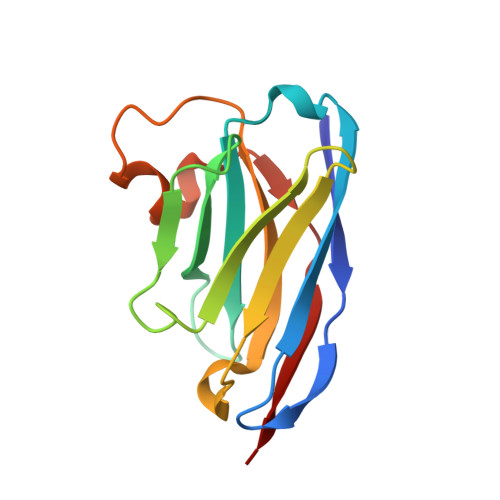
Anti-Nup98 nanobody MS98-27
A, C
129Vicugna pacosMutation(s): 0 
Entity Groups  
Sequence Clusters30% Identity50% Identity70% Identity90% Identity95% Identity100% Identity
Sequence Annotations
Expand
  • Reference Sequence
Find similar proteins by:  (by identity cutoff)  |  3D Structure
Entity ID: 2
MoleculeChains Sequence LengthOrganismDetailsImage
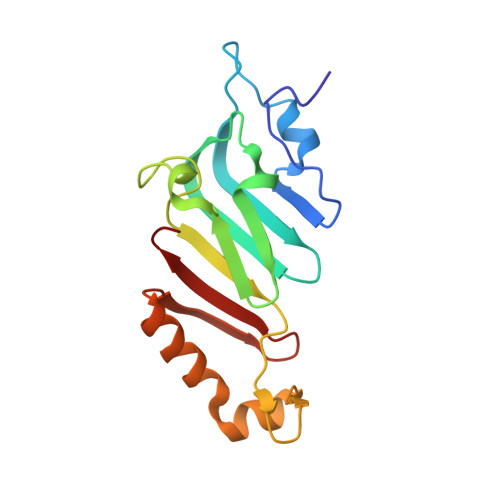
Nuclear pore complex protein Nup98
B, D
153Xenopus tropicalisMutation(s): 0 
Gene Names: nup98
UniProt
Find proteins for A0A6I8SCP2 (Xenopus tropicalis)
Explore A0A6I8SCP2 
Go to UniProtKB:  A0A6I8SCP2
Entity Groups  
Sequence Clusters30% Identity50% Identity70% Identity90% Identity95% Identity100% Identity
UniProt GroupA0A6I8SCP2
Sequence Annotations
Expand
  • Reference Sequence
Experimental Data & Validation

Experimental Data

  • Method: X-RAY DIFFRACTION
  • Resolution: 1.85 Å
  • R-Value Free:  0.209 (Depositor), 0.210 (DCC) 
  • R-Value Work:  0.184 (Depositor), 0.180 (DCC) 
  • R-Value Observed: 0.185 (Depositor) 
Space Group: C 1 2 1
Unit Cell:
Length ( Å )Angle ( ˚ )
a = 113.8α = 90
b = 149.81β = 133.089
c = 85.09γ = 90
Software Package:
Software NamePurpose
PHENIXrefinement
PHENIXrefinement
XDSdata reduction
XSCALEdata scaling
PHENIXphasing

Structure Validation

View Full Validation Report


Ligand Structure Quality Assessment 


Entry History 

Deposition Data

Revision History  (Full details and data files)

  • Version 1.0: 2021-04-07
    Type: Initial release
  • Version 1.1: 2023-08-02
    Changes: Database references, Source and taxonomy, Structure summary
  • Version 1.2: 2024-01-31
    Changes: Data collection, Refinement description
  • Version 1.3: 2024-05-22
    Changes: Database references
  • Version 1.4: 2024-10-16
    Changes: Structure summary