7NFN | pdb_00007nfn

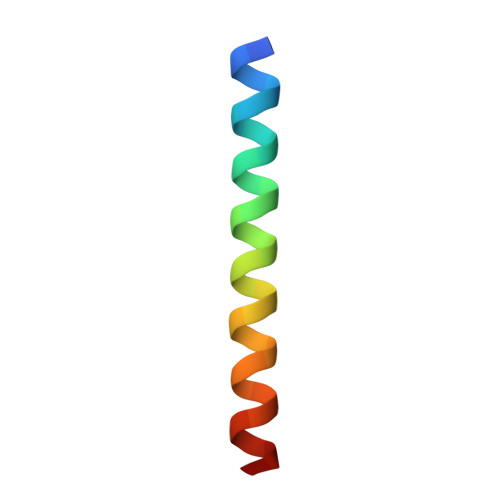
A heptameric barrel state of a de novo coiled-coil assembly: CC-Type2-(LaId)4-L21N-I24N.


Experimental Data Snapshot

  • Method: X-RAY DIFFRACTION
  • Resolution: 1.45 Å
  • R-Value Free: 
    0.178 (Depositor), 0.178 (DCC) 
  • R-Value Work: 
    0.134 (Depositor), 0.135 (DCC) 
  • R-Value Observed: 
    0.136 (Depositor) 

Starting Model: in silico
View more details

wwPDB Validation 3D Report Full Report

Validation slider image for 7NFN

This is version 1.3 of the entry. See complete history

Literature

Differential sensing with arrays of de novo designed peptide assemblies.

Dawson, W.M.Shelley, K.L.Fletcher, J.M.Scott, D.A.Lombardi, L.Rhys, G.G.LaGambina, T.J.Obst, U.Burton, A.J.Cross, J.A.Davies, G.Martin, F.J.O.Wiseman, F.J.Brady, R.L.Tew, D.Wood, C.W.Woolfson, D.N.

(2023) Nat Commun 14: 383-383

  • DOI: https://doi.org/10.1038/s41467-023-36024-y
  • Primary Citation Related Structures: 
    7NFF, 7NFG, 7NFH, 7NFI, 7NFJ, 7NFK, 7NFL, 7NFM, 7NFN, 7NFO, 7NFP, 8A09

  • PubMed Abstract: 

    Differential sensing attempts to mimic the mammalian senses of smell and taste to identify analytes and complex mixtures. In place of hundreds of complex, membrane-bound G-protein coupled receptors, differential sensors employ arrays of small molecules. Here we show that arrays of computationally designed de novo peptides provide alternative synthetic receptors for differential sensing. We use self-assembling α-helical barrels (αHBs) with central channels that can be altered predictably to vary their sizes, shapes and chemistries. The channels accommodate environment-sensitive dyes that fluoresce upon binding. Challenging arrays of dye-loaded barrels with analytes causes differential fluorophore displacement. The resulting fluorimetric fingerprints are used to train machine-learning models that relate the patterns to the analytes. We show that this system discriminates between a range of biomolecules, drink, and diagnostically relevant biological samples. As αHBs are robust and chemically diverse, the system has potential to sense many analytes in various settings.


  • Organizational Affiliation
    • School of Chemistry, University of Bristol, Cantock's Close, Bristol, BS8 1TS, UK. w.dawson@bristol.ac.uk.

Macromolecule Content 

  • Total Structure Weight: 47.74 kDa 
  • Atom Count: 3,993 
  • Modeled Residue Count: 428 
  • Deposited Residue Count: 448 
  • Unique protein chains: 1

Macromolecules

Find similar proteins by:|  3D Structure
Entity ID: 1
MoleculeChains  Sequence LengthOrganismDetailsImage
CC-Type2-(LaId)4-L21N-I24N
A, B, C, D, E
A, B, C, D, E, F, G, H, I, J, K, L, M, N
32synthetic constructMutation(s): 0 

Experimental Data & Validation

Experimental Data

  • Method: X-RAY DIFFRACTION
  • Resolution: 1.45 Å
  • R-Value Free:  0.178 (Depositor), 0.178 (DCC) 
  • R-Value Work:  0.134 (Depositor), 0.135 (DCC) 
  • R-Value Observed: 0.136 (Depositor) 
Space Group: P 1
Unit Cell:
Length ( Å )Angle ( ˚ )
a = 47.898α = 67.39
b = 47.91β = 67.49
c = 62.277γ = 77.73
Software Package:
Software NamePurpose
REFMACrefinement
PDB_EXTRACTdata extraction
DIALSdata reduction
Aimlessdata scaling
xia2data scaling
PHASERphasing

Structure Validation

View Full Validation Report


Entry History 

& Funding Information

Deposition Data


Funding OrganizationLocationGrant Number
European Research Council (ERC)European Union340764
Engineering and Physical Sciences Research CouncilUnited KingdomEP/G036764/1

Revision History  (Full details and data files)

  • Version 1.0: 2022-03-02
    Type: Initial release
  • Version 1.1: 2023-02-08
    Changes: Data collection, Database references
  • Version 1.2: 2024-05-01
    Changes: Data collection, Refinement description
  • Version 1.3: 2024-11-13
    Changes: Structure summary