7N51 | pdb_00007n51

Structure of a bacterial gasdermin from Vitiosangium sp.


Experimental Data Snapshot

  • Method: X-RAY DIFFRACTION
  • Resolution: 1.67 Å
  • R-Value Free: 
    0.218 (Depositor), 0.219 (DCC) 
  • R-Value Work: 
    0.194 (Depositor), 0.195 (DCC) 
  • R-Value Observed: 
    0.195 (Depositor) 

wwPDB Validation 3D Report Full Report

Validation slider image for 7N51

This is version 1.1 of the entry. See complete history

Literature

Bacterial gasdermins reveal an ancient mechanism of cell death.

Johnson, A.G.Wein, T.Mayer, M.L.Duncan-Lowey, B.Yirmiya, E.Oppenheimer-Shaanan, Y.Amitai, G.Sorek, R.Kranzusch, P.J.

(2022) Science 375: 221-225

  • DOI: https://doi.org/10.1126/science.abj8432
  • Primary Citation Related Structures: 
    7N50, 7N51, 7N52

  • PubMed Abstract: 

    Gasdermin proteins form large membrane pores in human cells that release immune cytokines and induce lytic cell death. Gasdermin pore formation is triggered by caspase-mediated cleavage during inflammasome signaling and is critical for defense against pathogens and cancer. We discovered gasdermin homologs encoded in bacteria that defended against phages and executed cell death. Structures of bacterial gasdermins revealed a conserved pore-forming domain that was stabilized in the inactive state with a buried lipid modification. Bacterial gasdermins were activated by dedicated caspase-like proteases that catalyzed site-specific cleavage and the removal of an inhibitory C-terminal peptide. Release of autoinhibition induced the assembly of large and heterogeneous pores that disrupted membrane integrity. Thus, pyroptosis is an ancient form of regulated cell death shared between bacteria and animals.


  • Organizational Affiliation
    • Department of Microbiology, Harvard Medical School, Boston, MA 02115, USA.

Macromolecule Content 

  • Total Structure Weight: 28.49 kDa 
  • Atom Count: 2,134 
  • Modeled Residue Count: 263 
  • Deposited Residue Count: 266 
  • Unique protein chains: 1

Macromolecules

Find similar proteins by:|  3D Structure
Entity ID: 1
MoleculeChains  Sequence LengthOrganismDetailsImage
Gasdermin266Vitiosangium sp. GDMCC 1.1324Mutation(s): 0 
Gene Names: DAT35_31115
UniProt
Find proteins for A0A2T4VDM4 (Vitiosangium sp. (strain GDMCC 1.1324))
Explore A0A2T4VDM4 
Go to UniProtKB:  A0A2T4VDM4
Entity Groups
Sequence Clusters30% Identity50% Identity70% Identity90% Identity95% Identity100% Identity
UniProt GroupA0A2T4VDM4
Sequence Annotations
Expand
Reference Sequence

Small Molecules

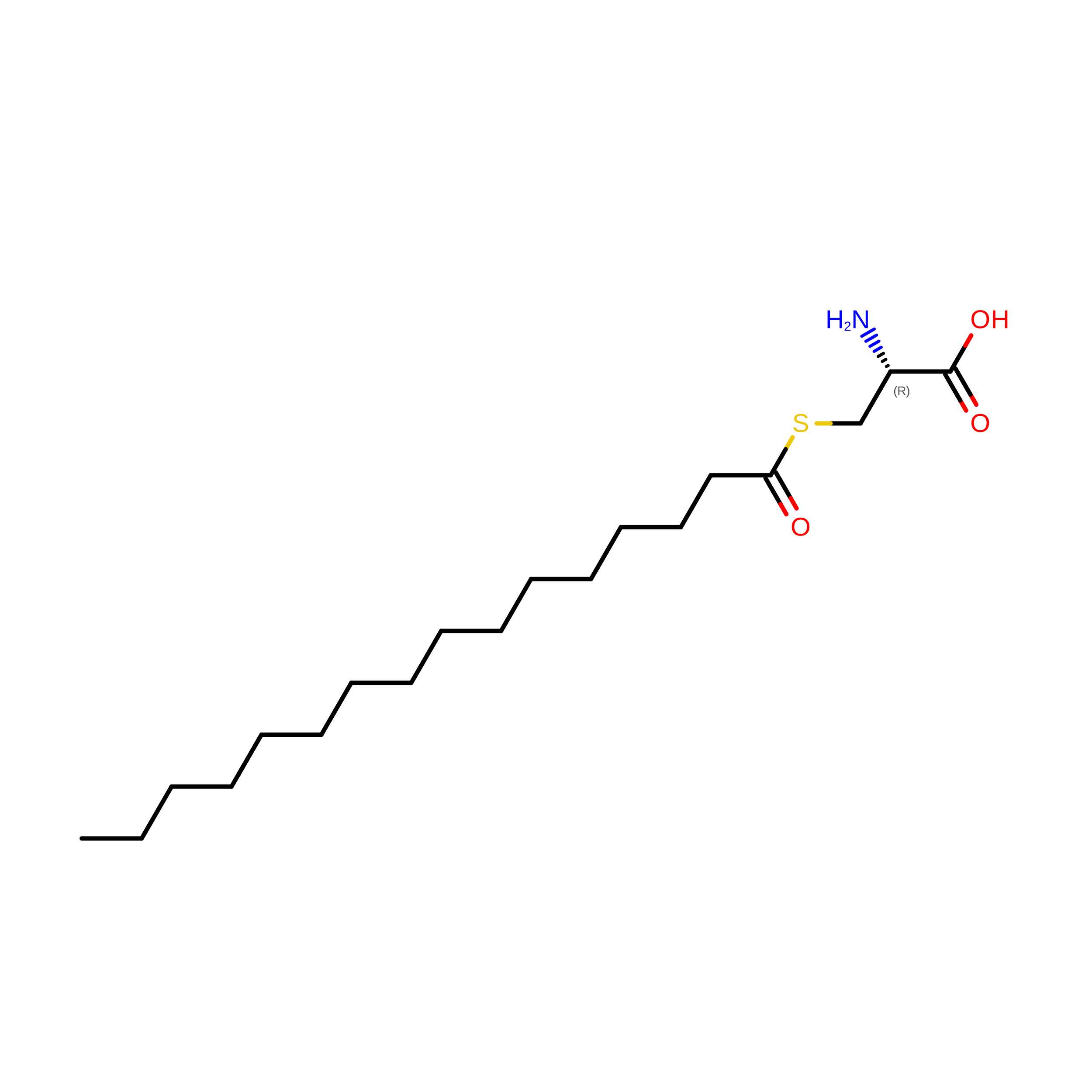
Modified Residues  1 Unique
IDChains TypeFormula2D DiagramParent
P1L
Query on P1L
A
L-PEPTIDE LINKINGC19 H37 N O3 SCYS

Experimental Data & Validation

Experimental Data

  • Method: X-RAY DIFFRACTION
  • Resolution: 1.67 Å
  • R-Value Free:  0.218 (Depositor), 0.219 (DCC) 
  • R-Value Work:  0.194 (Depositor), 0.195 (DCC) 
  • R-Value Observed: 0.195 (Depositor) 
Space Group: P 63 2 2
Unit Cell:
Length ( Å )Angle ( ˚ )
a = 87.383α = 90
b = 87.383β = 90
c = 141.969γ = 120
Software Package:
Software NamePurpose
PHENIXrefinement
XDSdata reduction
Aimlessdata scaling
PHENIXphasing

Structure Validation

View Full Validation Report


Entry History 

& Funding Information

Deposition Data


Funding OrganizationLocationGrant Number
National Institutes of Health/National Cancer Institute (NIH/NCI)United StatesT32CA207021

Revision History  (Full details and data files)

  • Version 1.0: 2021-06-16
    Type: Initial release
  • Version 1.1: 2022-01-26
    Changes: Database references