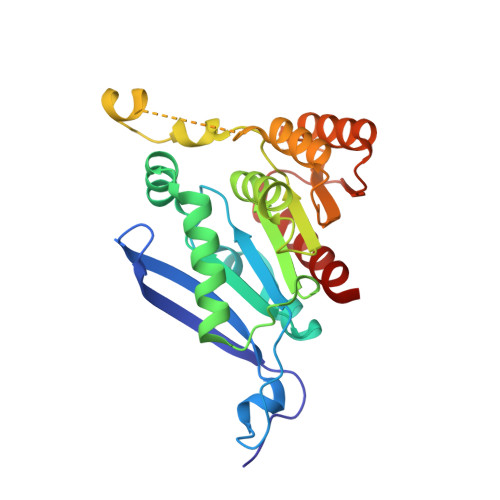
7L0A | pdb_00007l0a

Crystal structure of s-formylglutathione hydrolase (FrmB) from Staphylococcus aureus, apoenzyme


Experimental Data Snapshot

  • Method: X-RAY DIFFRACTION
  • Resolution: 1.60 Å
  • R-Value Free: 
    0.177 (Depositor), 0.180 (DCC) 
  • R-Value Work: 
    0.157 (Depositor), 0.159 (DCC) 
  • R-Value Observed: 
    0.158 (Depositor) 

Starting Model: experimental
View more details

wwPDB Validation 3D Report Full Report

Validation slider image for 7L0A

This is version 1.3 of the entry. See complete history

Literature

Structure-guided microbial targeting of antistaphylococcal prodrugs.

Miller, J.J.Shah, I.T.Hatten, J.Barekatain, Y.Mueller, E.A.Moustafa, A.M.Edwards, R.L.Dowd, C.S.Planet, P.J.Muller, F.L.Jez, J.M.Odom John, A.R.

(2021) Elife 10

  • DOI: https://doi.org/10.7554/eLife.66657
  • Primary Citation Related Structures: 
    7L0A, 7L0B

  • PubMed Abstract: 

    Carboxy ester prodrugs are widely employed to increase oral absorption and potency of phosphonate antibiotics. Prodrugging can mask problematic chemical features that prevent cellular uptake and may enable tissue-specific compound delivery. However, many carboxy ester promoieties are rapidly hydrolyzed by serum esterases, limiting their therapeutic potential. While carboxy ester-based prodrug targeting is feasible, it has seen limited use in microbes as microbial esterase-specific promoieties have not been described. Here we identify the bacterial esterases, GloB and FrmB, that activate carboxy ester prodrugs in Staphylococcus aureus. Additionally, we determine the substrate specificities for FrmB and GloB and demonstrate the structural basis of these preferences. Finally, we establish the carboxy ester substrate specificities of human and mouse sera, ultimately identifying several promoieties likely to be serum esterase-resistant and microbially labile. These studies will enable structure-guided design of antistaphylococcal promoieties and expand the range of molecules to target staphylococcal pathogens.


  • Organizational Affiliation
    • Department of Pediatrics, Washington University School of Medicine, St. Louis, United States.

Macromolecule Content 

  • Total Structure Weight: 59.94 kDa 
  • Atom Count: 4,610 
  • Modeled Residue Count: 503 
  • Deposited Residue Count: 522 
  • Unique protein chains: 1

Macromolecules

Find similar proteins by:|  3D Structure
Entity ID: 1
MoleculeChains  Sequence LengthOrganismDetailsImage
Esterase family protein
A, B
261Staphylococcus aureusMutation(s): 0 
Gene Names: 
EC: 3.1.2.12
UniProt
Find proteins for Q2FUY3 (Staphylococcus aureus (strain NCTC 8325 / PS 47))
Explore Q2FUY3 
Go to UniProtKB:  Q2FUY3
Entity Groups
Sequence Clusters30% Identity50% Identity70% Identity90% Identity95% Identity100% Identity
UniProt GroupQ2FUY3
Sequence Annotations
Expand
Reference Sequence

Experimental Data & Validation

Experimental Data

  • Method: X-RAY DIFFRACTION
  • Resolution: 1.60 Å
  • R-Value Free:  0.177 (Depositor), 0.180 (DCC) 
  • R-Value Work:  0.157 (Depositor), 0.159 (DCC) 
  • R-Value Observed: 0.158 (Depositor) 
Space Group: C 1 2 1
Unit Cell:
Length ( Å )Angle ( ˚ )
a = 128.303α = 90
b = 80.5β = 113.84
c = 66.651γ = 90
Software Package:
Software NamePurpose
PHENIXrefinement
HKL-3000data reduction
HKL-3000data scaling
PHASERphasing
Cootmodel building
PDB_EXTRACTdata extraction

Structure Validation

View Full Validation Report


Entry History 

& Funding Information

Deposition Data


Funding OrganizationLocationGrant Number
National Institutes of Health/National Institute Of Allergy and Infectious Diseases (NIH/NIAID)United StatesR01-AI103280
National Institutes of Health/National Institute Of Allergy and Infectious Diseases (NIH/NIAID)United StatesR21-AI123808
National Institutes of Health/National Institute Of Allergy and Infectious Diseases (NIH/NIAID)United StatesR21-AI130584

Revision History  (Full details and data files)

  • Version 1.0: 2020-12-23
    Type: Initial release
  • Version 1.1: 2021-07-07
    Changes: Database references
  • Version 1.2: 2021-08-25
    Changes: Database references
  • Version 1.3: 2023-10-18
    Changes: Data collection, Database references, Refinement description