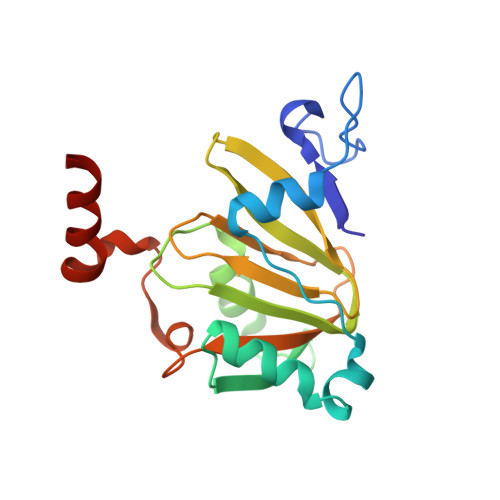
7JXG | pdb_00007jxg

Structural model for Fe-containing human acireductone dioxygenase


Experimental Data Snapshot

  • Method: SOLUTION NMR
  • Conformers Calculated: 100 
  • Conformers Submitted: 
  • Selection Criteria: structures with the least restraint violations 

wwPDB Validation 3D Report Full Report

Validation slider image for 7JXG

This is version 1.2 of the entry. See complete history

Literature

A Model for the Solution Structure of Human Fe(II)-Bound Acireductone Dioxygenase and Interactions with the Regulatory Domain of Matrix Metalloproteinase I (MMP-I).

Liu, X.Garber, A.Ryan, J.Deshpande, A.Ringe, D.Pochapsky, T.C.

(2020) Biochemistry 59: 4238-4249

  • DOI: https://doi.org/10.1021/acs.biochem.0c00724
  • Primary Citation Related Structures: 
    7JXG

  • PubMed Abstract: 

    The metalloenzyme acireductone dioxygenase (ARD) shows metal-dependent physical and enzymatic activities depending upon the metal bound in the active site. The Fe(II)-bound enzyme catalyzes the penultimate step of the methionine salvage pathway, converting 1,2-dihydroxy-5-(methylthio)pent-1-en-3-one (acireductone) into formate and the ketoacid precursor of methionine, 2-keto-4-thiomethyl-2-oxobutanoate, using O 2 as the oxidant. If Ni(II) is bound, an off-pathway shunt occurs, producing 3-methylthiopropionate, formate, and carbon monoxide from the same acireductone substrate. The solution structure of the Fe(II)-bound human enzyme, HsARD, is described and compared with the structures of Ni-bound forms of the closely related mouse enzyme, MmARD. Potential rationales for the different reactivities of the two isoforms are discussed. The human enzyme has been found to regulate the activity of matrix metalloproteinase I (MMP-I), which is involved in tumor metastasis, by binding the cytoplasmic transmembrane tail peptide of MMP-I. Nuclear magnetic resonance titration of HsARD with the MMP-I tail peptide permits identification of the peptide binding site on HsARD, a cleft anterior to the metal binding site adjacent to a dynamic proline-rich loop.


  • Organizational Affiliation
    • Department of Chemistry, Brandeis University, 415 South Street, Waltham, Massachusetts 02454-9110, United States.

Macromolecule Content 

  • Total Structure Weight: 21.59 kDa 
  • Atom Count: 1,515 
  • Modeled Residue Count: 178 
  • Deposited Residue Count: 179 
  • Unique protein chains: 1

Macromolecules

Find similar proteins by:|  3D Structure
Entity ID: 1
MoleculeChains  Sequence LengthOrganismDetailsImage
1,2-dihydroxy-3-keto-5-methylthiopentene dioxygenase179Homo sapiensMutation(s): 0 
Gene Names: ADI1MTCBP1HMFT1638
EC: 1.13.11.54 (PDB Primary Data), 1.13.11.53 (UniProt)
UniProt & NIH Common Fund Data Resources
Find proteins for Q9BV57 (Homo sapiens)
Explore Q9BV57 
Go to UniProtKB:  Q9BV57
PHAROS:  Q9BV57
GTEx:  ENSG00000182551 
Entity Groups
Sequence Clusters30% Identity50% Identity70% Identity90% Identity95% Identity100% Identity
UniProt GroupQ9BV57
Sequence Annotations
Expand
Reference Sequence

Small Molecules

Ligands 1 Unique
IDChains Name / Formula / InChI Key2D Diagram3D Interactions
FE2

Query on FE2


Download:Ideal Coordinates CCD File
B [auth A]FE (II) ION
Fe
CWYNVVGOOAEACU-UHFFFAOYSA-N

Experimental Data & Validation

Experimental Data

  • Method: SOLUTION NMR
  • Conformers Calculated: 100 
  • Conformers Submitted: 
  • Selection Criteria: structures with the least restraint violations 

Structure Validation

View Full Validation Report


Entry History 

& Funding Information

Deposition Data


Funding OrganizationLocationGrant Number
National Institutes of Health/National Institute of General Medical Sciences (NIH/NIGMS)R01-GM130997

Revision History  (Full details and data files)

  • Version 1.0: 2020-11-18
    Type: Initial release
  • Version 1.1: 2020-11-25
    Changes: Database references
  • Version 1.2: 2024-05-01
    Changes: Data collection, Database references