7JT4 | pdb_00007jt4

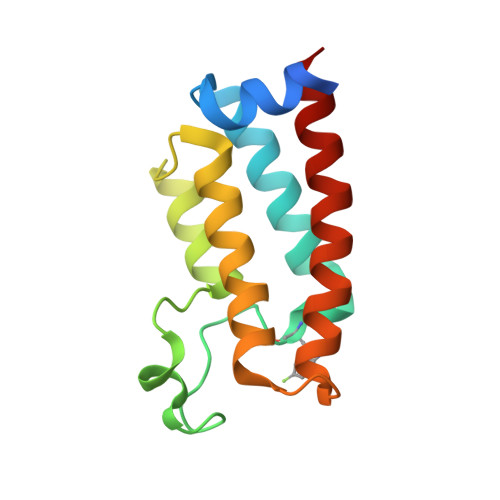
Crystal Structure of BPTF bromodomain labelled with 5-fluoro-tryptophan


Experimental Data Snapshot

  • Method: X-RAY DIFFRACTION
  • Resolution: 2.06 Å
  • R-Value Free: 
    0.186 (Depositor), 0.186 (DCC) 
  • R-Value Work: 
    0.165 (Depositor), 0.167 (DCC) 
  • R-Value Observed: 
    0.166 (Depositor) 

Starting Model: experimental
View more details

wwPDB Validation 3D Report Full Report

Validation slider image for 7JT4

This is version 1.1 of the entry. See complete history

Literature

Selectivity, ligand deconstruction, and cellular activity analysis of a BPTF bromodomain inhibitor

Kirberger, S.E.Ycas, P.D.Johnson, J.A.Chen, C.Ciccone, M.F.Woo, R.W.L.Urick, A.K.Zahid, H.Shi, K.Aihara, H.McAllister, S.D.Kashani-Sabet, M.Shi, J.Dickson, A.Dos Santos, C.O.Pomerantz, W.C.K.

(2019) Org Biomol Chem 17: 2020-2027

  • DOI: https://doi.org/10.1039/c8ob02599a
  • Primary Citation Related Structures: 
    7JT4

  • PubMed Abstract: 

    Bromodomain and PHD finger containing protein transcription factor (BPTF) is an epigenetic protein involved in chromatin remodelling and is a potential anticancer target. The BPTF bromodomain has one reported small molecule inhibitor (AU1, rac-1). Here, advances made on the structure-activity relationship of a BPTF bromodomain ligand are reported using a combination of experimental and molecular dynamics simulations leading to the active enatiomer (S)-1. Additionally, a ligand deconstruction analysis was conducted to characterize important pharmacophores for engaging the BPTF bromodomain. These studies have been enabled by a protein-based fluorine NMR approach, highlighting the versatility of the method for selectivity, ligand deconstruction, and ligand binding. To enable future analysis of biological activity, cell growth analyses in a panel of cancer cell lines were carried out using CRISPR-Cas9 and (S)-1 to identify cell-based model systems that are sensitive to BPTF inhibition.


  • Organizational Affiliation
    • Department of Chemistry, University of Minnesota, 207 Pleasant St. SE., Minneapolis, MN 55455, USA. wcp@umn.edu.

Macromolecule Content 

  • Total Structure Weight: 15.43 kDa 
  • Atom Count: 1,228 
  • Modeled Residue Count: 122 
  • Deposited Residue Count: 131 
  • Unique protein chains: 1

Macromolecules

Find similar proteins by:|  3D Structure
Entity ID: 1
MoleculeChains  Sequence LengthOrganismDetailsImage
Nucleosome-remodeling factor subunit BPTF131Homo sapiensMutation(s): 0 
Gene Names: BPTFFAC1FALZ
UniProt & NIH Common Fund Data Resources
Find proteins for Q12830 (Homo sapiens)
Explore Q12830 
Go to UniProtKB:  Q12830
PHAROS:  Q12830
GTEx:  ENSG00000171634 
Entity Groups
Sequence Clusters30% Identity50% Identity70% Identity90% Identity95% Identity100% Identity
UniProt GroupQ12830
Sequence Annotations
Expand
Reference Sequence

Small Molecules

Modified Residues  1 Unique
IDChains TypeFormula2D DiagramParent
FTR
Query on FTR
A
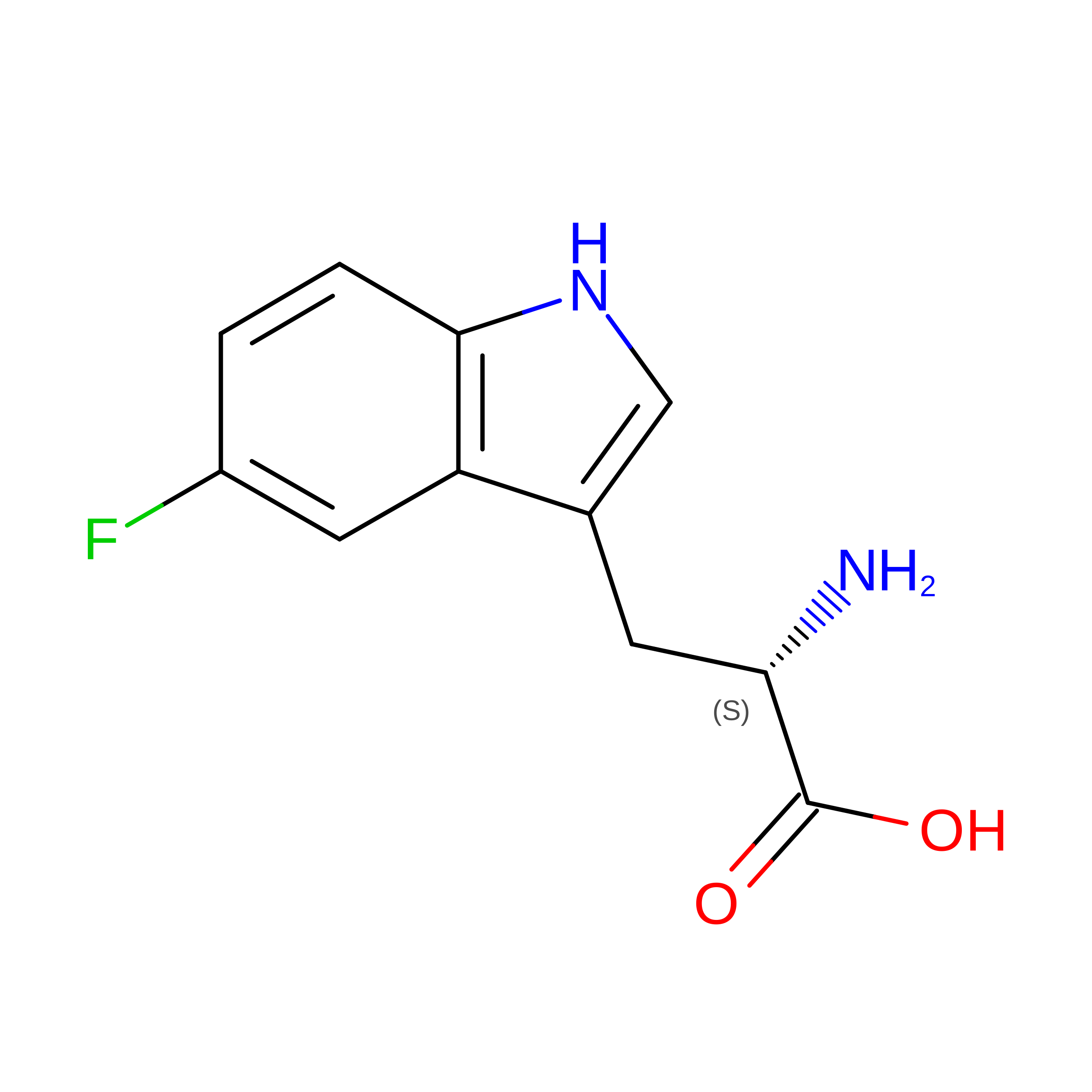
L-PEPTIDE LINKINGC11 H11 F N2 O2TRP

Experimental Data & Validation

Experimental Data

  • Method: X-RAY DIFFRACTION
  • Resolution: 2.06 Å
  • R-Value Free:  0.186 (Depositor), 0.186 (DCC) 
  • R-Value Work:  0.165 (Depositor), 0.167 (DCC) 
  • R-Value Observed: 0.166 (Depositor) 
Space Group: P 1 21 1
Unit Cell:
Length ( Å )Angle ( ˚ )
a = 27.335α = 90
b = 66.763β = 105.02
c = 39.26γ = 90
Software Package:
Software NamePurpose
PHENIXrefinement
HKL-2000data reduction
HKL-2000data scaling
PHASERphasing

Structure Validation

View Full Validation Report


Entry History 

& Funding Information

Deposition Data


Funding OrganizationLocationGrant Number
National Institutes of Health/National Institute of General Medical Sciences (NIH/NIGMS)United StatesGM118047
National Institutes of Health/National Library of Medicine (NIH/NLM)United States5T32GM008347-23

Revision History  (Full details and data files)

  • Version 1.0: 2021-07-28
    Type: Initial release
  • Version 1.1: 2023-10-18
    Changes: Data collection, Database references, Refinement description