7JQD | pdb_00007jqd

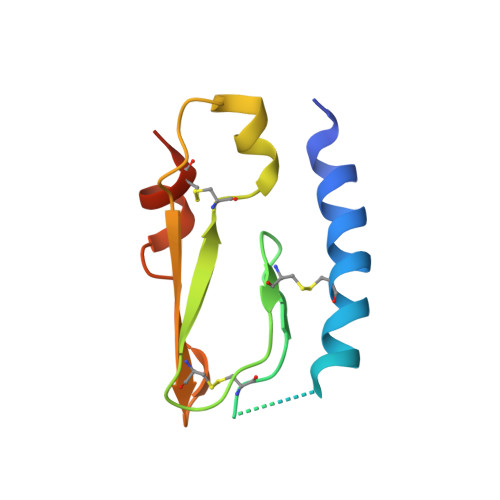
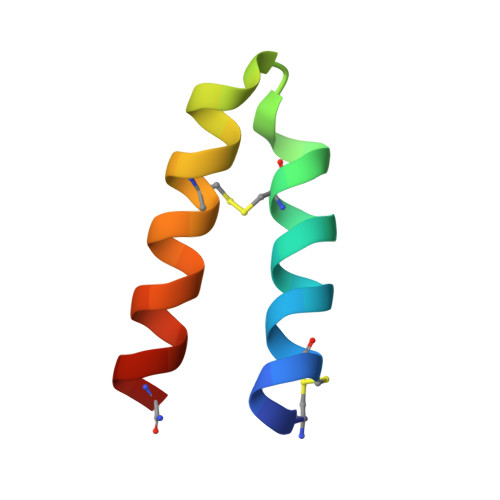
Crystal Structure of PAC1r in complex with peptide antagonist


Experimental Data Snapshot

  • Method: X-RAY DIFFRACTION
  • Resolution: 2.70 Å
  • R-Value Free: 
    0.291 (Depositor), 0.293 (DCC) 
  • R-Value Work: 
    0.204 (Depositor), 0.204 (DCC) 
  • R-Value Observed: 
    0.212 (Depositor) 

Starting Model: experimental
View more details

wwPDB Validation 3D Report Full Report

Validation slider image for 7JQD

This is version 1.3 of the entry. See complete history

Literature

Discovery of Selective Pituitary Adenylate Cyclase 1 Receptor (PAC1R) Antagonist Peptides Potent in a Maxadilan/PACAP38-Induced Increase in Blood Flow Pharmacodynamic Model.

Hu, E.Hong, F.T.Aral, J.Long, J.Piper, D.E.Poppe, L.Andrews, K.L.Hager, T.Davis, C.Li, H.Wong, P.Gavva, N.Shi, L.Zhu, D.X.D.Lehto, S.G.Xu, C.Miranda, L.P.

(2021) J Med Chem 64: 3427-3438

  • DOI: https://doi.org/10.1021/acs.jmedchem.0c01396
  • Primary Citation Related Structures: 
    7JQD

  • PubMed Abstract: 

    Inhibition of the pituitary adenylate cyclase 1 receptor (PAC1R) is a novel mechanism that could be used for abortive treatment of acute migraine. Our research began with comparative analysis of known PAC1R ligand scaffolds, PACAP38 and Maxadilan, which resulted in the selection of des(24-42) Maxadilan, 6 , as a starting point. C-terminal modifications of 6 improved the peptide metabolic stability in vitro and in vivo . SAR investigations identified synergistic combinations of amino acid replacements that significantly increased the in vitro PAC1R inhibitory activity of the analogs to the pM IC 90 range. Our modifications further enabled deletion of up to six residues without impacting potency, thus improving peptide ligand binding efficiency. Analogs 17 and 18 exhibited robust in vivo efficacy in the rat Maxadilan-induced increase in blood flow (MIIBF) pharmacodynamic model at 0.3 mg/kg subcutaneous dosing. The first cocrystal structure of a PAC1R antagonist peptide ( 18 ) with PAC1R extracellular domain is reported.


  • Organizational Affiliation
    • Therapeutic Discovery, Amgen Inc., One Amgen Center Drive, Thousand Oaks, California 91320, United States.

Macromolecule Content 

  • Total Structure Weight: 16.25 kDa 
  • Atom Count: 984 
  • Modeled Residue Count: 124 
  • Deposited Residue Count: 144 
  • Unique protein chains: 2

Macromolecules

Find similar proteins by:|  3D Structure
Entity ID: 1
MoleculeChains  Sequence LengthOrganismDetailsImage
Pituitary adenylate cyclase-activating polypeptide type I receptor105Homo sapiensMutation(s): 5 
Gene Names: ADCYAP1R1
UniProt & NIH Common Fund Data Resources
Find proteins for P41586 (Homo sapiens)
Explore P41586 
Go to UniProtKB:  P41586
PHAROS:  P41586
GTEx:  ENSG00000078549 
Entity Groups
Sequence Clusters30% Identity50% Identity70% Identity90% Identity95% Identity100% Identity
UniProt GroupP41586
Sequence Annotations
Expand
Reference Sequence
Find similar proteins by:|  3D Structure
Entity ID: 2
MoleculeChains  Sequence LengthOrganismDetailsImage
Peptide-4339Lutzomyia longipalpisMutation(s): 0 
UniProt
Find proteins for P30659 (Lutzomyia longipalpis)
Explore P30659 
Go to UniProtKB:  P30659
Entity Groups
Sequence Clusters30% Identity50% Identity70% Identity90% Identity95% Identity100% Identity
UniProt GroupP30659
Sequence Annotations
Expand
Reference Sequence

Experimental Data & Validation

Experimental Data

  • Method: X-RAY DIFFRACTION
  • Resolution: 2.70 Å
  • R-Value Free:  0.291 (Depositor), 0.293 (DCC) 
  • R-Value Work:  0.204 (Depositor), 0.204 (DCC) 
  • R-Value Observed: 0.212 (Depositor) 
Space Group: P 43 21 2
Unit Cell:
Length ( Å )Angle ( ˚ )
a = 67.68α = 90
b = 67.68β = 90
c = 56.98γ = 90
Software Package:
Software NamePurpose
Aimlessdata scaling
PHENIXrefinement
PDB_EXTRACTdata extraction
iMOSFLMdata reduction
PHASERphasing

Structure Validation

View Full Validation Report


Entry History 

Deposition Data

Revision History  (Full details and data files)

  • Version 1.0: 2021-03-24
    Type: Initial release
  • Version 1.1: 2021-04-07
    Changes: Database references
  • Version 1.2: 2023-10-18
    Changes: Data collection, Database references, Refinement description
  • Version 1.3: 2024-11-20
    Changes: Structure summary