7JLS | pdb_00007jls

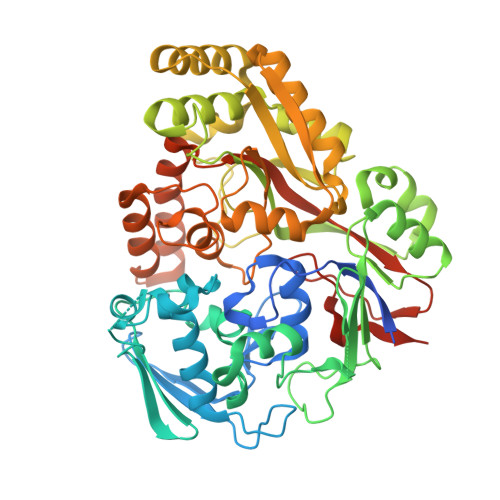
RV3666c bound to tripeptide


Experimental Data Snapshot

  • Method: X-RAY DIFFRACTION
  • Resolution: 1.52 Å
  • R-Value Free: 
    0.221 (Depositor), 0.226 (DCC) 
  • R-Value Work: 
    0.185 (Depositor), 0.192 (DCC) 
  • R-Value Observed: 
    0.187 (Depositor) 

wwPDB Validation 3D Report Full Report

Validation slider image for 7JLS

This is version 1.2 of the entry. See complete history

Literature

Biophysical analysis of the Mycobacteria tuberculosis peptide binding protein DppA reveals a stringent peptide binding pocket.

Fernando, D.M.Gee, C.T.Griffith, E.C.Meyer, C.J.Wilt, L.A.Tangallapally, R.Wallace, M.J.Miller, D.J.Lee, R.E.

(2021) Tuberculosis (Edinb) 132: 102157-102157

  • DOI: https://doi.org/10.1016/j.tube.2021.102157
  • Primary Citation Related Structures: 
    7JLS

  • PubMed Abstract: 

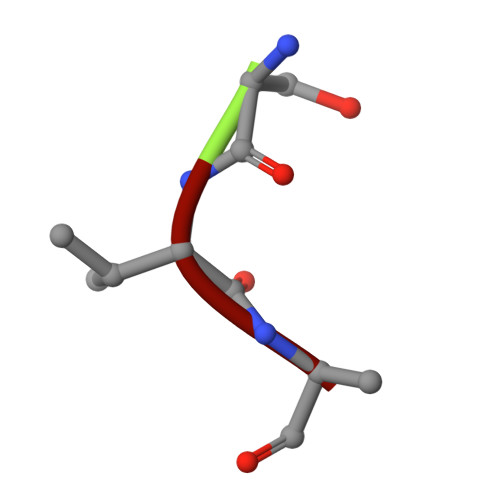
    The peptide binding protein DppA is an ABC transporter found in prokaryotes that has the potential to be used as drug delivery tool for hybrid antibiotic compounds. Understanding the motifs and structures that bind to DppA is critical to the development of these bivalent compounds. This study focused on the biophysical analysis of the MtDppA from M. tuberculosis. Analysis of the crystal structure revealed a SVA tripeptide was co-crystallized with the protein. Further peptide analysis demonstrated MtDppA shows very little affinity for dipeptides but rather preferentially binds to peptides that are 3-4 amino acids in length. The structure-activity relationships (SAR) between MtDppA and tripeptides with varied amino acid substitutions were evaluated using thermal shift, SPR, and molecular dynamics simulations. Efforts to identify novel ligands for use as alternative scaffolds through the thermal shift screening of 35,000 compounds against MtDppA were unsuccessful, indicating that the MtDppA binding pocket is highly specialized for uptake of peptides. Future development of compounds that seek to utilize MtDppA as a drug delivery mechanism, will likely require a tri- or tetrapeptide component with a hydrophobic -non-acidic peptide sequence.


  • Organizational Affiliation
    • Department of Chemical Biology and Therapeutics, St. Jude Children's Research Hospital, Memphis, TN 38105, USA.

Macromolecule Content 

  • Total Structure Weight: 60.89 kDa 
  • Atom Count: 4,254 
  • Modeled Residue Count: 500 
  • Deposited Residue Count: 556 
  • Unique protein chains: 2

Macromolecules

Find similar proteins by:|  3D Structure
Entity ID: 1
MoleculeChains  Sequence LengthOrganismDetailsImage
Probable periplasmic dipeptide-binding lipoprotein DppA553Mycobacterium tuberculosis H37RvMutation(s): 0 
Gene Names: dppARv3666c
UniProt
Find proteins for I6X811 (Mycobacterium tuberculosis (strain ATCC 25618 / H37Rv))
Explore I6X811 
Go to UniProtKB:  I6X811
Entity Groups
Sequence Clusters30% Identity50% Identity70% Identity90% Identity95% Identity100% Identity
UniProt GroupI6X811
Sequence Annotations
Expand
Reference Sequence
Find similar proteins by:  Sequence   |   3D Structure  
Entity ID: 2
MoleculeChains  Sequence LengthOrganismDetailsImage
Peptide SER-VAL-ALA3Escherichia coli BL21(DE3)Mutation(s): 0 

Experimental Data & Validation

Experimental Data

  • Method: X-RAY DIFFRACTION
  • Resolution: 1.52 Å
  • R-Value Free:  0.221 (Depositor), 0.226 (DCC) 
  • R-Value Work:  0.185 (Depositor), 0.192 (DCC) 
  • R-Value Observed: 0.187 (Depositor) 
Space Group: P 1 21 1
Unit Cell:
Length ( Å )Angle ( ˚ )
a = 54.05α = 90
b = 69.96β = 109.5
c = 65.39γ = 90
Software Package:
Software NamePurpose
REFMACrefinement
HKL-2000data scaling
HKL2Mapphasing
PDB_EXTRACTdata extraction
SHELXCDphasing
HKL-2000data reduction

Structure Validation

View Full Validation Report


Entry History 

& Funding Information

Deposition Data


Funding OrganizationLocationGrant Number
National Institutes of Health/National Institute Of Allergy and Infectious Diseases (NIH/NIAID)United StatesR01AI090810-08

Revision History  (Full details and data files)

  • Version 1.0: 2021-06-09
    Type: Initial release
  • Version 1.1: 2021-12-29
    Changes: Database references
  • Version 1.2: 2024-05-22
    Changes: Data collection