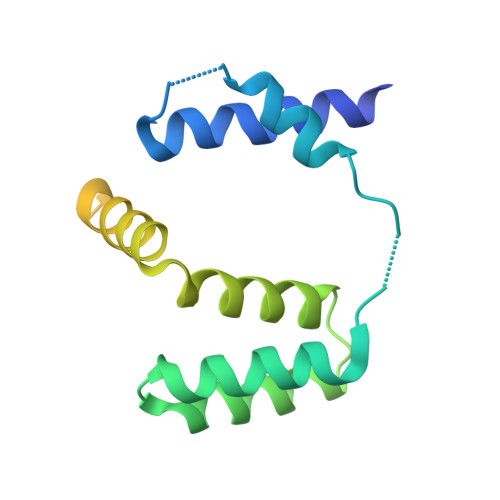
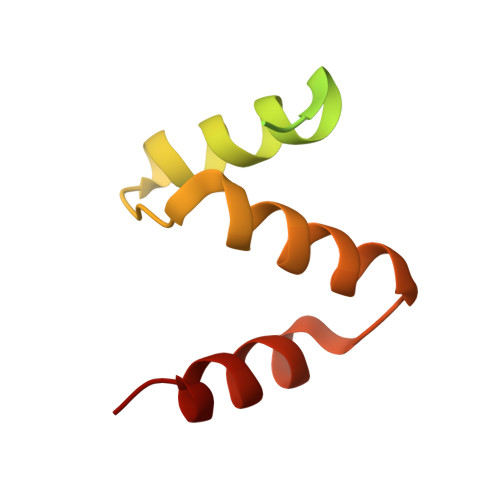
7FAD | pdb_00007fad

Crystal structure of Xenopus GCP2-N terminal domain and Mzt2


Experimental Data Snapshot

  • Method: X-RAY DIFFRACTION
  • Resolution: 3.20 Å
  • R-Value Free: 
    0.237 (Depositor), 0.238 (DCC) 
  • R-Value Work: 
    0.206 (Depositor), 0.207 (DCC) 
  • R-Value Observed: 
    0.209 (Depositor) 

wwPDB Validation 3D Report Full Report

Validation slider image for 7FAD

This is version 1.3 of the entry. See complete history

Literature

A gamma-tubulin complex independent pathway could suppress ciliogenesis by promoting cilia disassembly

Shankar, S.Hsu, Z.T.Ezquerra, A.Li, C.C.Huang, T.L.Coyaud, E.Viais, R.Grauffel, C.Raught, B.Lim, C.Luders, J.Tsai, S.Y.Hsia, K.C.

(2022) Cell Rep 41: 111642-111642

  • DOI: https://doi.org/10.1016/j.celrep.2022.111642
  • Primary Citation Related Structures: 
    7FAD

  • PubMed Abstract: 

    The primary cilium, a microtubule-based sensory organelle, undergoes cycles of assembly and disassembly that govern the cell cycle progression critical to cell proliferation and differentiation. Although cilia assembly has been studied extensively, the molecular mechanisms underlying cilia disassembly are less well understood. Here, we uncover a γ-tubulin ring complex (γ-TuRC)-dependent pathway that promotes cilia disassembly and thereby prevents cilia formation. We further demonstrate that Kif2A, a kinesin motor that bears microtubule-depolymerizing activity, is recruited to the cilium basal body in a γ-TuRC-dependent manner. Our mechanistic analyses show that γ-TuRC specifically recruits Kif2A via the GCP2 subunit and its binding partner Mzt2. Hence, despite the long-standing view that γ-TuRC acts mainly as a microtubule template, we illustrate that its functional heterogeneity at the basal body facilitates both microtubule nucleation and Kif2A recruitment-mediated regulation of ciliogenesis, ensuring cell cycle progression.


  • Organizational Affiliation
    • Molecular and Cell Biology, Taiwan International Graduate Program, Academia Sinica and National Defense Medical Center, Taipei 11490, Taiwan; Institute of Molecular Biology, Academia Sinica, Taipei 11529, Taiwan.

Macromolecule Content 

  • Total Structure Weight: 88.16 kDa 
  • Atom Count: 3,665 
  • Modeled Residue Count: 456 
  • Deposited Residue Count: 798 
  • Unique protein chains: 2

Macromolecules

Find similar proteins by:|  3D Structure
Entity ID: 1
MoleculeChains  Sequence LengthOrganismDetailsImage
Gamma-tubulin complex component
A, C, E
168Xenopus laevisMutation(s): 0 
Gene Names: tubgcp2.Ltubgcp2tubgcp2-prov
UniProt
Find proteins for Q6DDJ4 (Xenopus laevis)
Explore Q6DDJ4 
Go to UniProtKB:  Q6DDJ4
Entity Groups
Sequence Clusters30% Identity50% Identity70% Identity90% Identity95% Identity100% Identity
UniProt GroupQ6DDJ4
Sequence Annotations
Expand
Reference Sequence
Find similar proteins by:|  3D Structure
Entity ID: 2
MoleculeChains  Sequence LengthOrganismDetailsImage
Mitotic-spindle organizing protein 2B
B, D, F
98Xenopus tropicalisMutation(s): 0 
Gene Names: mzt2bfam128mozart2TEgg010b01.1
UniProt
Find proteins for Q28DB1 (Xenopus tropicalis)
Explore Q28DB1 
Go to UniProtKB:  Q28DB1
Entity Groups
Sequence Clusters30% Identity50% Identity70% Identity90% Identity95% Identity100% Identity
UniProt GroupQ28DB1
Sequence Annotations
Expand
Reference Sequence

Experimental Data & Validation

Experimental Data

  • Method: X-RAY DIFFRACTION
  • Resolution: 3.20 Å
  • R-Value Free:  0.237 (Depositor), 0.238 (DCC) 
  • R-Value Work:  0.206 (Depositor), 0.207 (DCC) 
  • R-Value Observed: 0.209 (Depositor) 
Space Group: I 2 2 2
Unit Cell:
Length ( Å )Angle ( ˚ )
a = 82.878α = 90
b = 125.099β = 90
c = 204.56γ = 90
Software Package:
Software NamePurpose
PHENIXrefinement
PDB_EXTRACTdata extraction
HKL-2000data reduction
HKL-2000data scaling
PHENIXphasing

Structure Validation

View Full Validation Report


Entry History 

& Funding Information

Deposition Data


Funding OrganizationLocationGrant Number
Ministry of Science and Technology (MoST, Taiwan)Taiwan--
Academia Sinica (Taiwan)Taiwan--

Revision History  (Full details and data files)

  • Version 1.0: 2022-07-13
    Type: Initial release
  • Version 1.1: 2023-01-25
    Changes: Database references
  • Version 1.2: 2023-02-15
    Changes: Database references
  • Version 1.3: 2024-05-29
    Changes: Data collection, Refinement description