Download Mendeley
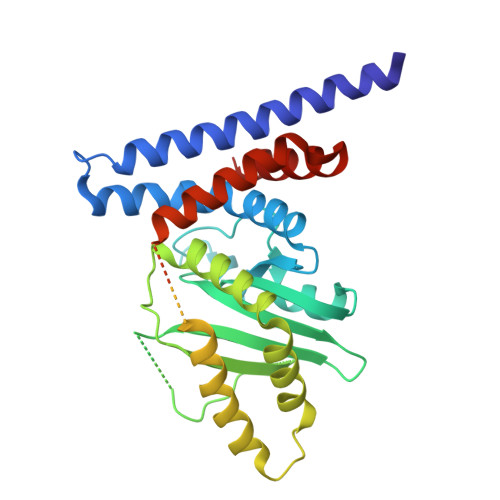
Secondary-structure switch regulates the substrate binding of a YopJ family acetyltransferase.
Xia, Y., Zou, R., Escouboue, M., Zhong, L., Zhu, C., Pouzet, C., Wu, X., Wang, Y., Lv, G., Zhou, H., Sun, P., Ding, K., Deslandes, L., Yuan, S., Zhang, Z.M.(2021) Nat Commun 12: 5969-5969
- PubMed: 34645811 Search on PubMedSearch on PubMed Central
- DOI: https://doi.org/10.1038/s41467-021-26183-1
- Primary Citation Related Structures:
7F3N - PubMed Abstract:
The Yersinia outer protein J (YopJ) family effectors are widely deployed through the type III secretion system by both plant and animal pathogens. As non-canonical acetyltransferases, the enzymatic activities of YopJ family effectors are allosterically activated by the eukaryote-specific ligand inositol hexaphosphate (InsP6). However, the underpinning molecular mechanism remains undefined. Here we present the crystal structure of apo-PopP2, a YopJ family member secreted by the plant pathogen Ralstonia solanacearum. Structural comparison of apo-PopP2 with the InsP6-bound PopP2 reveals a substantial conformational readjustment centered in the substrate-binding site. Combining biochemical and computational analyses, we further identify a mechanism by which the association of InsP6 with PopP2 induces an α-helix-to-β-strand transition in the catalytic core, resulting in stabilization of the substrate recognition helix in the target protein binding site. Together, our study uncovers the molecular basis governing InsP6-mediated allosteric regulation of YopJ family acetyltransferases and further expands the paradigm of fold-switching proteins.
- International Cooperative Laboratory of Traditional Chinese Medicine Modernization and Innovative Drug Development of Chinese Ministry of Education (MOE), College of Pharmacy, Jinan University, 510632, Guangzhou, China.
Organizational Affiliation: