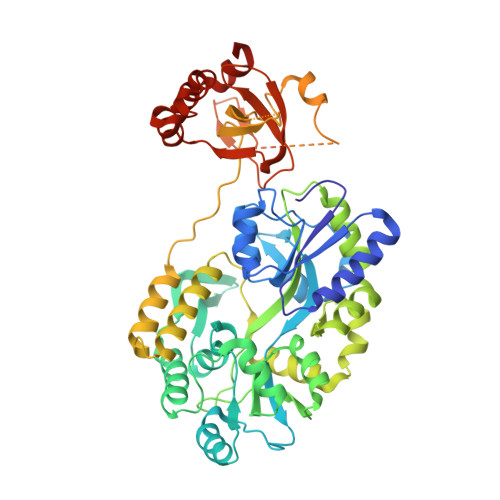
7E29 | pdb_00007e29

Crystal Structure of Saccharomyces cerevisiae Ioc4 PWWP domain fused with MBP


Experimental Data Snapshot

  • Method: X-RAY DIFFRACTION
  • Resolution: 2.30 Å
  • R-Value Free: 
    0.229 (Depositor), 0.229 (DCC) 
  • R-Value Work: 
    0.173 (Depositor), 0.174 (DCC) 
  • R-Value Observed: 
    0.177 (Depositor) 

Starting Model: experimental
View more details

wwPDB Validation 3D Report Full Report

Validation slider image for 7E29

This is version 1.2 of the entry. See complete history. 

Literature

H3K36 methylation and DNA-binding both promote Ioc4 recruitment and Isw1b remodeler function.

Li, J., Bergmann, L., Rafael de Almeida, A., Webb, K.M., Gogol, M.M., Voigt, P., Liu, Y., Liang, H., Smolle, M.M.

(2022) Nucleic Acids Res 50: 2549-2565

  • DOI: https://doi.org/10.1093/nar/gkac077
  • Primary Citation Related Structures: 
    7E29

  • PubMed Abstract: 

    The Isw1b chromatin-remodeling complex is specifically recruited to gene bodies to help retain pre-existing histones during transcription by RNA polymerase II. Recruitment is dependent on H3K36 methylation and the Isw1b subunit Ioc4, which contains an N-terminal PWWP domain. Here, we present the crystal structure of the Ioc4-PWWP domain, including a detailed functional characterization of the domain on its own as well as in the context of full-length Ioc4 and the Isw1b remodeler. The Ioc4-PWWP domain preferentially binds H3K36me3-containing nucleosomes. Its ability to bind DNA is required for nucleosome binding. It is also furthered by the unique insertion motif present in Ioc4-PWWP. The ability to bind H3K36me3 and DNA promotes the interaction of full-length Ioc4 with nucleosomes in vitro and they are necessary for its recruitment to gene bodies in vivo. Furthermore, a fully functional Ioc4-PWWP domain promotes efficient remodeling by Isw1b and the maintenance of ordered chromatin in vivo, thereby preventing the production of non-coding RNAs.


  • Organizational Affiliation: 
    • State Key Laboratory of Biomacromolecules, Institute of Biophysics, Chinese Academy of Sciences, 15 Datun Road, Chaoyang District, Beijing 100101, China.

Macromolecule Content 

  • Total Structure Weight: 61.69 kDa 
  • Atom Count: 4,210 
  • Modeled Residue Count: 496 
  • Deposited Residue Count: 551 
  • Unique protein chains: 1

Macromolecules

Find similar proteins by:|  3D Structure
Entity ID: 1
MoleculeChains  Sequence LengthOrganismDetailsImage
Maltose/maltodextrin-binding periplasmic protein,ISWI one complex protein 4551Escherichia coli K-12, Saccharomyces cerevisiae S288C
This entity is chimeric
Mutation(s): 3 
Gene Names: malE, b4034, JW3994, IOC4, YMR044W, YM9532.09
UniProt
Find proteins for P0AEX9 (Escherichia coli (strain K12))
Explore P0AEX9 
Go to UniProtKB:  P0AEX9
Find proteins for Q04213 (Saccharomyces cerevisiae (strain ATCC 204508 / S288c))
Explore Q04213 
Go to UniProtKB:  Q04213
Entity Groups
Sequence Clusters30% Identity50% Identity70% Identity90% Identity95% Identity100% Identity
UniProt GroupsP0AEX9Q04213
Sequence Annotations
Expand
Reference Sequence

Oligosaccharides

Help  
Entity ID: 2
MoleculeChains Length2D Diagram GlycosylationD Interactions
alpha-D-glucopyranose-(1-4)-alpha-D-glucopyranose
B
2N/A
Glycosylation Resources
GlyTouCan: G07411ON
GlyCosmos: G07411ON

Biologically Interesting Molecules (External Reference) 

1 Unique

Experimental Data & Validation

Experimental Data

  • Method: X-RAY DIFFRACTION
  • Resolution: 2.30 Å
  • R-Value Free:  0.229 (Depositor), 0.229 (DCC) 
  • R-Value Work:  0.173 (Depositor), 0.174 (DCC) 
  • R-Value Observed: 0.177 (Depositor) 
Space Group: P 63
Unit Cell:
Length ( Å )Angle ( ˚ )
a = 153.303α = 90
b = 153.303β = 90
c = 42.004γ = 120
Software Package:
Software NamePurpose
PHENIXrefinement
HKL-2000data reduction
HKL-2000data scaling
PHASERphasing

Structure Validation

View Full Validation Report


Entry History 

Deposition Data

Revision History  (Full details and data files)

  • Version 1.0: 2022-02-09
    Type: Initial release
  • Version 1.1: 2022-05-25
    Changes: Database references
  • Version 1.2: 2023-11-29
    Changes: Data collection, Refinement description