Download Mendeley
Understanding the mechanism of asymmetric gene regulation determined by the VqmA of vibriophage.
Gu, Y., Zhi, S.X., Yang, N., Yang, W.S.(2021) Biochem Biophys Res Commun 558: 51-56
- PubMed: 33895551 Search on PubMed
- DOI: https://doi.org/10.1016/j.bbrc.2021.04.036
- Primary Citation Related Structures:
7DWM - PubMed Abstract:
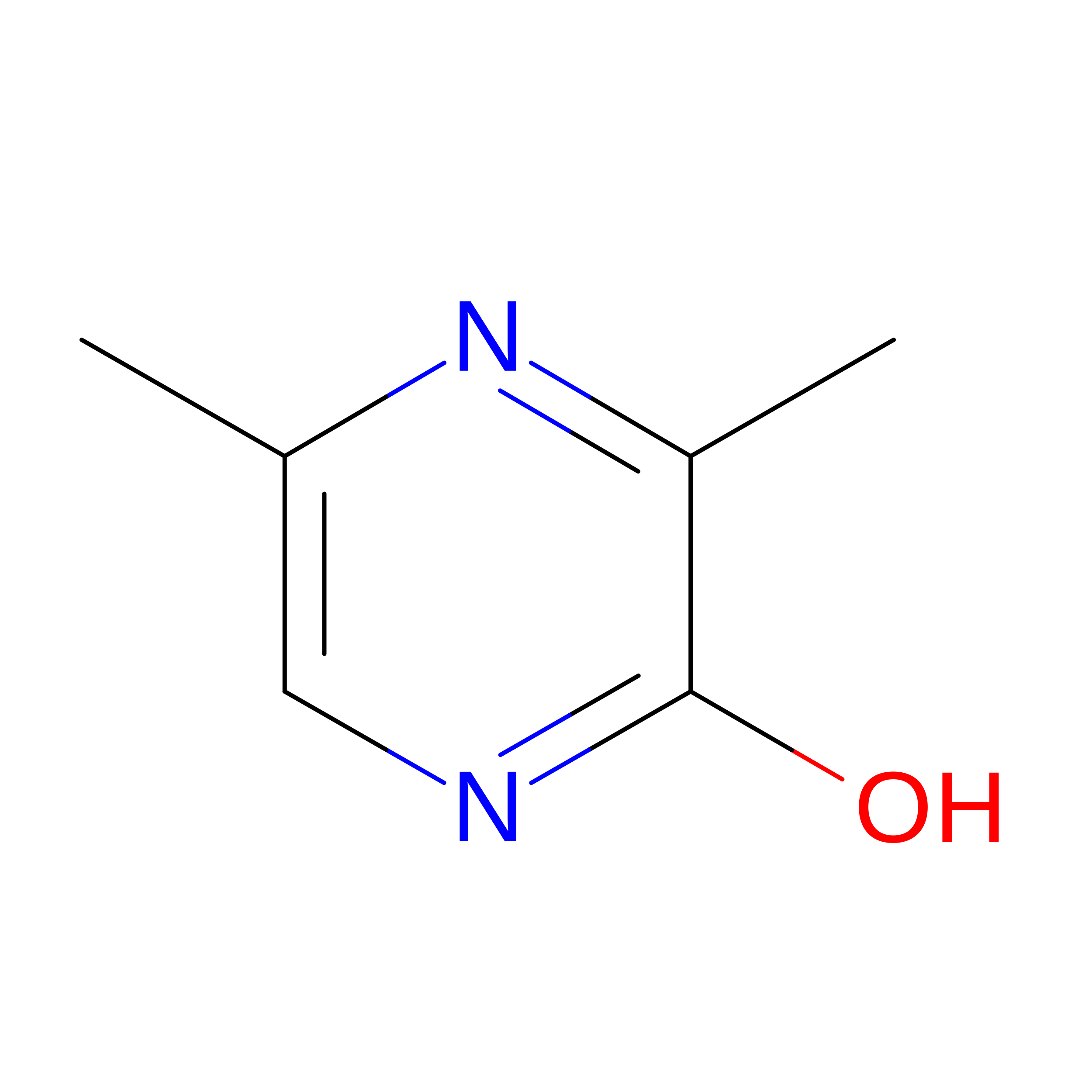
The quorum-sensing (QS) system between the phages and their hosts is important for the phage lysis-lysogeny decision. In Vibrio cholerae, the QS system consists of a LuxR-type receptor VqmA (VqmA Vc ) and an autoinducer molecule 3,5-dimethylpyrazin-2-ol (DPO). A VqmA homolog encoded by vibriophage VP882 (VqmA Phage ) can intervene the host QS system via binding to both the host-produced DPO and its cognate promoter (Pqtip) to induce the phage lysogeny-to-lysis transition, whereas VqmA Vc cannot influence the VqmA Phage -induced pathway, suggesting an asymmetry regulation. In this study, we report the crystal structure of VqmA Phage -DPO complex at 2.65 Å and reveal that the mechanism of DPO recognition is conserved in VqmA homologs. Besides, we identify a non-classical palindrome sequence in Pqtip, which can be effectively recognized by VqmA Phage but not VqmA Vc . The sequence contains an interval longer than that in the vqmR promoter recognized by VqmA Vc . In addition, the two DBD regions in the VqmA Phage dimer exhibit more relaxed architecture than that of the reported VqmA Vc , which is likely to be in the conformation that may easily bind to target promoter containing a longer interval. In summary, our findings provide a structural and biochemical basis for the DBD-dependent DNA recognition in different promoter regions in the phage lysogeny-to-lysis decision communication system, and provide clues for developing phage therapies against Vibrio cholerae infection.
- State Key Laboratory of Medicinal Chemical Biology, College of Pharmacy and Key Laboratory of Medical Data Analysis and Statistical Research of Tianjin, Nankai University, 300353, Tianjin, China.
Organizational Affiliation: