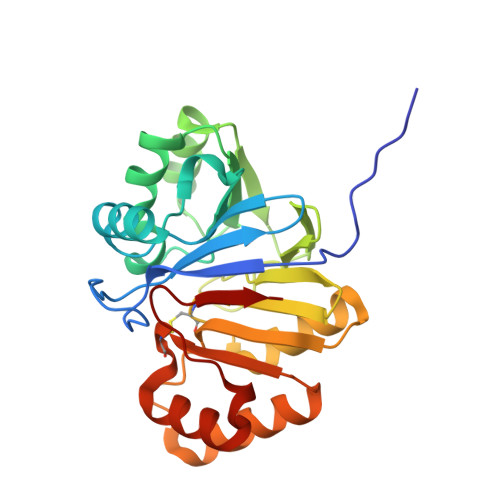
7DCK | pdb_00007dck

Crystal structure of phosphodiesterase tw9814


Experimental Data Snapshot

  • Method: X-RAY DIFFRACTION
  • Resolution: 2.34 Å
  • R-Value Free: 
    0.209 (Depositor), 0.210 (DCC) 
  • R-Value Work: 
    0.179 (Depositor), 0.180 (DCC) 
  • R-Value Observed: 
    0.180 (Depositor) 

Starting Model: experimental
View more details

wwPDB Validation 3D Report Full Report

Validation slider image for 7DCK

This is version 1.4 of the entry. See complete history

Literature

Structural and functional identification of the uncharacterized metallo-beta-lactamase superfamily protein TW9814 as a phosphodiesterase with unique metal coordination.

Heo, Y.Park, S.B.Jeon, Y.E.Yun, J.H.Jeong, B.G.Cha, S.S.Lee, W.

(2022) Acta Crystallogr D Struct Biol 78: 532-541

  • DOI: https://doi.org/10.1107/S2059798322002108
  • Primary Citation Related Structures: 
    7DCK

  • PubMed Abstract: 

    Metallo-β-lactamase (MBL) superfamily proteins have a common αβ/βα sandwich fold and perform a variety of functions through metal-mediated catalysis. However, because of the enormous scale of this superfamily, only a small percentage of the proteins belonging to the superfamily have been annotated structurally or functionally to date. Therefore, much remains unknown about the MBL superfamily proteins. Here, TW9814, a hypothetical MBL superfamily protein, was structurally and functionally investigated. Guided by the crystal structure of dimeric TW9814, it was demonstrated that TW9814 functions as a phosphodiesterase (PDE) in the presence of divalent metal ions such as manganese(II) or nickel(II). A docking model between TW9814 and the substrate bis(p-nitrophenyl)phosphate (bpNPP) showed the importance of the dimerization of TW9814 for its bpNPP-hydrolyzing activity and for the interaction between the enzyme and the substrate. TW9814 showed outstanding catalytic efficiency (k cat /K m ) under alkaline conditions compared with other PDEs. The activity of TW9814 appears to be regulated through a disulfide bond, which is a feature that is not present in other MBL superfamily members. This study provides a platform for the functional characterization of other hypothetical proteins of the MBL or other superfamilies.


  • Organizational Affiliation
    • Department of Biochemistry, Yonsei University, 50 Yonsei-ro, Seoul 03722, Republic of Korea.

Macromolecule Content 

  • Total Structure Weight: 55.21 kDa 
  • Atom Count: 3,906 
  • Modeled Residue Count: 487 
  • Deposited Residue Count: 496 
  • Unique protein chains: 1

Macromolecules

Find similar proteins by:|  3D Structure
Entity ID: 1
MoleculeChains  Sequence LengthOrganismDetailsImage
Lactamase_B domain-containing protein
A, B
248Epsilonproteobacteria bacterium (ex Lamellibrachia satsuma)Mutation(s): 0 
Gene Names: P794_03345
UniProt
Find proteins for A0ACD6BAJ0 (Epsilonproteobacteria bacterium)
Explore A0ACD6BAJ0 
Go to UniProtKB:  A0ACD6BAJ0
Entity Groups
Sequence Clusters30% Identity50% Identity70% Identity90% Identity95% Identity100% Identity
UniProt GroupA0ACD6BAJ0
Sequence Annotations
Expand
Reference Sequence

Experimental Data & Validation

Experimental Data

  • Method: X-RAY DIFFRACTION
  • Resolution: 2.34 Å
  • R-Value Free:  0.209 (Depositor), 0.210 (DCC) 
  • R-Value Work:  0.179 (Depositor), 0.180 (DCC) 
  • R-Value Observed: 0.180 (Depositor) 
Space Group: P 61
Unit Cell:
Length ( Å )Angle ( ˚ )
a = 164.288α = 90
b = 164.288β = 90
c = 55.645γ = 120
Software Package:
Software NamePurpose
PHENIXrefinement
HKL-2000data reduction
HKL-2000data scaling
PHENIXphasing

Structure Validation

View Full Validation Report


Entry History 

Deposition Data

Revision History  (Full details and data files)

  • Version 1.0: 2021-10-27
    Type: Initial release
  • Version 1.1: 2022-03-30
    Changes: Database references
  • Version 1.2: 2022-04-13
    Changes: Database references
  • Version 1.3: 2023-11-29
    Changes: Data collection, Refinement description
  • Version 1.4: 2024-10-30
    Changes: Structure summary