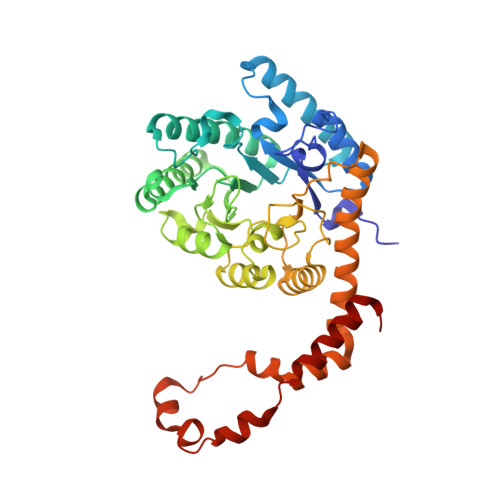
7CK0 | pdb_00007ck0

Room temperature structure of glucose isomerase delivered in lard by serial millisecond crystallography

  • Classification: ISOMERASE
  • Organism(s): Streptomyces pseudogriseolus
  • Mutation(s): No 

  • Deposited: 2020-07-15 Released: 2020-11-18 
  • Deposition Author(s): Nam, K.H.
  • Funding Organization(s): National Research Foundation (NRF, Korea)

Experimental Data Snapshot

  • Method: X-RAY DIFFRACTION
  • Resolution: 1.80 Å
  • R-Value Free: 
    0.177 (Depositor), 0.181 (DCC) 
  • R-Value Work: 
    0.158 (Depositor), 0.162 (DCC) 
  • R-Value Observed: 
    0.158 (Depositor) 

Starting Model: experimental
View more details

wwPDB Validation 3D Report Full Report

Validation slider image for 7CK0

This is version 1.2 of the entry. See complete history

Literature

Lard Injection Matrix for Serial Crystallography.

Nam, K.H.

(2020) Int J Mol Sci 21

  • DOI: https://doi.org/10.3390/ijms21175977
  • Primary Citation Related Structures: 
    7CJZ, 7CK0

  • PubMed Abstract: 

    Serial crystallography (SX) using X-ray free electron laser or synchrotron X-ray allows for the determination of structures, at room temperature, with reduced radiation damage. Moreover, it allows for the study of structural dynamics of macromolecules using a time-resolved pump-probe, as well as mix-and-inject experiments. Delivering a crystal sample using a viscous medium decreases sample consumption by lowering the flow rate while being extruded from the injector or syringe as compared to a liquid jet injector. Since the environment of crystal samples varies, continuous development of the delivery medium is important for extended SX applications. Herein, I report the preparation and characterization of a lard-based sample delivery medium for SX. This material was obtained using heat treatment, and then the soluble impurities were removed through phase separation. The lard injection medium was highly stable and could be injected via a syringe needle extruded at room temperature with a flow rate < 200 nL/min. Serial millisecond crystallography experiments were performed using lard, and the room temperature structures of lysozyme and glucose isomerase embedded in lard at 1.75 and 1.80 Å, respectively, were determined. The lard medium showed X-ray background scattering similar or relatively lower than shortenings and lipidic cubic phase; therefore, it can be used as sample delivery medium in SX experiments.


  • Organizational Affiliation
    • Department of Life Science, Pohang University of Science and Technology, Pohang 37673, Korea.

Macromolecule Content 

  • Total Structure Weight: 43.33 kDa 
  • Atom Count: 3,335 
  • Modeled Residue Count: 386 
  • Deposited Residue Count: 388 
  • Unique protein chains: 1

Macromolecules

Find similar proteins by:|  3D Structure
Entity ID: 1
MoleculeChains  Sequence LengthOrganismDetailsImage
Xylose isomerase388Streptomyces pseudogriseolusMutation(s): 0 
EC: 5.3.1.5
UniProt
Find proteins for P24300 (Streptomyces pseudogriseolus)
Explore P24300 
Go to UniProtKB:  P24300
Entity Groups
Sequence Clusters30% Identity50% Identity70% Identity90% Identity95% Identity100% Identity
UniProt GroupP24300
Sequence Annotations
Expand
Reference Sequence

Experimental Data & Validation

Experimental Data

  • Method: X-RAY DIFFRACTION
  • Resolution: 1.80 Å
  • R-Value Free:  0.177 (Depositor), 0.181 (DCC) 
  • R-Value Work:  0.158 (Depositor), 0.162 (DCC) 
  • R-Value Observed: 0.158 (Depositor) 
Space Group: I 2 2 2
Unit Cell:
Length ( Å )Angle ( ˚ )
a = 94.19α = 90
b = 99.92β = 90
c = 103.25γ = 90
Software Package:
Software NamePurpose
PHENIXrefinement
PDB_EXTRACTdata extraction
CrystFELdata reduction
CrystFELdata scaling
PHENIXphasing

Structure Validation

View Full Validation Report


Entry History 

& Funding Information

Deposition Data

  • Released Date: 2020-11-18 
  • Deposition Author(s): Nam, K.H.

Funding OrganizationLocationGrant Number
National Research Foundation (NRF, Korea)Korea, Republic OfNRF-2017R1D1A1B03033087
National Research Foundation (NRF, Korea)Korea, Republic OfNRF-2017M3A9F6029736

Revision History  (Full details and data files)

  • Version 1.0: 2020-11-18
    Type: Initial release
  • Version 1.1: 2023-09-06
    Changes: Data collection, Database references
  • Version 1.2: 2023-11-29
    Changes: Refinement description