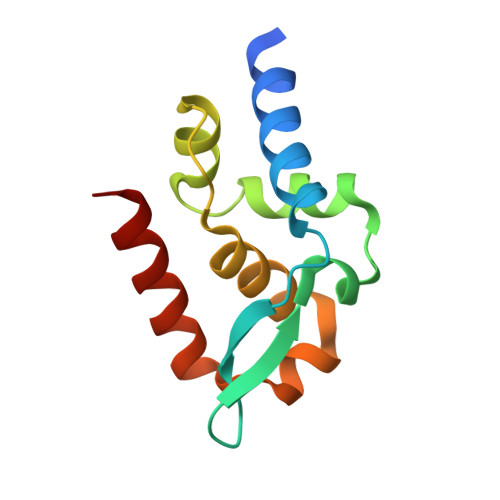
7C21 | pdb_00007c21

Crystal structure of Duvenhage virus phosphoprotein C-terminal domain


Experimental Data Snapshot

  • Method: X-RAY DIFFRACTION
  • Resolution: 1.95 Å
  • R-Value Free: 
    0.265 (Depositor), 0.268 (DCC) 
  • R-Value Work: 
    0.198 (Depositor), 0.199 (DCC) 
  • R-Value Observed: 
    0.203 (Depositor) 

Starting Model: experimental
View more details

wwPDB Validation 3D Report Full Report

Validation slider image for 7C21

This is version 1.1 of the entry. See complete history

Literature

Structural comparison of the C-terminal domain of functionally divergent lyssavirus P proteins.

Sugiyama, A.Nomai, T.Jiang, X.Minami, M.Yao, M.Maenaka, K.Ito, N.Gooley, P.R.Moseley, G.W.Ose, T.

(2020) Biochem Biophys Res Commun 529: 507-512

  • DOI: https://doi.org/10.1016/j.bbrc.2020.05.195
  • Primary Citation Related Structures: 
    7C20, 7C21

  • PubMed Abstract: 

    Lyssavirus P protein is a multifunctional protein that interacts with numerous host-cell proteins. The C-terminal domain (CTD) of P is important for inhibition of JAK-STAT signaling enabling the virus to evade host immunity. Several regions on the surface of rabies virus P are reported to interact with host factors. Among them, an extended, discrete hydrophobic patch of P CTD is notable. Although structures of P CTD of two strains of rabies virus, and of mokola virus have been solved, the structure of P CTD for Duvenhage virus, which is functionally divergent from these species for immune evasion function, is not known. Here, we analyze the structures of P CTD of Duvenhage and of a distinct rabies virus strain to gain further insight on the nature and potential function of the hydrophobic surface. Molecular contacts in crystals suggest that the hydrophobic patch is important to intermolecular interactions with other proteins, which differ between the lyssavirus species.


  • Organizational Affiliation
    • Faculty of Advanced Life Science, Hokkaido University, Kita-10, Nishi-8, Kita-ku, Sapporo, 060-0810, Japan.

Macromolecule Content 

  • Total Structure Weight: 12.87 kDa 
  • Atom Count: 892 
  • Modeled Residue Count: 105 
  • Deposited Residue Count: 112 
  • Unique protein chains: 1

Macromolecules

Find similar proteins by:|  3D Structure
Entity ID: 1
MoleculeChains  Sequence LengthOrganismDetailsImage
Phosphoprotein112Lyssavirus duvenhageMutation(s): 0 
UniProt
Find proteins for O56774 (Duvenhage virus)
Explore O56774 
Go to UniProtKB:  O56774
Entity Groups
Sequence Clusters30% Identity50% Identity70% Identity90% Identity95% Identity100% Identity
UniProt GroupO56774
Sequence Annotations
Expand
Reference Sequence

Experimental Data & Validation

Experimental Data

  • Method: X-RAY DIFFRACTION
  • Resolution: 1.95 Å
  • R-Value Free:  0.265 (Depositor), 0.268 (DCC) 
  • R-Value Work:  0.198 (Depositor), 0.199 (DCC) 
  • R-Value Observed: 0.203 (Depositor) 
Space Group: C 1 2 1
Unit Cell:
Length ( Å )Angle ( ˚ )
a = 95.19α = 90
b = 49.52β = 99.75
c = 25.28γ = 90
Software Package:
Software NamePurpose
PHENIXrefinement
XDSdata reduction
XSCALEdata scaling
MOLREPphasing

Structure Validation

View Full Validation Report


Entry History 

& Funding Information

Deposition Data


Funding OrganizationLocationGrant Number
Japan Society for the Promotion of Science (JSPS)Japan17K07296

Revision History  (Full details and data files)

  • Version 1.0: 2021-03-17
    Type: Initial release
  • Version 1.1: 2023-11-29
    Changes: Data collection, Database references, Refinement description