7C04 | pdb_00007c04

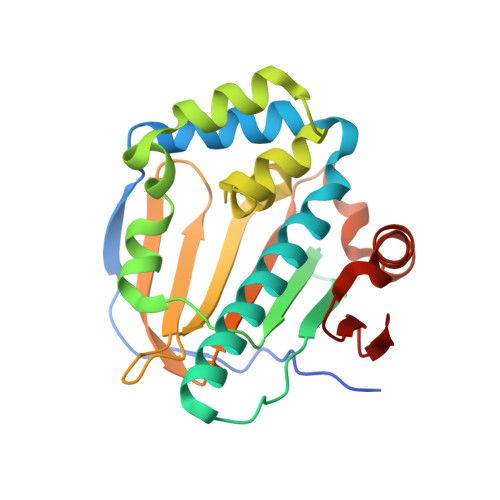
Crystal structure of human Trap1 with DN203492


Experimental Data Snapshot

  • Method: X-RAY DIFFRACTION
  • Resolution: 1.70 Å
  • R-Value Free: 
    0.234 (Depositor), 0.238 (DCC) 
  • R-Value Work: 
    0.189 (Depositor), 0.193 (DCC) 
  • R-Value Observed: 
    0.191 (Depositor) 

Starting Model: experimental
View more details

wwPDB Validation 3D Report Full Report

Validation slider image for 7C04

Ligand Structure Quality Assessment 


This is version 1.1 of the entry. See complete history

Literature

Development of pyrazolo[3,4-d]pyrimidine-6-amine-based TRAP1 inhibitors that demonstrate in vivo anticancer activity in mouse xenograft models.

Kim, D.Kim, S.Y.Kim, D.Yoon, N.G.Yun, J.Hong, K.B.Lee, C.Lee, J.H.Kang, B.H.Kang, S.

(2020) Bioorg Chem 101: 103901-103901

  • DOI: https://doi.org/10.1016/j.bioorg.2020.103901
  • Primary Citation Related Structures: 
    7C04, 7C05

  • PubMed Abstract: 

    TNF Receptor Associated Protein 1 (TRAP1) is a mitochondrial paralog of Hsp90 related to the promotion of tumorigenesis in various cancers via maintaining mitochondrial integrity, reducing the production of reactive oxygen species, and reprogramming cellular metabolism. Consequently, Hsp90 and TRAP1 have been targeted to develop cancer therapeutics. Herein, we report a series of pyrazolo[3,4-d]pyrimidine derivatives that are mitochondria-permeable TRAP1 inhibitors. Structure-based drug design guided the optimization of potency, leading to the identification of compounds 47 and 48 as potent TRAP1 and Hsp90 inhibitors with good metabolic and plasma stability as well as acceptable CYP and hERG inhibition. X-ray co-crystallization studies confirmed both 47 and 48 interact with the ATP binding pocket in the TRAP1 protein. Compounds 47 and 48 demonstrated excellent anticancer efficiency in various cancer cells, with limited toxicity over normal hepatocyte and prostate cells. Mouse PC3 xenograft studies showed 47 and 48 significantly reduced tumor growth.


  • Organizational Affiliation
    • New Drug Development Center, Daegu-Gyeongbuk Medical Innovation Foundation (DGMIF), Daegu 41061, South Korea.

Macromolecule Content 

  • Total Structure Weight: 26.14 kDa 
  • Atom Count: 1,872 
  • Modeled Residue Count: 223 
  • Deposited Residue Count: 235 
  • Unique protein chains: 1

Macromolecules

Find similar proteins by:|  3D Structure
Entity ID: 1
MoleculeChains  Sequence LengthOrganismDetailsImage
Heat shock protein 75 kDa, mitochondrial235Homo sapiensMutation(s): 0 
Gene Names: TRAP1HSP75
UniProt & NIH Common Fund Data Resources
Find proteins for Q12931 (Homo sapiens)
Explore Q12931 
Go to UniProtKB:  Q12931
PHAROS:  Q12931
GTEx:  ENSG00000126602 
Entity Groups
Sequence Clusters30% Identity50% Identity70% Identity90% Identity95% Identity100% Identity
UniProt GroupQ12931
Sequence Annotations
Expand
Reference Sequence

Small Molecules

Ligands 1 Unique
IDChains Name / Formula / InChI Key2D Diagram3D Interactions
FEU
(Subject of Investigation/LOI)

Query on FEU


Download:Ideal Coordinates CCD File
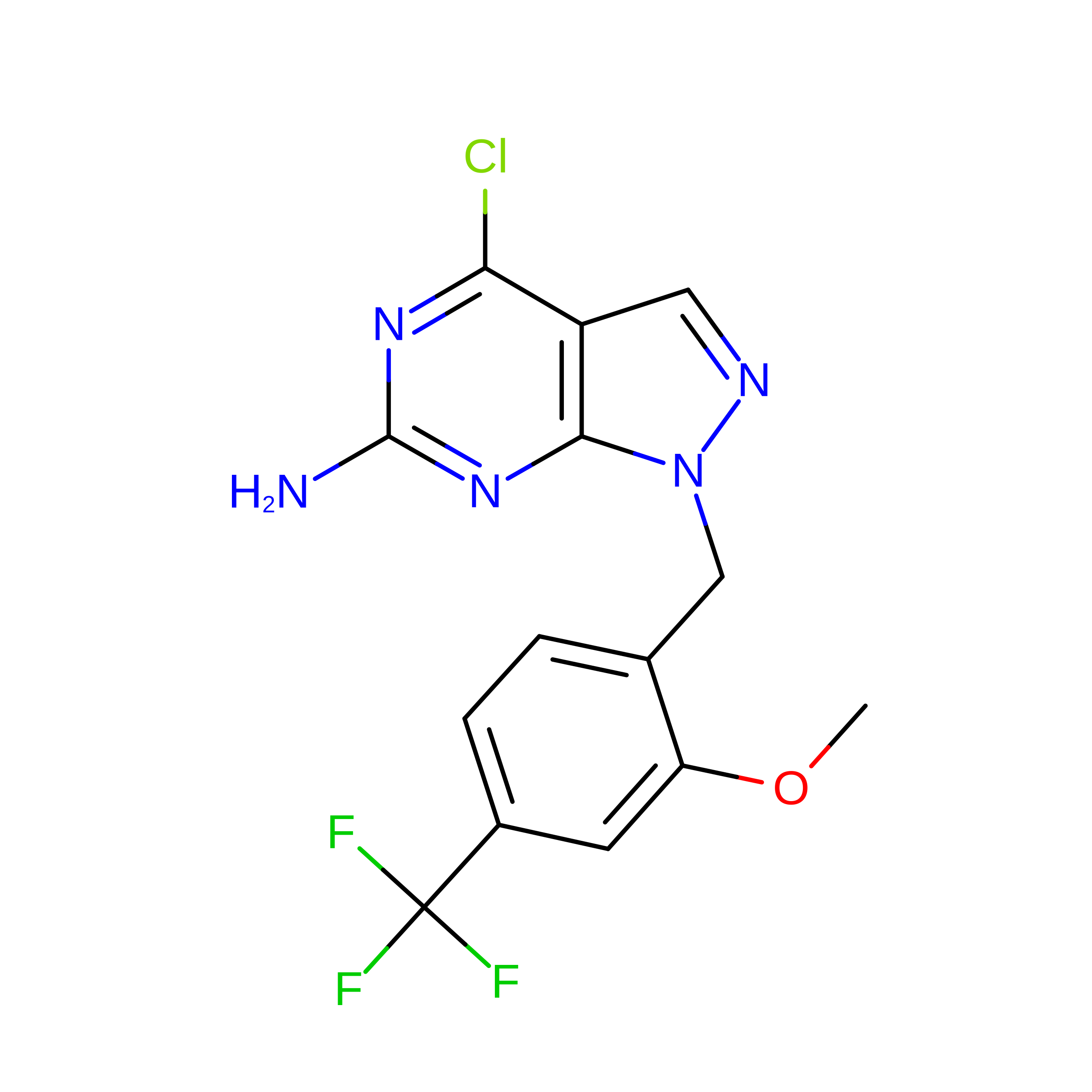
B [auth A]4-chloranyl-1-[[2-methoxy-4-(trifluoromethyl)phenyl]methyl]pyrazolo[3,4-d]pyrimidin-6-amine
C14 H11 Cl F3 N5 O
CRNFGOLKBZYMGM-UHFFFAOYSA-N

Experimental Data & Validation

Experimental Data

  • Method: X-RAY DIFFRACTION
  • Resolution: 1.70 Å
  • R-Value Free:  0.234 (Depositor), 0.238 (DCC) 
  • R-Value Work:  0.189 (Depositor), 0.193 (DCC) 
  • R-Value Observed: 0.191 (Depositor) 
Space Group: H 3
Unit Cell:
Length ( Å )Angle ( ˚ )
a = 110.405α = 90
b = 110.405β = 90
c = 59.445γ = 120
Software Package:
Software NamePurpose
HKL-2000data processing
PHENIXrefinement
Cootmodel building
HKL-2000data reduction
HKL-2000data scaling

Structure Validation

View Full Validation Report


Ligand Structure Quality Assessment 


Entry History 

Deposition Data

Revision History  (Full details and data files)

  • Version 1.0: 2020-07-08
    Type: Initial release
  • Version 1.1: 2023-11-29
    Changes: Data collection, Database references, Refinement description