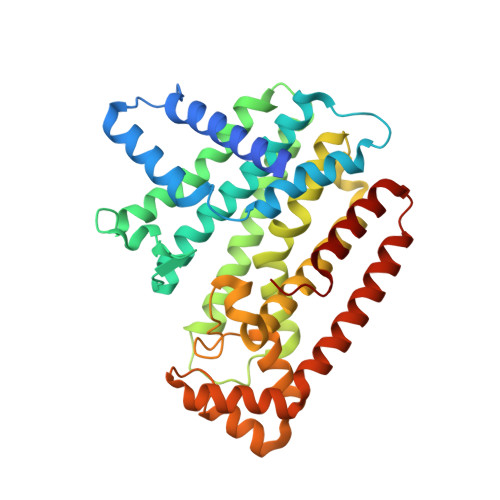
7BUX | pdb_00007bux

Eucommia ulmoides FPS1


Experimental Data Snapshot

  • Method: X-RAY DIFFRACTION
  • Resolution: 2.20 Å
  • R-Value Free: 
    0.248 (Depositor), 0.250 (DCC) 
  • R-Value Work: 
    0.233 (Depositor), 0.235 (DCC) 
  • R-Value Observed: 
    0.234 (Depositor) 

Starting Model: experimental
View more details

wwPDB Validation 3D Report Full Report

Validation slider image for 7BUX

This is version 1.2 of the entry. See complete history

Literature

Structure-function studies of ultrahigh molecular weight isoprenes provide key insights into their biosynthesis.

Kajiura, H.Yoshizawa, T.Tokumoto, Y.Suzuki, N.Takeno, S.Takeno, K.J.Yamashita, T.Tanaka, S.I.Kaneko, Y.Fujiyama, K.Matsumura, H.Nakazawa, Y.

(2021) Commun Biol 4: 215-215

  • DOI: https://doi.org/10.1038/s42003-021-01739-5
  • Primary Citation Related Structures: 
    7BUU, 7BUV, 7BUW, 7BUX

  • PubMed Abstract: 

    Some plant trans-1,4-prenyltransferases (TPTs) produce ultrahigh molecular weight trans-1,4-polyisoprene (TPI) with a molecular weight of over 1.0 million. Although plant-derived TPI has been utilized in various industries, its biosynthesis and physiological function(s) are unclear. Here, we identified three novel Eucommia ulmoides TPT isoforms-EuTPT1, 3, and 5, which synthesized TPI in vitro without other components. Crystal structure analysis of EuTPT3 revealed a dimeric architecture with a central hydrophobic tunnel. Mutation of Cys94 and Ala95 on the central hydrophobic tunnel no longer synthesizd TPI, indicating that Cys94 and Ala95 were essential for forming the dimeric architecture of ultralong-chain TPTs and TPI biosynthesis. A spatiotemporal analysis of the physiological function of TPI in E. ulmoides suggested that it is involved in seed development and maturation. Thus, our analysis provides functional and mechanistic insights into TPI biosynthesis and uncovers biological roles of TPI in plants.


  • Organizational Affiliation
    • International Center for Biotechnology, Osaka University, 2-1 Yamada-oka, Suita, Osaka, 565-0871, Japan.

Macromolecule Content 

  • Total Structure Weight: 83.18 kDa 
  • Atom Count: 5,540 
  • Modeled Residue Count: 672 
  • Deposited Residue Count: 716 
  • Unique protein chains: 1

Macromolecules

Find similar proteins by:|  3D Structure
Entity ID: 1
MoleculeChains  Sequence LengthOrganismDetailsImage
FPS2
A, B
358Eucommia ulmoidesMutation(s): 0 
Gene Names: EUFPS2FPS2
UniProt
Find proteins for Q94IE8 (Eucommia ulmoides)
Explore Q94IE8 
Go to UniProtKB:  Q94IE8
Entity Groups
Sequence Clusters30% Identity50% Identity70% Identity90% Identity95% Identity100% Identity
UniProt GroupQ94IE8
Sequence Annotations
Expand
Reference Sequence

Experimental Data & Validation

Experimental Data

  • Method: X-RAY DIFFRACTION
  • Resolution: 2.20 Å
  • R-Value Free:  0.248 (Depositor), 0.250 (DCC) 
  • R-Value Work:  0.233 (Depositor), 0.235 (DCC) 
  • R-Value Observed: 0.234 (Depositor) 
Space Group: P 1 21 1
Unit Cell:
Length ( Å )Angle ( ˚ )
a = 54α = 90
b = 71.27β = 103.497
c = 103.38γ = 90
Software Package:
Software NamePurpose
XDSdata reduction
XSCALEdata scaling
MOLREPphasing
PHENIXrefinement

Structure Validation

View Full Validation Report


Entry History 

& Funding Information

Deposition Data


Funding OrganizationLocationGrant Number
Japan Society for the Promotion of Science (JSPS)Japan17H05732
Japan Society for the Promotion of Science (JSPS)Japan18K06094
Japan Society for the Promotion of Science (JSPS)Japan19H04735
Japan Society for the Promotion of Science (JSPS)Japan19K16060

Revision History  (Full details and data files)

  • Version 1.0: 2021-02-17
    Type: Initial release
  • Version 1.1: 2021-03-10
    Changes: Database references
  • Version 1.2: 2023-11-29
    Changes: Data collection, Database references, Refinement description