7BJZ | pdb_00007bjz

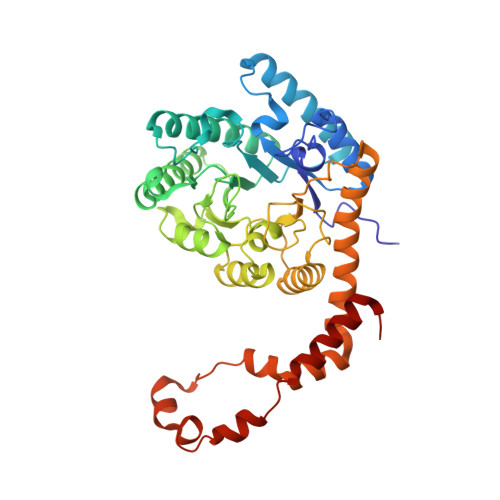
GLUCOSE ISOMERASE S171W in H32


Experimental Data Snapshot

  • Method: X-RAY DIFFRACTION
  • Resolution: 2.13 Å
  • R-Value Free: 
    0.233 (Depositor), 0.242 (DCC) 
  • R-Value Work: 
    0.203 (Depositor), 0.215 (DCC) 
  • R-Value Observed: 
    0.204 (Depositor) 

Starting Model: experimental
View more details

wwPDB Validation 3D Report Full Report

Validation slider image for 7BJZ

This is version 1.2 of the entry. See complete history

Literature

Nucleation of protein mesocrystals via oriented attachment.

Van Driessche, A.E.S.Van Gerven, N.Joosten, R.R.M.Ling, W.L.Bacia, M.Sommerdijk, N.Sleutel, M.

(2021) Nat Commun 12: 3902-3902

  • DOI: https://doi.org/10.1038/s41467-021-24171-z
  • Primary Citation Related Structures: 
    7BJZ

  • PubMed Abstract: 

    Self-assembly of proteins holds great promise for the bottom-up design and production of synthetic biomaterials. In conventional approaches, designer proteins are pre-programmed with specific recognition sites that drive the association process towards a desired organized state. Although proven effective, this approach poses restrictions on the complexity and material properties of the end-state. An alternative, hierarchical approach that has found wide adoption for inorganic systems, relies on the production of crystalline nanoparticles that become the building blocks of a next-level assembly process driven by oriented attachment (OA). As it stands, OA has not yet been observed for protein systems. Here we employ cryo-transmission electron microscopy (cryoEM) in the high nucleation rate limit of protein crystals and map the self-assembly route at molecular resolution. We observe the initial formation of facetted nanocrystals that merge lattices by means of OA alignment well before contact is made, satisfying non-trivial symmetry rules in the process. As these nanocrystalline assemblies grow larger we witness imperfect docking events leading to oriented aggregation into mesocrystalline assemblies. These observations highlight the underappreciated role of the interaction between crystalline nuclei, and the impact of OA on the crystallization process of proteins.


  • Organizational Affiliation
    • Univ. Grenoble Alpes, CNRS, ISTerre, Grenoble, France.

Macromolecule Content 

  • Total Structure Weight: 86.93 kDa 
  • Atom Count: 6,110 
  • Modeled Residue Count: 772 
  • Deposited Residue Count: 776 
  • Unique protein chains: 1

Macromolecules

Find similar proteins by:|  3D Structure
Entity ID: 1
MoleculeChains  Sequence LengthOrganismDetailsImage
Xylose isomerase
A, B
388Streptomyces pseudogriseolusMutation(s): 2 
Gene Names: xylA
EC: 5.3.1.5
UniProt
Find proteins for P24300 (Streptomyces pseudogriseolus)
Explore P24300 
Go to UniProtKB:  P24300
Entity Groups
Sequence Clusters30% Identity50% Identity70% Identity90% Identity95% Identity100% Identity
UniProt GroupP24300
Sequence Annotations
Expand
Reference Sequence

Experimental Data & Validation

Experimental Data

  • Method: X-RAY DIFFRACTION
  • Resolution: 2.13 Å
  • R-Value Free:  0.233 (Depositor), 0.242 (DCC) 
  • R-Value Work:  0.203 (Depositor), 0.215 (DCC) 
  • R-Value Observed: 0.204 (Depositor) 
Space Group: H 3 2
Unit Cell:
Length ( Å )Angle ( ˚ )
a = 132.85α = 90
b = 132.85β = 90
c = 234.85γ = 120
Software Package:
Software NamePurpose
REFMACrefinement
xia2data reduction
XSCALEdata scaling
MOLREPphasing

Structure Validation

View Full Validation Report


Entry History 

& Funding Information

Deposition Data

  • Released Date: 2021-06-16 
  • Deposition Author(s): Sleutel, M.

Funding OrganizationLocationGrant Number
Research Foundation - Flanders (FWO)BelgiumG0H5316N
Research Foundation - Flanders (FWO)Belgium1516215N

Revision History  (Full details and data files)

  • Version 1.0: 2021-06-16
    Type: Initial release
  • Version 1.1: 2021-07-07
    Changes: Database references
  • Version 1.2: 2024-01-31
    Changes: Data collection, Database references, Refinement description