7BFR | pdb_00007bfr

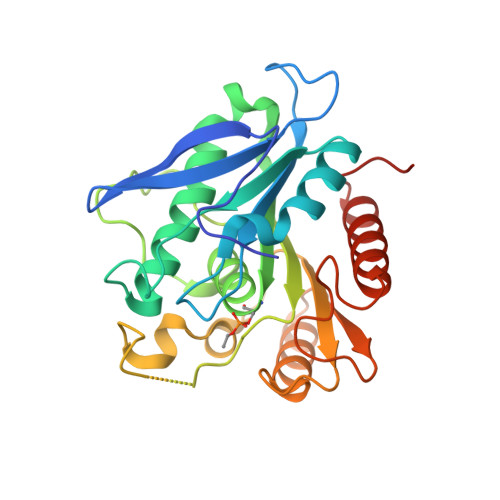
Thermogutta terrifontis esterase 2 phosphorylated by paraoxon


Experimental Data Snapshot

  • Method: X-RAY DIFFRACTION
  • Resolution: 1.99 Å
  • R-Value Free: 
    0.207 (Depositor), 0.209 (DCC) 
  • R-Value Work: 
    0.161 (Depositor), 0.162 (DCC) 
  • R-Value Observed: 
    0.163 (Depositor) 

Starting Model: experimental
View more details

wwPDB Validation 3D Report Full Report

Validation slider image for 7BFR

This is version 1.1 of the entry. See complete history

Literature

A Thermophilic Bacterial Esterase for Scavenging Nerve Agents: A Kinetic, Biophysical and Structural Study.

Bzdrenga, J.Trenet, E.Chantegreil, F.Bernal, K.Nachon, F.Brazzolotto, X.

(2021) Molecules 26

  • DOI: https://doi.org/10.3390/molecules26030657
  • Primary Citation Related Structures: 
    7BFN, 7BFO, 7BFR, 7BFT, 7BFU, 7BFV

  • PubMed Abstract: 

    Organophosphorous nerve agents (OPNA) pose an actual and major threat for both military and civilians alike, as an upsurge in their use has been observed in the recent years. Currently available treatments mitigate the effect of the nerve agents, and could be vastly improved by means of scavengers of the nerve agents. Consequently, efforts have been made over the years into investigating enzymes, also known as bioscavengers, which have the potential either to trap or hydrolyze these toxic compounds. We investigated the previously described esterase 2 from Thermogutta terrifontis (TtEst2) as a potential bioscavenger of nerve agents. As such, we assessed its potential against G-agents (tabun, sarin, and cyclosarin), VX, as well as the pesticide paraoxon. We report that TtEst2 is a good bioscavenger of paraoxon and G-agents, but is rather slow at scavenging VX. X-ray crystallography studies showed that TtEst2 forms an irreversible complex with the aforementioned agents, and allowed the identification of amino-acids, whose mutagenesis could lead to better scavenging properties for VX. In conjunction with its cheap production and purification processes, as well as a robust structural backbone, further engineering of TtEst2 could lead to a stopgap bioscavenger useful for in corpo scavenging or skin decontamination.


  • Organizational Affiliation
    • Département de Toxicologie et Risques Chimiques, Institut de Recherche Biomédicale des Armées, 91220 Brétigny-sur-Orge, France.

Macromolecule Content 

  • Total Structure Weight: 31.78 kDa 
  • Atom Count: 2,261 
  • Modeled Residue Count: 260 
  • Deposited Residue Count: 287 
  • Unique protein chains: 1

Macromolecules

Find similar proteins by:|  3D Structure
Entity ID: 1
MoleculeChains  Sequence LengthOrganismDetailsImage
Esterase287Thermogutta terrifontisMutation(s): 0 
EC: 3.1.1.1
UniProt
Find proteins for A0A286RIX1 (Thermogutta terrifontis)
Explore A0A286RIX1 
Go to UniProtKB:  A0A286RIX1
Entity Groups
Sequence Clusters30% Identity50% Identity70% Identity90% Identity95% Identity100% Identity
UniProt GroupA0A286RIX1
Sequence Annotations
Expand
Reference Sequence

Small Molecules

Ligands 1 Unique
IDChains Name / Formula / InChI Key2D Diagram3D Interactions
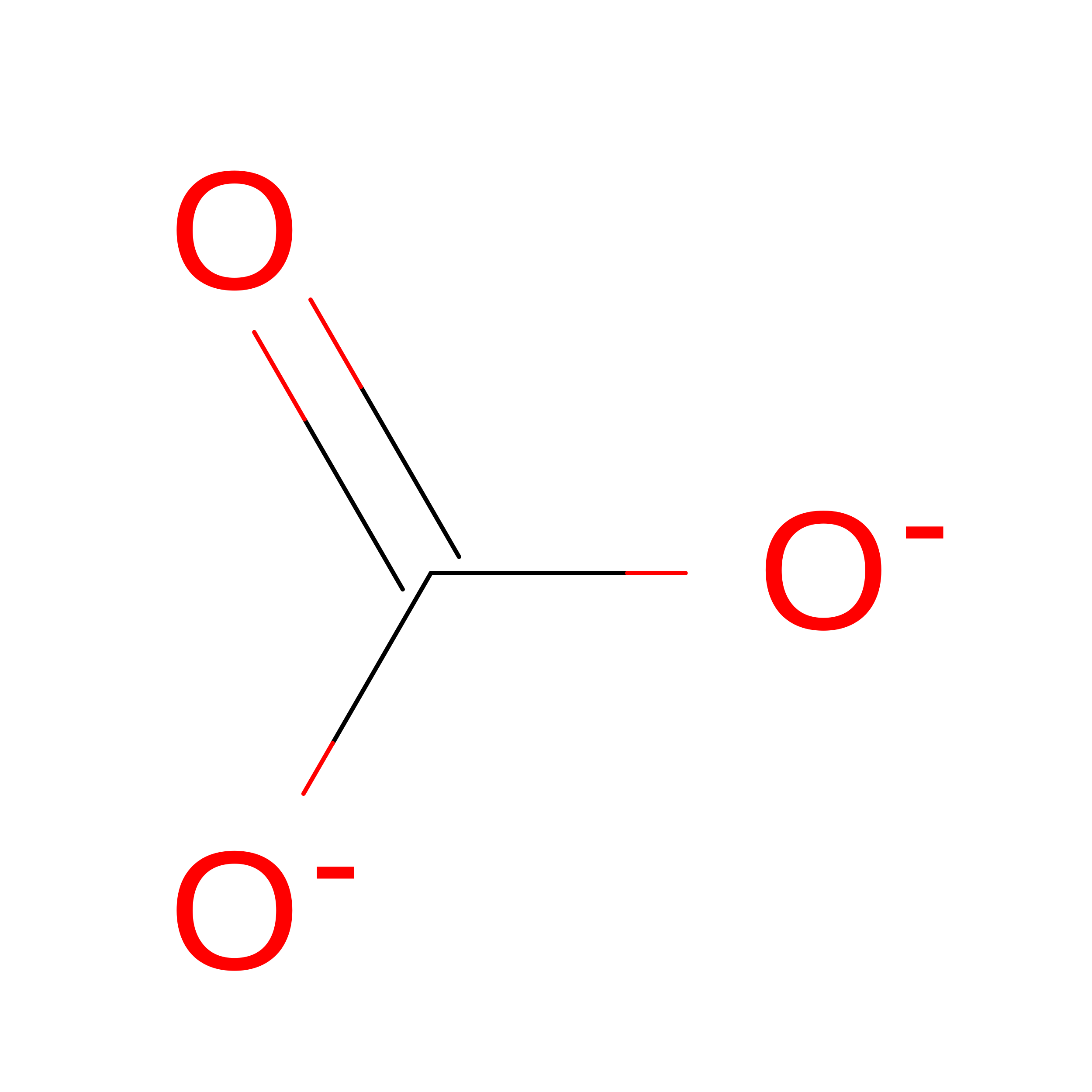
CO3

Query on CO3


Download:Ideal Coordinates CCD File
B [auth A]CARBONATE ION
C O3
BVKZGUZCCUSVTD-UHFFFAOYSA-L
Modified Residues  1 Unique
IDChains TypeFormula2D DiagramParent
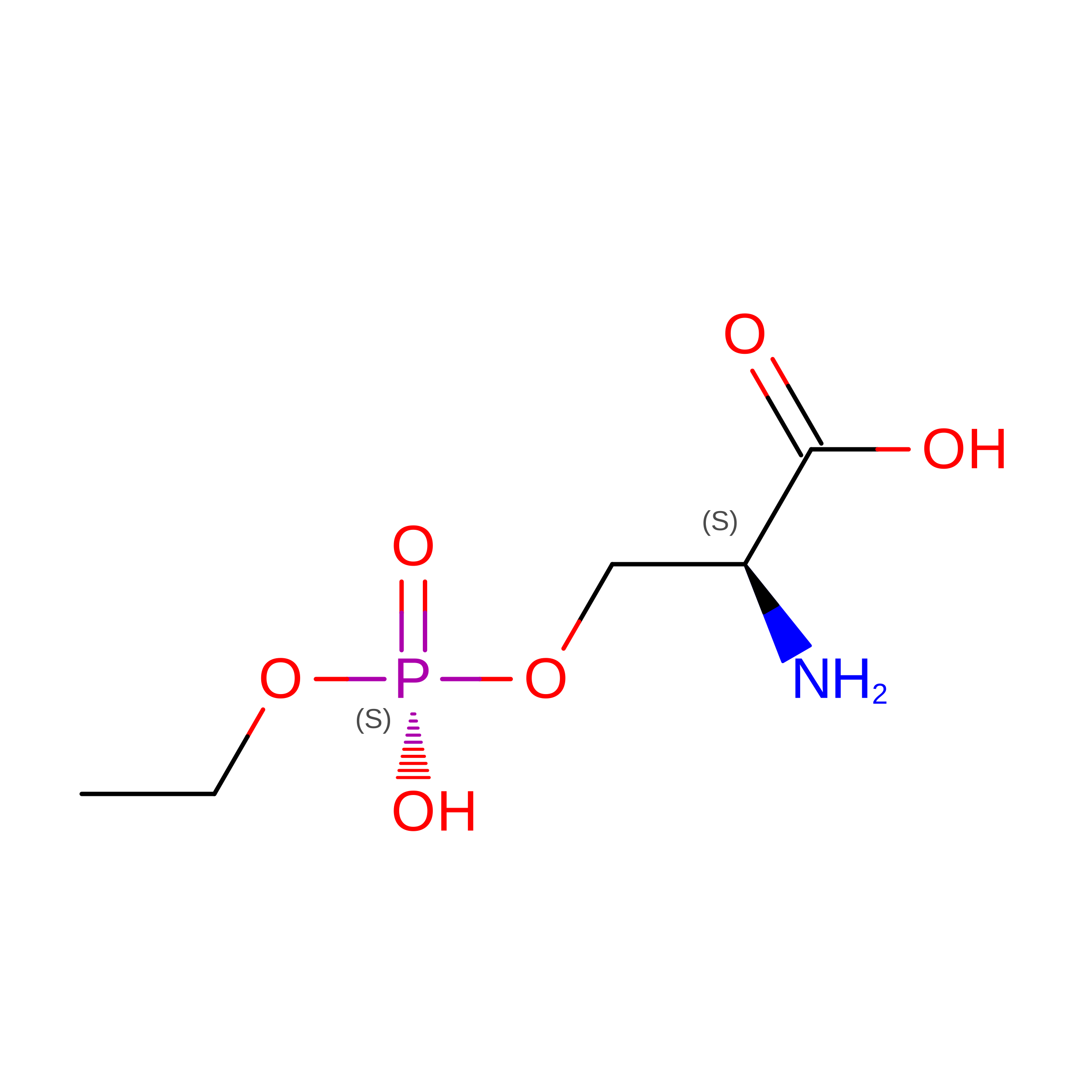
MIR
Query on MIR
A
L-PEPTIDE LINKINGC5 H12 N O6 PSER

Experimental Data & Validation

Experimental Data

  • Method: X-RAY DIFFRACTION
  • Resolution: 1.99 Å
  • R-Value Free:  0.207 (Depositor), 0.209 (DCC) 
  • R-Value Work:  0.161 (Depositor), 0.162 (DCC) 
  • R-Value Observed: 0.163 (Depositor) 
Space Group: P 21 21 21
Unit Cell:
Length ( Å )Angle ( ˚ )
a = 53.52α = 90
b = 67.64β = 90
c = 75.97γ = 90
Software Package:
Software NamePurpose
XDSdata reduction
XSCALEdata scaling
PHENIXrefinement
PHASERphasing

Structure Validation

View Full Validation Report


Entry History 

& Funding Information

Deposition Data


Funding OrganizationLocationGrant Number
French Ministry of Armed ForcesFranceNBC-5-C-4210

Revision History  (Full details and data files)

  • Version 1.0: 2021-02-10
    Type: Initial release
  • Version 1.1: 2024-01-31
    Changes: Data collection, Database references, Refinement description