7BCQ | pdb_00007bcq

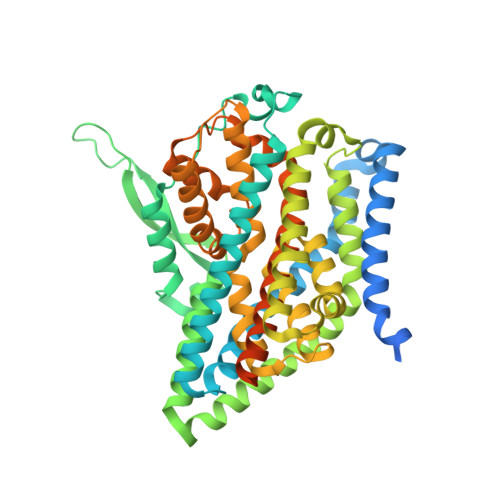
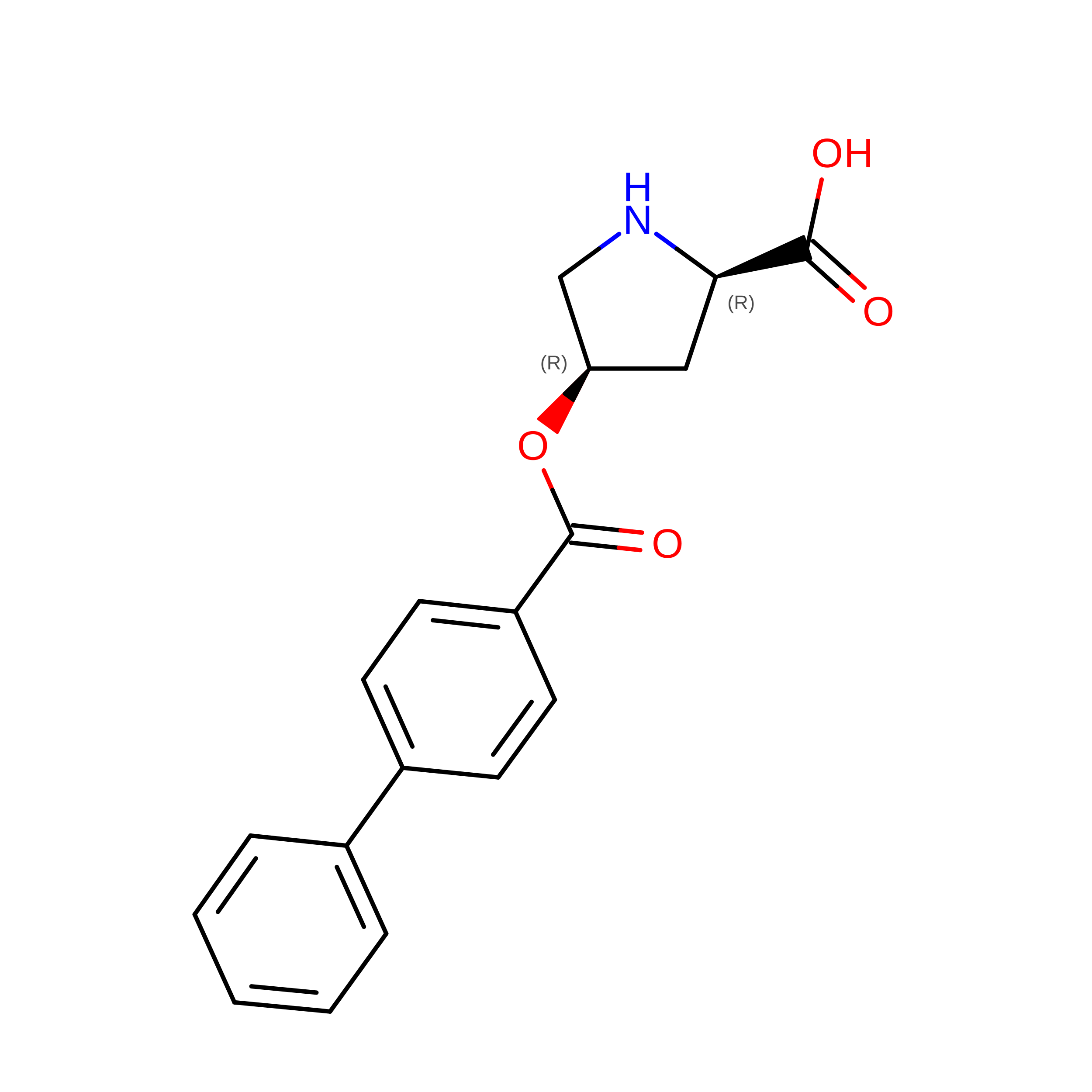
ASCT2 in the presence of the inhibitor Lc-BPE (position "up") in the outward-open conformation.


Experimental Data Snapshot

  • Method: ELECTRON MICROSCOPY
  • Resolution: 3.43 Å
  • Aggregation State: PARTICLE 
  • Reconstruction Method: SINGLE PARTICLE 

Starting Model: experimental
View more details

wwPDB Validation 3D Report Full Report

Validation slider image for 7BCQ

This is version 1.2 of the entry. See complete history

Literature

Rational design of ASCT2 inhibitors using an integrated experimental-computational approach.

Garibsingh, R.A.Ndaru, E.Garaeva, A.A.Shi, Y.Zielewicz, L.Zakrepine, P.Bonomi, M.Slotboom, D.J.Paulino, C.Grewer, C.Schlessinger, A.

(2021) Proc Natl Acad Sci U S A 118

  • DOI: https://doi.org/10.1073/pnas.2104093118
  • Primary Citation Related Structures: 
    7BCQ, 7BCS, 7BCT

  • PubMed Abstract: 

    ASCT2 (SLC1A5) is a sodium-dependent neutral amino acid transporter that controls amino acid homeostasis in peripheral tissues. In cancer, ASCT2 is up-regulated where it modulates intracellular glutamine levels, fueling cell proliferation. Nutrient deprivation via ASCT2 inhibition provides a potential strategy for cancer therapy. Here, we rationally designed stereospecific inhibitors exploiting specific subpockets in the substrate binding site using computational modeling and cryo-electron microscopy (cryo-EM). The final structures combined with molecular dynamics simulations reveal multiple pharmacologically relevant conformations in the ASCT2 binding site as well as a previously unknown mechanism of stereospecific inhibition. Furthermore, this integrated analysis guided the design of a series of unique ASCT2 inhibitors. Our results provide a framework for future development of cancer therapeutics targeting nutrient transport via ASCT2, as well as demonstrate the utility of combining computational modeling and cryo-EM for solute carrier ligand discovery.


  • Organizational Affiliation
    • Department of Pharmacological Sciences, Icahn School of Medicine at Mount Sinai, New York, NY 10029.

Macromolecule Content 

  • Total Structure Weight: 170.85 kDa 
  • Atom Count: 9,861 
  • Modeled Residue Count: 1,326 
  • Deposited Residue Count: 1,623 
  • Unique protein chains: 1

Macromolecules

Find similar proteins by:|  3D Structure
Entity ID: 1
MoleculeChains  Sequence LengthOrganismDetailsImage
Neutral amino acid transporter B(0)
A, B, C
541Homo sapiensMutation(s): 0 
Gene Names: SLC1A5ASCT2M7V1RDRRDRC
Membrane Entity: Yes 
UniProt & NIH Common Fund Data Resources
Find proteins for Q15758 (Homo sapiens)
Explore Q15758 
Go to UniProtKB:  Q15758
PHAROS:  Q15758
GTEx:  ENSG00000105281 
Entity Groups
Sequence Clusters30% Identity50% Identity70% Identity90% Identity95% Identity100% Identity
UniProt GroupQ15758
Sequence Annotations
Expand
Reference Sequence

Experimental Data & Validation

Experimental Data

  • Method: ELECTRON MICROSCOPY
  • Resolution: 3.43 Å
  • Aggregation State: PARTICLE 
  • Reconstruction Method: SINGLE PARTICLE 
EM Software:
TaskSoftware PackageVersion
RECONSTRUCTIONRELION3.0.8
MODEL REFINEMENTPHENIX1.18.2-3874-000

Structure Validation

View Full Validation Report


Entry History 

& Funding Information

Deposition Data


Funding OrganizationLocationGrant Number
Netherlands Organisation for Scientific Research (NWO)Netherlands722.017.001
Netherlands Organisation for Scientific Research (NWO)Netherlands740.018.016
National Institutes of Health/National Institute of General Medical Sciences (NIH/NIGMS)United StatesR01 GM108911
National Institutes of Health/National Cancer Institute (NIH/NCI)United StatesT32 CA078207
National Science Foundation (NSF, United States)United States1515028
National Institutes of Health/National Institute of General Medical Sciences (NIH/NIGMS)United StatesR15 GM135843-01
Netherlands Organisation for Scientific Research (NWO)Netherlands714.018.003

Revision History  (Full details and data files)

  • Version 1.0: 2021-09-22
    Type: Initial release
  • Version 1.1: 2021-09-29
    Changes: Data collection, Database references
  • Version 1.2: 2024-07-10
    Changes: Data collection, Refinement description