7ARX | pdb_00007arx

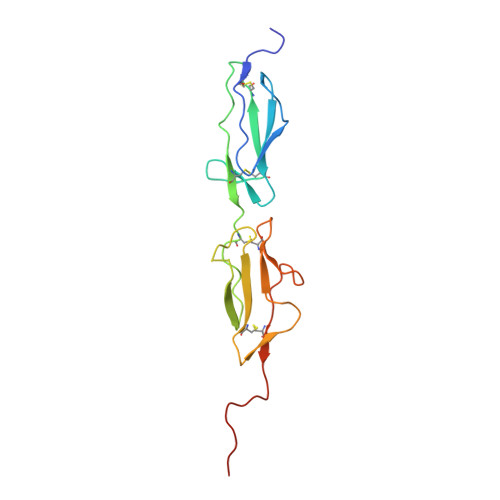
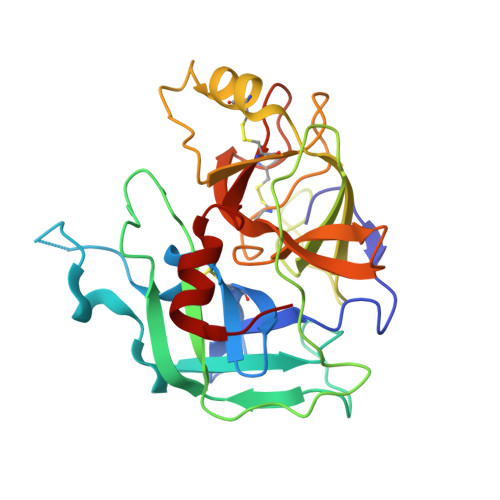
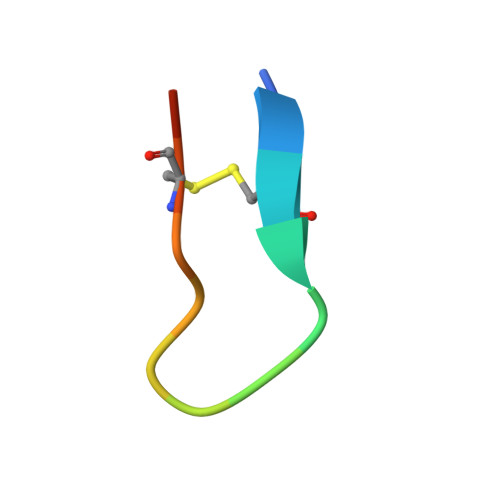
Crystal structure of the catalytic fragment of masp-1 in complex with SFMI1


Experimental Data Snapshot

  • Method: X-RAY DIFFRACTION
  • Resolution: 2.42 Å
  • R-Value Free: 
    0.285 (Depositor), 0.285 (DCC) 
  • R-Value Work: 
    0.256 (Depositor), 0.257 (DCC) 
  • R-Value Observed: 
    0.257 (Depositor) 

Starting Model: experimental
View more details

wwPDB Validation 3D Report Full Report

Validation slider image for 7ARX

This is version 2.3 of the entry. See complete history. 

Literature

Directed Evolution-Driven Increase of Structural Plasticity Is a Prerequisite for Binding the Complement Lectin Pathway Blocking MASP-Inhibitor Peptides.

Durvanger, Z., Boros, E., Nagy, Z.A., Hegedus, R., Megyeri, M., Dobo, J., Gal, P., Schlosser, G., Angyan, A.F., Gaspari, Z., Perczel, A., Harmat, V., Mezo, G., Menyhard, D.K., Pal, G.

(2022) ACS Chem Biol 17: 969-986

  • DOI: https://doi.org/10.1021/acschembio.2c00114
  • Primary Citation Related Structures: 
    7ARX

  • PubMed Abstract: 

    MASP-1 and MASP-2 are key activator proteases of the complement lectin pathway. The first specific mannose-binding lectin-associated serine protease (MASP) inhibitors had been developed from the 14-amino-acid sunflower trypsin inhibitor (SFTI) peptide by phage display, yielding SFTI-based MASP inhibitors, SFMIs. Here, we present the crystal structure of the MASP-1/SFMI1 complex that we analyzed in comparison to other existing MASP-1/2 structures. Rigidified backbone structure has long been accepted as a structural prerequisite for peptide inhibitors of proteases. We found that a hydrophobic cluster organized around the P2 Thr residue is essential for the structural stability of wild-type SFTI. We also found that the same P2 Thr prevents binding of the rigid SFTI-like peptides to the substrate-binding cleft of both MASPs as the cleft is partially blocked by large gatekeeper enzyme loops. Directed evolution removed this obstacle by replacing the P2 Thr with a Ser, providing the SFMIs with high-degree structural plasticity, which proved to be essential for MASP inhibition. To gain more insight into the structural criteria for SFMI-based MASP-2 inhibition, we systematically modified MASP-2-specific SFMI2 by capping its two termini and by replacing its disulfide bridge with varying length thioether linkers. By doing so, we also aimed to generate a versatile scaffold that is resistant to reducing environment and has increased stability in exopeptidase-containing biological environments. We found that the reduction-resistant disulfide-substituted l-2,3-diaminopropionic acid (Dap) variant possessed near-native potency. As MASP-2 is involved in the life-threatening thrombosis in COVID-19 patients, our synthetic, selective MASP-2 inhibitors could be relevant coronavirus drug candidates.


  • Organizational Affiliation: 
    • Laboratory of Structural Chemistry and Biology, Institute of Chemistry, ELTE Eötvös Loránd University, Pázmány Péter sétány 1/A, H-1117 Budapest, Hungary.

Macromolecule Content 

  • Total Structure Weight: 47.11 kDa 
  • Atom Count: 2,977 
  • Modeled Residue Count: 410 
  • Deposited Residue Count: 420 
  • Unique protein chains: 3

Macromolecules

Find similar proteins by:|  3D Structure
Entity ID: 1
MoleculeChains  Sequence LengthOrganismDetailsImage
Mannan-binding lectin serine protease 1155Homo sapiensMutation(s): 0 
Gene Names: MASP1, CRARF, CRARF1, PRSS5
EC: 3.4.21
UniProt & NIH Common Fund Data Resources
Find proteins for P48740 (Homo sapiens)
Explore P48740 
Go to UniProtKB:  P48740
PHAROS:  P48740
GTEx:  ENSG00000127241 
Entity Groups
Sequence Clusters30% Identity50% Identity70% Identity90% Identity95% Identity100% Identity
UniProt GroupP48740
Sequence Annotations
Expand
Reference Sequence
Find similar proteins by:|  3D Structure
Entity ID: 2
MoleculeChains  Sequence LengthOrganismDetailsImage
Mannan-binding lectin serine protease 1251Homo sapiensMutation(s): 0 
Gene Names: MASP1, CRARF, CRARF1, PRSS5
EC: 3.4.21
UniProt & NIH Common Fund Data Resources
Find proteins for P48740 (Homo sapiens)
Explore P48740 
Go to UniProtKB:  P48740
PHAROS:  P48740
GTEx:  ENSG00000127241 
Entity Groups
Sequence Clusters30% Identity50% Identity70% Identity90% Identity95% Identity100% Identity
UniProt GroupP48740
Sequence Annotations
Expand
Reference Sequence
Find similar proteins by:  Sequence   |   3D Structure  
Entity ID: 3
MoleculeChains  Sequence LengthOrganismDetailsImage
SFMI1 - Sunflower MASP1 inhibitor14Helianthus annuusMutation(s): 0 
UniProt
Find proteins for Q4GWU5 (Helianthus annuus)
Explore Q4GWU5 
Go to UniProtKB:  Q4GWU5
Entity Groups
Sequence Clusters30% Identity50% Identity70% Identity90% Identity95% Identity100% Identity
UniProt GroupQ4GWU5
Sequence Annotations
Expand
Reference Sequence

Small Molecules

Ligands 1 Unique
IDChains Name / Formula / InChI Key2D Diagram3D Interactions
PEG

Query on PEG


Download:Ideal Coordinates CCD File
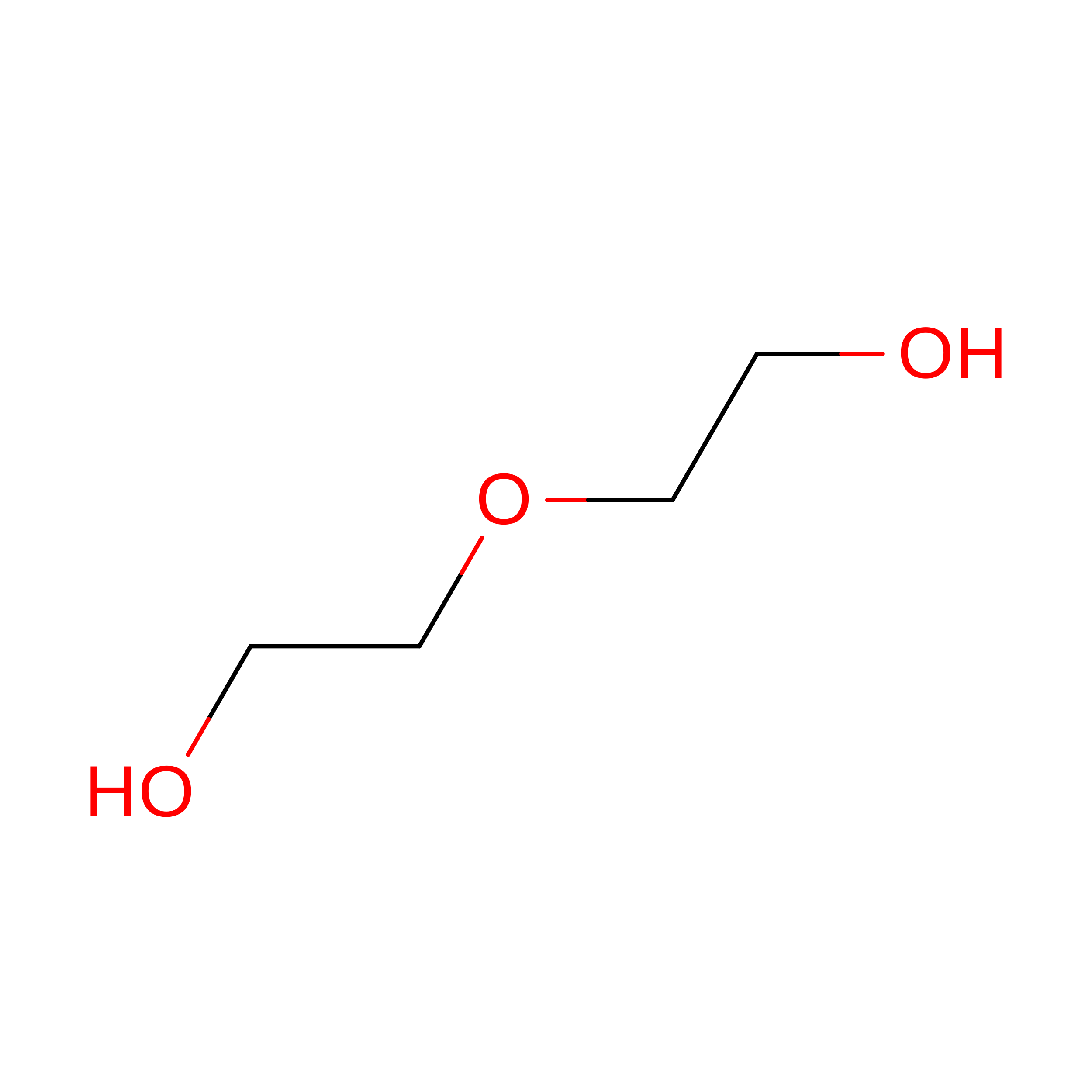
D [auth B]DI(HYDROXYETHYL)ETHER
C4 H10 O3
MTHSVFCYNBDYFN-UHFFFAOYSA-N

Experimental Data & Validation

Experimental Data

  • Method: X-RAY DIFFRACTION
  • Resolution: 2.42 Å
  • R-Value Free:  0.285 (Depositor), 0.285 (DCC) 
  • R-Value Work:  0.256 (Depositor), 0.257 (DCC) 
  • R-Value Observed: 0.257 (Depositor) 
Space Group: P 31 2 1
Unit Cell:
Length ( Å )Angle ( ˚ )
a = 69.3α = 90
b = 69.3β = 90
c = 161.8γ = 120
Software Package:
Software NamePurpose
PHENIXrefinement
PHENIXrefinement
XDSdata reduction
XSCALEdata scaling
PHASERphasing

Structure Validation

View Full Validation Report


Entry History 

& Funding Information

Deposition Data


Funding OrganizationLocationGrant Number
European Regional Development FundHungaryVEKOP-2.3.3-15-2017-00020, VEKOP-2.3.2-16-2017-00014 and VEKOP-2.3.3-15-2017-00018
Hungarian National Research, Development and Innovation OfficeHungary2018-1.2.1-NKP-2018-00005
Hungarian National Research, Development and Innovation OfficeHungaryNK100769, NK100834, K116305, K119374 and K119386

Revision History  (Full details and data files)

  • Version 1.0: 2021-11-03
    Type: Initial release
  • Version 2.0: 2022-02-23
    Type: Coordinate replacement
    Reason: Model completeness
    Changes: Advisory, Atomic model, Data collection, Database references, Derived calculations, Refinement description, Source and taxonomy, Structure summary
  • Version 2.1: 2022-05-18
    Changes: Database references
  • Version 2.2: 2024-01-31
    Changes: Data collection, Refinement description
  • Version 2.3: 2024-11-13
    Changes: Structure summary