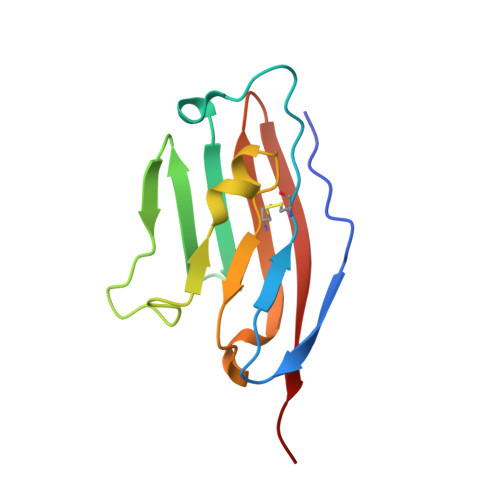
6SRU | pdb_00006sru

Structure of Ig-like V-type domian of mouse Programmed cell death 1 ligand 1 (PD-L1)


Experimental Data Snapshot

  • Method: X-RAY DIFFRACTION
  • Resolution: 2.53 Å
  • R-Value Free: 
    0.279 (Depositor), 0.281 (DCC) 
  • R-Value Work: 
    0.228 (Depositor), 0.233 (DCC) 
  • R-Value Observed: 
    0.230 (Depositor) 

Starting Model: experimental
View more details

wwPDB Validation 3D Report Full Report

Validation slider image for 6SRU

This is version 1.2 of the entry. See complete history

Literature

Human and mouse PD-L1: similar molecular structure, but different druggability profiles.

Magiera-Mularz, K.Kocik, J.Musielak, B.Plewka, J.Sala, D.Machula, M.Grudnik, P.Hajduk, M.Czepiel, M.Siedlar, M.Holak, T.A.Skalniak, L.

(2021) iScience 24: 101960-101960

  • DOI: https://doi.org/10.1016/j.isci.2020.101960
  • Primary Citation Related Structures: 
    6SRU

  • PubMed Abstract: 

    In the development of PD-L1-blocking therapeutics, it is essential to transfer initial in vitro findings into proper in vivo animal models. Classical immunocompetent mice are attractive due to high accessibility and low experimental costs. However, it is unknown whether inter-species differences in PD-L1 sequence and structure would allow for human-mouse cross applications. Here, we disclose the first structure of the mouse ( m ) PD-L1 and analyze its similarity to the human ( h ) PD-L1. We show that m PD-L1 interacts with h PD-1 and provides a negative signal toward activated Jurkat T cells. We also show major differences in druggability between the h PD-L1 and m PD-L1 using therapeutic antibodies, a macrocyclic peptide, and small molecules. Our study indicates that while the amino acid sequence is well conserved between the h PD-L1 and m PD-L1 and overall structures are almost identical, crucial differences determine the interaction with anti-PD-L1 agents, that cannot be easily predicted in silico .


  • Organizational Affiliation
    • Department of Organic Chemistry, Faculty of Chemistry, Jagiellonian University, Gronostajowa 2, 30-387 Krakow, Poland.

Macromolecule Content 

  • Total Structure Weight: 133.35 kDa 
  • Atom Count: 8,676 
  • Modeled Residue Count: 1,146 
  • Deposited Residue Count: 1,180 
  • Unique protein chains: 1

Macromolecules

Find similar proteins by:|  3D Structure
Entity ID: 1
MoleculeChains  Sequence LengthOrganismDetailsImage
Programmed cell death 1 ligand 1
A, B, C, D, E
A, B, C, D, E, F, G, H, I, J
118Mus musculusMutation(s): 0 
Gene Names: Cd274B7h1Pdcd1l1Pdcd1lg1Pdl1
UniProt
Find proteins for Q9EP73 (Mus musculus)
Explore Q9EP73 
Go to UniProtKB:  Q9EP73
Entity Groups
Sequence Clusters30% Identity50% Identity70% Identity90% Identity95% Identity100% Identity
UniProt GroupQ9EP73
Sequence Annotations
Expand
Reference Sequence

Experimental Data & Validation

Experimental Data

  • Method: X-RAY DIFFRACTION
  • Resolution: 2.53 Å
  • R-Value Free:  0.279 (Depositor), 0.281 (DCC) 
  • R-Value Work:  0.228 (Depositor), 0.233 (DCC) 
  • R-Value Observed: 0.230 (Depositor) 
Space Group: P 1 21 1
Unit Cell:
Length ( Å )Angle ( ˚ )
a = 73.92α = 90
b = 107.715β = 99.15
c = 79.531γ = 90
Software Package:
Software NamePurpose
PHENIXrefinement
PDB_EXTRACTdata extraction
XDSdata reduction
XSCALEdata scaling
Aimlessdata scaling
PHASERphasing

Structure Validation

View Full Validation Report


Entry History 

& Funding Information

Deposition Data


Funding OrganizationLocationGrant Number
European UnionPolandPOIR.04.04.00-00-420F/17-00

Revision History  (Full details and data files)

  • Version 1.0: 2021-02-03
    Type: Initial release
  • Version 1.1: 2024-01-24
    Changes: Data collection, Database references, Refinement description
  • Version 1.2: 2024-10-23
    Changes: Structure summary