6PTE | pdb_00006pte

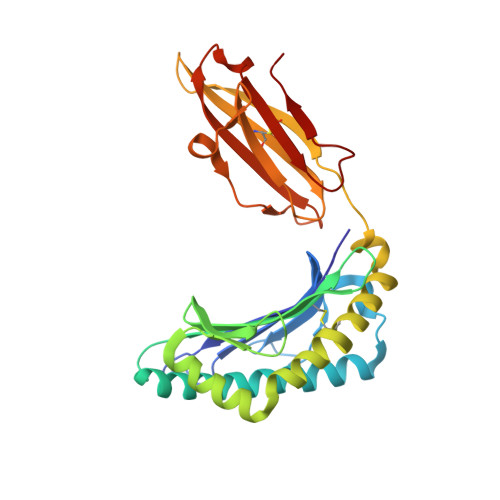
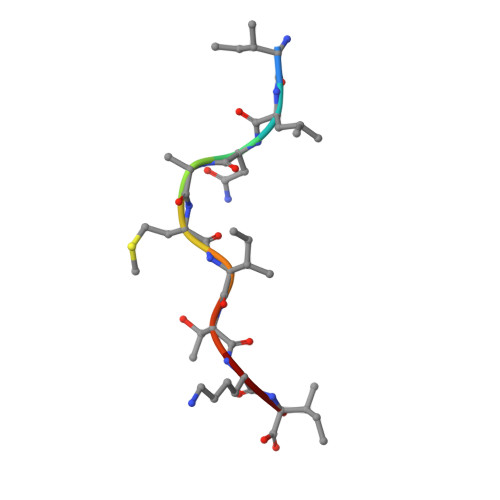
Crystal Structure of ILNAMITKI peptide bound to HLA-A2


Experimental Data Snapshot

  • Method: X-RAY DIFFRACTION
  • Resolution: 1.90 Å
  • R-Value Free: 
    0.185 (Depositor), 0.186 (DCC) 
  • R-Value Work: 
    0.159 (Depositor), 0.160 (DCC) 
  • R-Value Observed: 
    0.162 (Depositor) 

Starting Model: experimental
View more details

wwPDB Validation 3D Report Full Report

Validation slider image for 6PTE

This is version 1.4 of the entry. See complete history

Literature

Structure Based Prediction of Neoantigen Immunogenicity.

Riley, T.P.Keller, G.L.J.Smith, A.R.Davancaze, L.M.Arbuiso, A.G.Devlin, J.R.Baker, B.M.

(2019) Front Immunol 10: 2047-2047

  • DOI: https://doi.org/10.3389/fimmu.2019.02047
  • Primary Citation Related Structures: 
    6OPD, 6PTB, 6PTE

  • PubMed Abstract: 

    The development of immunological therapies that incorporate peptide antigens presented to T cells by MHC proteins is a long sought-after goal, particularly for cancer, where mutated neoantigens are being explored as personalized cancer vaccines. Although neoantigens can be identified through sequencing, bioinformatics and mass spectrometry, identifying those which are immunogenic and able to promote tumor rejection remains a significant challenge. Here we examined the potential of high-resolution structural modeling followed by energetic scoring of structural features for predicting neoantigen immunogenicity. After developing a strategy to rapidly and accurately model nonameric peptides bound to the common class I MHC protein HLA-A2, we trained a neural network on structural features that influence T cell receptor (TCR) and peptide binding energies. The resulting structurally-parameterized neural network outperformed methods that do not incorporate explicit structural or energetic properties in predicting CD8 + T cell responses of HLA-A2 presented nonameric peptides, while also providing insight into the underlying structural and biophysical mechanisms governing immunogenicity. Our proof-of-concept study demonstrates the potential for structure-based immunogenicity predictions in the development of personalized peptide-based vaccines.


  • Organizational Affiliation
    • Department of Chemistry and Biochemistry and the Harper Cancer Research Institute, University of Notre Dame, Notre Dame, IN, United States.

Macromolecule Content 

  • Total Structure Weight: 180.2 kDa 
  • Atom Count: 14,302 
  • Modeled Residue Count: 1,536 
  • Deposited Residue Count: 1,536 
  • Unique protein chains: 3

Macromolecules

Find similar proteins by:|  3D Structure
Entity ID: 1
MoleculeChains  Sequence LengthOrganismDetailsImage
HLA class I histocompatibility antigen, A-2 alpha chainA,
D [auth E],
G [auth H],
J [auth K]
275Homo sapiensMutation(s): 0 
Gene Names: HLA-AHLAA
UniProt & NIH Common Fund Data Resources
Find proteins for P04439 (Homo sapiens)
Explore P04439 
Go to UniProtKB:  P04439
PHAROS:  P04439
GTEx:  ENSG00000206503 
Entity Groups
Sequence Clusters30% Identity50% Identity70% Identity90% Identity95% Identity100% Identity
UniProt GroupP04439
Sequence Annotations
Expand
Reference Sequence
Find similar proteins by:|  3D Structure
Entity ID: 2
MoleculeChains  Sequence LengthOrganismDetailsImage
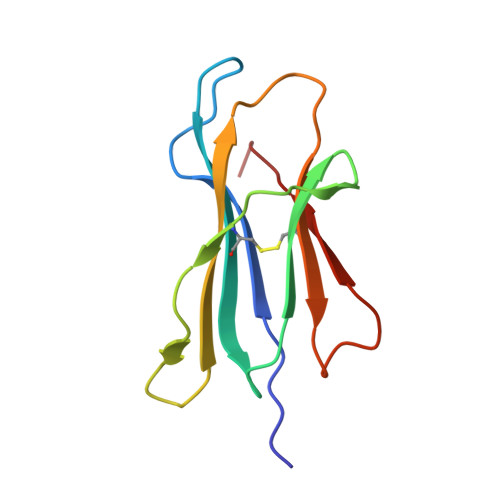
Beta-2-microglobulinB,
E [auth F],
H [auth I],
K [auth L]
100Homo sapiensMutation(s): 0 
Gene Names: B2MCDABP0092HDCMA22P
UniProt & NIH Common Fund Data Resources
Find proteins for P61769 (Homo sapiens)
Explore P61769 
Go to UniProtKB:  P61769
PHAROS:  P61769
GTEx:  ENSG00000166710 
Entity Groups
Sequence Clusters30% Identity50% Identity70% Identity90% Identity95% Identity100% Identity
UniProt GroupP61769
Sequence Annotations
Expand
Reference Sequence
Find similar proteins by:  Sequence   |   3D Structure  
Entity ID: 3
MoleculeChains  Sequence LengthOrganismDetailsImage
HAUS augmin-like complex subunit 3C,
F [auth D],
I [auth G],
L [auth J]
9Homo sapiensMutation(s): 0 
UniProt & NIH Common Fund Data Resources
Find proteins for Q68CZ6 (Homo sapiens)
Explore Q68CZ6 
Go to UniProtKB:  Q68CZ6
PHAROS:  Q68CZ6
GTEx:  ENSG00000214367 
Entity Groups
UniProt GroupQ68CZ6
Sequence Annotations
Expand
Reference Sequence

Small Molecules

Ligands 2 Unique
IDChains Name / Formula / InChI Key2D Diagram3D Interactions
GOL

Query on GOL


Download:Ideal Coordinates CCD File
BA [auth J]
M [auth A]
N [auth A]
P [auth C]
Q [auth E]
BA [auth J],
M [auth A],
N [auth A],
P [auth C],
Q [auth E],
R [auth E],
T [auth D],
U [auth H],
V [auth H],
X [auth G],
Y [auth K],
Z [auth K]
GLYCEROL
C3 H8 O3
PEDCQBHIVMGVHV-UHFFFAOYSA-N
NA

Query on NA


Download:Ideal Coordinates CCD File
AA [auth L],
O [auth B],
S [auth F],
W [auth I]
SODIUM ION
Na
FKNQFGJONOIPTF-UHFFFAOYSA-N

Experimental Data & Validation

Experimental Data

  • Method: X-RAY DIFFRACTION
  • Resolution: 1.90 Å
  • R-Value Free:  0.185 (Depositor), 0.186 (DCC) 
  • R-Value Work:  0.159 (Depositor), 0.160 (DCC) 
  • R-Value Observed: 0.162 (Depositor) 
Space Group: P 1
Unit Cell:
Length ( Å )Angle ( ˚ )
a = 58.429α = 90.01
b = 84.106β = 90.06
c = 85.363γ = 90.02
Software Package:
Software NamePurpose
PHENIXrefinement
HKL-2000data reduction
HKL-2000data scaling
PHASERphasing

Structure Validation

View Full Validation Report


Entry History 

Deposition Data

Revision History  (Full details and data files)

  • Version 1.0: 2019-09-04
    Type: Initial release
  • Version 1.1: 2019-09-18
    Changes: Data collection, Derived calculations
  • Version 1.2: 2019-10-09
    Changes: Data collection, Database references
  • Version 1.3: 2023-10-11
    Changes: Data collection, Database references, Derived calculations, Refinement description
  • Version 1.4: 2024-11-06
    Changes: Structure summary