6OVP | pdb_00006ovp

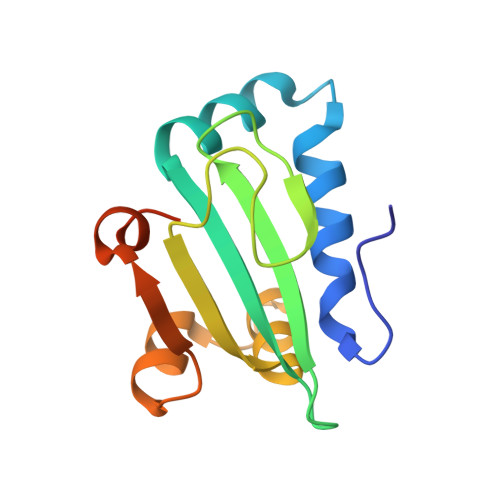
Sterol Carrier Protein 2 from Yarrowia Lipolytica (apo form)


Experimental Data Snapshot

  • Method: X-RAY DIFFRACTION
  • Resolution: 1.99 Å
  • R-Value Free: 
    0.293 (Depositor), 0.293 (DCC) 
  • R-Value Work: 
    0.241 (Depositor), 0.244 (DCC) 
  • R-Value Observed: 
    0.243 (Depositor) 

Starting Model: experimental
View more details

wwPDB Validation 3D Report Full Report

Validation slider image for 6OVP

This is version 1.3 of the entry. See complete history

Literature

The structure of unliganded sterol carrier protein 2 from Yarrowia lipolytica unveils a mechanism for binding site occlusion.

Gianotti, A.R.Klinke, S.Ermacora, M.R.

(2020) J Struct Biol 213: 107675-107675

  • DOI: https://doi.org/10.1016/j.jsb.2020.107675
  • Primary Citation Related Structures: 
    6OVP

  • PubMed Abstract: 

    Isolated or as a part of multidomain proteins, Sterol Carrier Protein 2 (SCP2) exhibits high affinity and broad specificity for different lipidic and hydrophobic compounds. A wealth of structural information on SCP2 domains in all forms of life is currently available; however, many aspects of its ligand binding activity are poorly understood. ylSCP2 is a well-characterized single domain SCP2 from the yeast Yarrowia lipolytica. Herein, we report the X-ray structure of unliganded ylSCP2 refined to 2.0 Å resolution. Comparison with the previously solved liganded ylSCP2 structure unveiled a novel mechanism for binding site occlusion. The liganded ylSCP2 binding site is a large cavity with a volume of more than 800 Å 3 . In unliganded ylSCP2 the binding site is reduced to about 140 Å 3 . The obliteration is caused by a swing movement of the C-terminal α helix 5 and a subtle compaction of helices 2-4. Previous pairwise comparisons were between homologous SCP2 domains with a uncertain binding status. The reported unliganded ylSCP2 structure allows for the first time a fully controlled comparative analysis of the conformational effects of ligand occupation dispelling several doubts regarding the architecture of SCP2 binding site.


  • Organizational Affiliation
    • Departamento de Ciencia y Tecnología, Universidad Nacional de Quilmes, Argentina; Grupo de Biología Estructural y Biotecnología, IMBICE, CONICET, Universidad Nacional de Quilmes, Argentina.

Macromolecule Content 

  • Total Structure Weight: 28.21 kDa 
  • Atom Count: 1,898 
  • Modeled Residue Count: 246 
  • Deposited Residue Count: 258 
  • Unique protein chains: 1

Macromolecules

Find similar proteins by:|  3D Structure
Entity ID: 1
MoleculeChains  Sequence LengthOrganismDetailsImage
Fatty acid-binding protein
A, B
129Yarrowia lipolyticaMutation(s): 0 
Gene Names: SCP2YALI0E01298g
UniProt
Find proteins for P80547 (Yarrowia lipolytica (strain CLIB 122 / E 150))
Explore P80547 
Go to UniProtKB:  P80547
Entity Groups
Sequence Clusters30% Identity50% Identity70% Identity90% Identity95% Identity100% Identity
UniProt GroupP80547
Sequence Annotations
Expand
Reference Sequence

Small Molecules

Ligands 1 Unique
IDChains Name / Formula / InChI Key2D Diagram3D Interactions
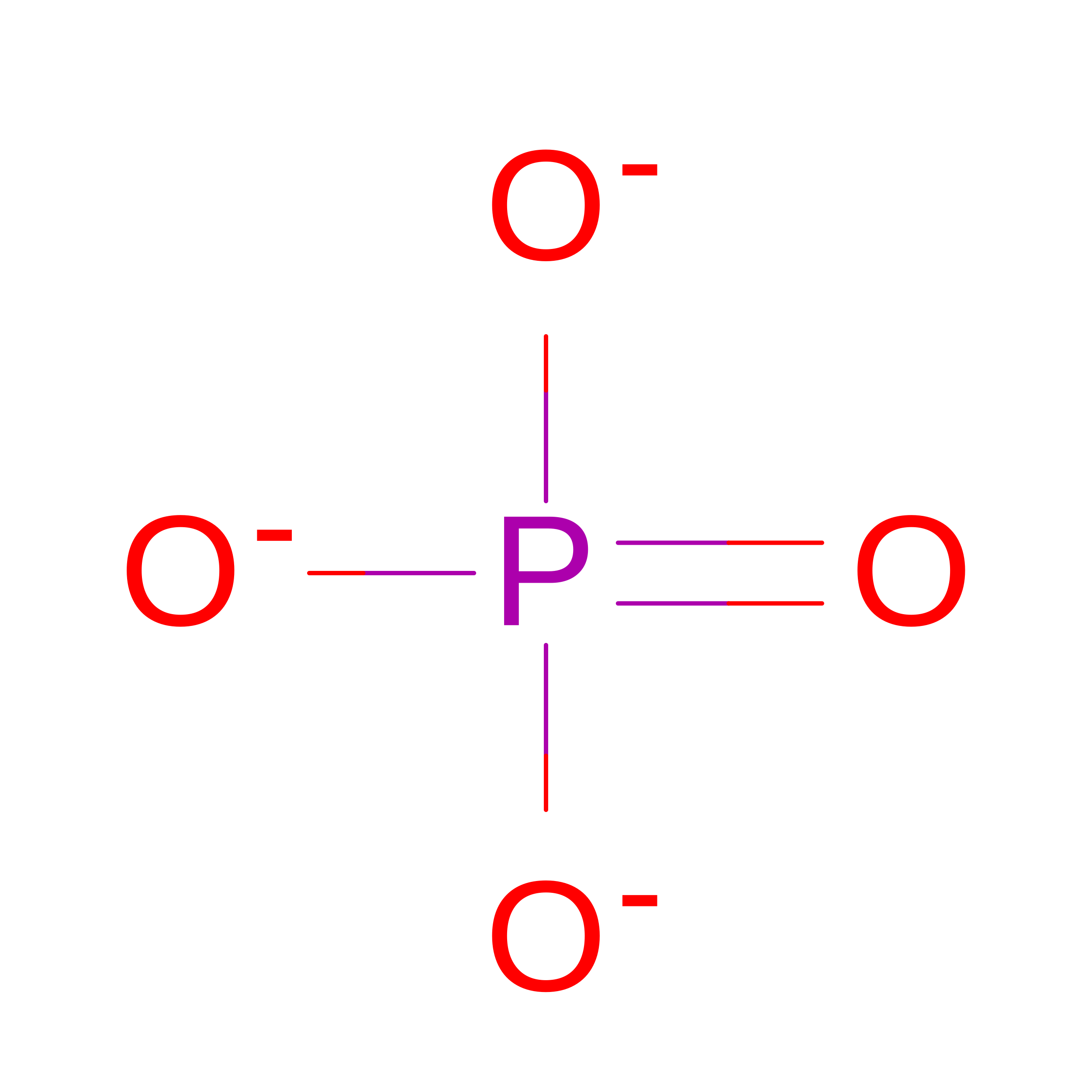
PO4

Query on PO4


Download:Ideal Coordinates CCD File
C [auth B]PHOSPHATE ION
O4 P
NBIIXXVUZAFLBC-UHFFFAOYSA-K

Experimental Data & Validation

Experimental Data

  • Method: X-RAY DIFFRACTION
  • Resolution: 1.99 Å
  • R-Value Free:  0.293 (Depositor), 0.293 (DCC) 
  • R-Value Work:  0.241 (Depositor), 0.244 (DCC) 
  • R-Value Observed: 0.243 (Depositor) 
Space Group: P 31 2 1
Unit Cell:
Length ( Å )Angle ( ˚ )
a = 67.92α = 90
b = 67.92β = 90
c = 117.04γ = 120
Software Package:
Software NamePurpose
PHENIXrefinement
XDSdata reduction
XDSdata scaling
PHASERphasing
Cootmodel building
MxCuBEdata collection

Structure Validation

View Full Validation Report


Entry History 

& Funding Information

Deposition Data


Funding OrganizationLocationGrant Number
Agencia Nacional de Promocion Cientifica y Tecnologica (FONCYT)ArgentinaPICT 2016-0584

Revision History  (Full details and data files)

  • Version 1.0: 2020-05-20
    Type: Initial release
  • Version 1.1: 2020-12-16
    Changes: Database references
  • Version 1.2: 2020-12-23
    Changes: Database references
  • Version 1.3: 2023-10-11
    Changes: Data collection, Database references, Refinement description