Download Mendeley
Efficient Chemical Protein Synthesis using Fmoc-Masked N-Terminal Cysteine in Peptide Thioester Segments.
Kar, A., Mannuthodikayil, J., Singh, S., Biswas, A., Dubey, P., Das, A., Mandal, K.(2020) Angew Chem Int Ed Engl 59: 14796-14801
- PubMed: 32333711 Search on PubMedSearch on PubMed Central
- DOI: https://doi.org/10.1002/anie.202000491
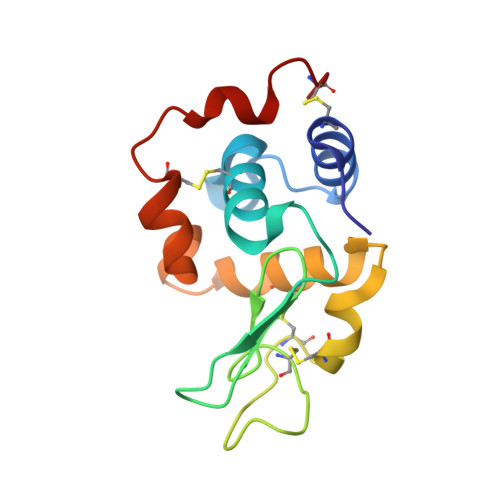
- Primary Citation Related Structures:
6LFH - PubMed Abstract:
We report an operationally simple method to facilitate chemical protein synthesis by fully convergent and one-pot native chemical ligations utilizing the fluorenylmethyloxycarbonyl (Fmoc) moiety as an N-masking group of the N-terminal cysteine of the middle peptide thioester segment(s). The Fmoc group is stable to the harsh oxidative conditions frequently used to generate peptide thioesters from peptide hydrazide or o-aminoanilide. The ready availability of Fmoc-Cys(Trt)-OH, which is routinely used in Fmoc solid-phase peptide synthesis, where the Fmoc group is pre-installed on cysteine residue, minimizes additional steps required for the temporary protection of the N-terminal cysteinyl peptides. The Fmoc group is readily removed after ligation by short exposure (<7 min) to 20 % piperidine at pH 11 in aqueous conditions at room temperature. Subsequent native chemical ligation reactions can be performed in presence of piperidine in the same solution at pH 7.
- TIFR Centre for Interdisciplinary Sciences, Tata Institute of Fundamental Research Hyderabad, 36/p Gopanpally, Hyderabad, 500046, Telangana, India.
Organizational Affiliation: