6JO3 | pdb_00006jo3

Crystal structure of (S)-3-O-geranylgeranylglyceryl phosphate synthase from Thermoplasma acidophilum in complex with substrate sn-glycerol-1-phosphate


Experimental Data Snapshot

  • Method: X-RAY DIFFRACTION
  • Resolution: 2.35 Å
  • R-Value Free: 
    0.223 (Depositor), 0.225 (DCC) 
  • R-Value Work: 
    0.199 (Depositor), 0.201 (DCC) 
  • R-Value Observed: 
    0.200 (Depositor) 

Starting Model: experimental
View more details

wwPDB Validation 3D Report Full Report

Validation slider image for 6JO3

Ligand Structure Quality Assessment 


This is version 1.4 of the entry. See complete history

Literature

Crystal structure of (S)-3-O-geranylgeranylglyceryl phosphate synthase from Thermoplasma acidophilum in complex with the substrate sn-glycerol 1-phosphate.

Nemoto, N.Miyazono, K.I.Tanokura, M.Yamagishi, A.

(2019) Acta Crystallogr F Struct Biol Commun 75: 470-479

  • DOI: https://doi.org/10.1107/S2053230X19007453
  • Primary Citation Related Structures: 
    6JO3

  • PubMed Abstract: 

    (S)-3-O-Geranylgeranylglyceryl phosphate synthase (GGGPS) catalyzes the initial ether-bond formation between sn-glycerol 1-phosphate (G1P) and geranylgeranyl pyrophosphate to synthesize (S)-3-O-geranylgeranylglyceryl phosphate in the production of an archaeal cell-membrane lipid molecule. Archaeal GGGPS proteins are divided into two groups (group I and group II). In this study, the crystal structure of the archaeal group II GGGPS from Thermoplasma acidophilum (TaGGGPS) was determined at 2.35 Å resolution. The structure of TaGGGPS showed that it has a TIM-barrel fold, the third helix of which is disordered (α3*), and that it forms a homodimer, although a pre-existing structure of an archaeal group II GGGPS (from Methanothermobacter thermautotrophicus) showed a hexameric form. The structure of TaGGGPS showed the precise G1P-recognition mechanism of an archaeal group II GGGPS. The structure of TaGGGPS and molecular-dynamics simulation analysis showed fluctuation of the β2-α2, α3* and α5a regions, which is predicted to be important for substrate uptake and/or product release by TaGGGPS.


  • Organizational Affiliation
    • Faculty of Advanced Engineering, Chiba Institute of Technology, 2-17-1 Tsudanuma, Narashino, Chiba 275-0016, Japan.

Macromolecule Content 

  • Total Structure Weight: 27.46 kDa 
  • Atom Count: 1,913 
  • Modeled Residue Count: 247 
  • Deposited Residue Count: 253 
  • Unique protein chains: 1

Macromolecules

Find similar proteins by:|  3D Structure
Entity ID: 1
MoleculeChains  Sequence LengthOrganismDetailsImage
Geranylgeranylglyceryl phosphate synthase253Thermoplasma acidophilum DSM 1728Mutation(s): 0 
Gene Names: Ta0995
EC: 2.5.1.41
UniProt
Find proteins for Q9HJH3 (Thermoplasma acidophilum (strain ATCC 25905 / DSM 1728 / JCM 9062 / NBRC 15155 / AMRC-C165))
Explore Q9HJH3 
Go to UniProtKB:  Q9HJH3
Entity Groups
Sequence Clusters30% Identity50% Identity70% Identity90% Identity95% Identity100% Identity
UniProt GroupQ9HJH3
Sequence Annotations
Expand
Reference Sequence

Small Molecules

Ligands 1 Unique
IDChains Name / Formula / InChI Key2D Diagram3D Interactions
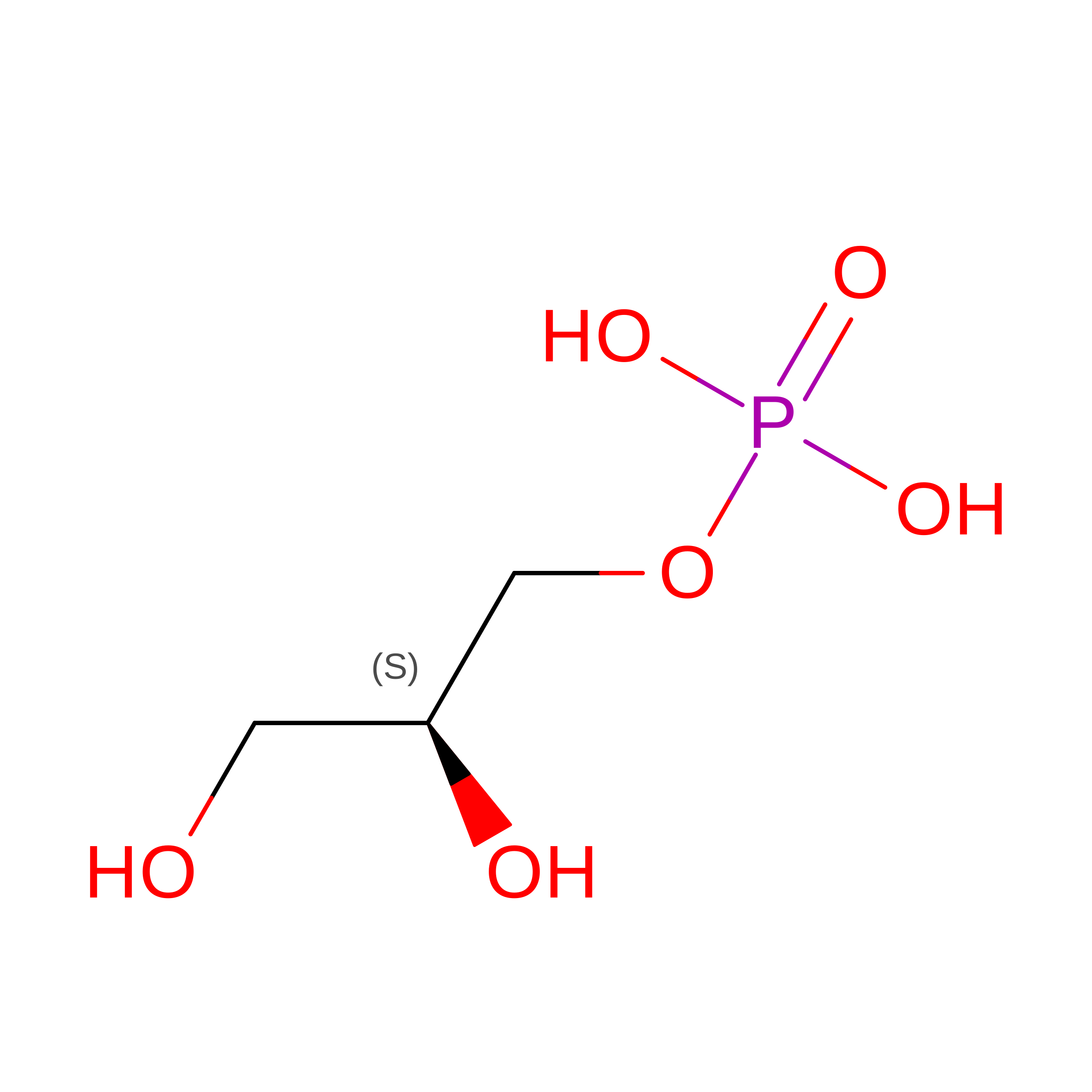
1GP
(Subject of Investigation/LOI)

Query on 1GP


Download:Ideal Coordinates CCD File
B [auth A]SN-GLYCEROL-1-PHOSPHATE
C3 H9 O6 P
AWUCVROLDVIAJX-VKHMYHEASA-N

Experimental Data & Validation

Experimental Data

  • Method: X-RAY DIFFRACTION
  • Resolution: 2.35 Å
  • R-Value Free:  0.223 (Depositor), 0.225 (DCC) 
  • R-Value Work:  0.199 (Depositor), 0.201 (DCC) 
  • R-Value Observed: 0.200 (Depositor) 
Space Group: P 65 2 2
Unit Cell:
Length ( Å )Angle ( ˚ )
a = 105.595α = 90
b = 105.595β = 90
c = 142.498γ = 120
Software Package:
Software NamePurpose
PHENIXrefinement
XDSdata reduction
XDSdata scaling
MOLREPphasing

Structure Validation

View Full Validation Report


Ligand Structure Quality Assessment 


Entry History 

& Funding Information

Deposition Data


Funding OrganizationLocationGrant Number
Ministry of Education, Culture, Sports, Science and Technology (Japan)Japan--

Revision History  (Full details and data files)

  • Version 1.0: 2019-04-03
    Type: Initial release
  • Version 1.1: 2019-05-15
    Changes: Data collection, Structure summary
  • Version 1.2: 2019-07-17
    Changes: Data collection, Database references
  • Version 1.3: 2019-11-20
    Changes: Database references
  • Version 1.4: 2023-11-22
    Changes: Data collection, Database references, Refinement description