6HON | pdb_00006hon

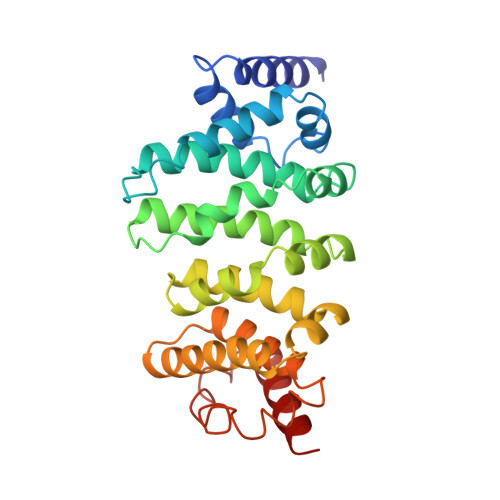
Drosophila NOT4 CBM peptide bound to human CAF40


Experimental Data Snapshot

  • Method: X-RAY DIFFRACTION
  • Resolution: 2.20 Å
  • R-Value Free: 
    0.230 (Depositor), 0.228 (DCC) 
  • R-Value Work: 
    0.193 (Depositor), 0.197 (DCC) 
  • R-Value Observed: 
    0.195 (Depositor) 

Starting Model: experimental
View more details

wwPDB Validation 3D Report Full Report

Validation slider image for 6HON

This is version 1.2 of the entry. See complete history

Literature

A conserved CAF40-binding motif in metazoan NOT4 mediates association with the CCR4-NOT complex.

Keskeny, C.Raisch, T.Sgromo, A.Igreja, C.Bhandari, D.Weichenrieder, O.Izaurralde, E.

(2019) Genes Dev 33: 236-252

  • DOI: https://doi.org/10.1101/gad.320952.118
  • Primary Citation Related Structures: 
    6HOM, 6HON

  • PubMed Abstract: 

    The multisubunit CCR4-NOT mRNA deadenylase complex plays important roles in the posttranscriptional regulation of gene expression. The NOT4 E3 ubiquitin ligase is a stable component of the CCR4-NOT complex in yeast but does not copurify with the human or Drosophila melanogaster complex. Here we show that the C-terminal regions of human and D. melanogaster NOT4 contain a conserved sequence motif that directly binds the CAF40 subunit of the CCR4-NOT complex (CAF40-binding motif [CBM]). In addition, nonconserved sequences flanking the CBM also contact other subunits of the complex. Crystal structures of the CBM-CAF40 complex reveal a mutually exclusive binding surface for NOT4 and Roquin or Bag of marbles mRNA regulatory proteins. Furthermore, CAF40 depletion or structure-guided mutagenesis to disrupt the NOT4-CAF40 interaction impairs the ability of NOT4 to elicit decay of tethered reporter mRNAs in cells. Together with additional sequence analyses, our results reveal the molecular basis for the association of metazoan NOT4 with the CCR4-NOT complex and show that it deviates substantially from yeast. They mark the NOT4 ubiquitin ligase as an ancient but nonconstitutive cofactor of the CCR4-NOT deadenylase with potential recruitment and/or effector functions.


  • Organizational Affiliation
    • Department of Biochemistry, Max Planck Institute for Developmental Biology, D-72076 Tübingen, Germany.

Macromolecule Content 

  • Total Structure Weight: 68.12 kDa 
  • Atom Count: 4,805 
  • Modeled Residue Count: 592 
  • Deposited Residue Count: 598 
  • Unique protein chains: 2

Macromolecules

Find similar proteins by:|  3D Structure
Entity ID: 1
MoleculeChains  Sequence LengthOrganismDetailsImage
CCR4-NOT transcription complex subunit 9
A, C
273Homo sapiensMutation(s): 0 
Gene Names: CNOT9RCD1RQCD1
UniProt & NIH Common Fund Data Resources
Find proteins for Q92600 (Homo sapiens)
Explore Q92600 
Go to UniProtKB:  Q92600
PHAROS:  Q92600
GTEx:  ENSG00000144580 
Entity Groups
Sequence Clusters30% Identity50% Identity70% Identity90% Identity95% Identity100% Identity
UniProt GroupQ92600
Sequence Annotations
Expand
Reference Sequence
Find similar proteins by:|  3D Structure
Entity ID: 2
MoleculeChains  Sequence LengthOrganismDetailsImage
CCR4-NOT transcription complex subunit 4, isoform L
B, D
26Drosophila melanogasterMutation(s): 0 
EC: 2.3.2.27
UniProt
Find proteins for M9PCL9 (Drosophila melanogaster)
Explore M9PCL9 
Go to UniProtKB:  M9PCL9
Entity Groups
Sequence Clusters30% Identity50% Identity70% Identity90% Identity95% Identity100% Identity
UniProt GroupM9PCL9
Sequence Annotations
Expand
Reference Sequence

Experimental Data & Validation

Experimental Data

  • Method: X-RAY DIFFRACTION
  • Resolution: 2.20 Å
  • R-Value Free:  0.230 (Depositor), 0.228 (DCC) 
  • R-Value Work:  0.193 (Depositor), 0.197 (DCC) 
  • R-Value Observed: 0.195 (Depositor) 
Space Group: I 21 21 21
Unit Cell:
Length ( Å )Angle ( ˚ )
a = 85.63α = 90
b = 90.32β = 90
c = 196.99γ = 90
Software Package:
Software NamePurpose
BUSTERrefinement
XDSdata reduction
XSCALEdata scaling
PHASERphasing

Structure Validation

View Full Validation Report


Entry History 

Deposition Data

Revision History  (Full details and data files)

  • Version 1.0: 2019-02-06
    Type: Initial release
  • Version 1.1: 2019-02-13
    Changes: Data collection, Database references
  • Version 1.2: 2024-01-24
    Changes: Data collection, Database references, Derived calculations, Refinement description