6ZYS | pdb_00006zys

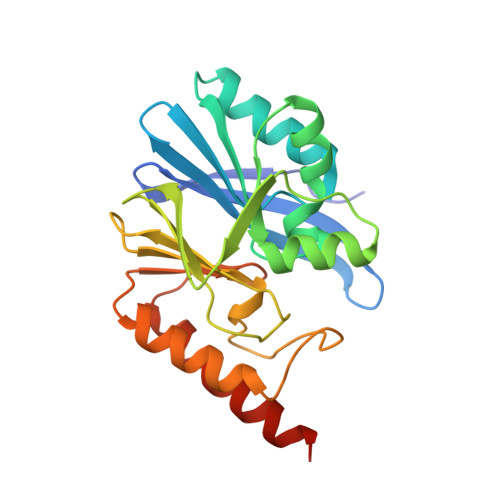
Structure of IMP-1 with 2-Mercaptomethyl-thiazolidine D-syn-1b


Experimental Data Snapshot

  • Method: X-RAY DIFFRACTION
  • Resolution: 1.87 Å
  • R-Value Free: 
    0.201 (Depositor), 0.206 (DCC) 
  • R-Value Work: 
    0.174 (Depositor), 0.180 (DCC) 
  • R-Value Observed: 
    0.175 (Depositor) 

Starting Model: experimental
View more details

wwPDB Validation 3D Report Full Report

Validation slider image for 6ZYS

Ligand Structure Quality Assessment 


This is version 1.2 of the entry. See complete history

Literature

2-Mercaptomethyl-thiazolidines use conserved aromatic-S interactions to achieve broad-range inhibition of metallo-beta-lactamases.

Rossi, M.A.Martinez, V.Hinchliffe, P.Mojica, M.F.Castillo, V.Moreno, D.M.Smith, R.Spellberg, B.Drusano, G.L.Banchio, C.Bonomo, R.A.Spencer, J.Vila, A.J.Mahler, G.

(2021) Chem Sci 12: 2898-2908

  • DOI: https://doi.org/10.1039/d0sc05172a
  • Primary Citation Related Structures: 
    6ZYN, 6ZYO, 6ZYP, 6ZYQ, 6ZYR, 6ZYS

  • PubMed Abstract: 

    Infections caused by multidrug resistant (MDR) bacteria are a major public health threat. Carbapenems are among the most potent antimicrobial agents that are commercially available to treat MDR bacteria. Bacterial production of carbapenem-hydrolysing metallo-β-lactamases (MBLs) challenges their safety and efficacy, with subclass B1 MBLs hydrolysing almost all β-lactam antibiotics. MBL inhibitors would fulfil an urgent clinical need by prolonging the lifetime of these life-saving drugs. Here we report the synthesis and activity of a series of 2-mercaptomethyl-thiazolidines (MMTZs), designed to replicate MBL interactions with reaction intermediates or hydrolysis products. MMTZs are potent competitive inhibitors of B1 MBLs in vitro ( e.g. , K i = 0.44 μM vs. NDM-1). Crystal structures of MMTZ complexes reveal similar binding patterns to the most clinically important B1 MBLs (NDM-1, VIM-2 and IMP-1), contrasting with previously studied thiol-based MBL inhibitors, such as bisthiazolidines (BTZs) or captopril stereoisomers, which exhibit lower, more variable potencies and multiple binding modes. MMTZ binding involves thiol coordination to the Zn(ii) site and extensive hydrophobic interactions, burying the inhibitor more deeply within the active site than d/l-captopril. Unexpectedly, MMTZ binding features a thioether-π interaction with a conserved active-site aromatic residue, consistent with their equipotent inhibition and similar binding to multiple MBLs. MMTZs penetrate multiple Enterobacterales, inhibit NDM-1 in situ , and restore carbapenem potency against clinical isolates expressing B1 MBLs. Based on their inhibitory profile and lack of eukaryotic cell toxicity, MMTZs represent a promising scaffold for MBL inhibitor development. These results also suggest sulphur-π interactions can be exploited for general ligand design in medicinal chemistry.


  • Organizational Affiliation
    • Instituto de Biología Molecular y Celular de Rosario (IBR, CONICET-UNR) Ocampo and Esmeralda S2002LRK Rosario Argentina vila@ibr-conicet.gov.ar.

Macromolecule Content 

  • Total Structure Weight: 103.03 kDa 
  • Atom Count: 7,450 
  • Modeled Residue Count: 878 
  • Deposited Residue Count: 920 
  • Unique protein chains: 1

Macromolecules

Find similar proteins by:|  3D Structure
Entity ID: 1
MoleculeChains  Sequence LengthOrganismDetailsImage
Beta-lactamase IMP-1
A, B, C, D
230Serratia marcescensMutation(s): 0 
EC: 3.5.2.6 (PDB Primary Data), 3.1.26 (UniProt)
UniProt
Find proteins for P52699 (Serratia marcescens)
Explore P52699 
Go to UniProtKB:  P52699
Entity Groups
Sequence Clusters30% Identity50% Identity70% Identity90% Identity95% Identity100% Identity
UniProt GroupP52699
Sequence Annotations
Expand
Reference Sequence

Small Molecules

Ligands 3 Unique
IDChains Name / Formula / InChI Key2D Diagram3D Interactions
QST
(Subject of Investigation/LOI)

Query on QST


Download:Ideal Coordinates CCD File
G [auth A],
J [auth B],
O [auth C],
S [auth D]
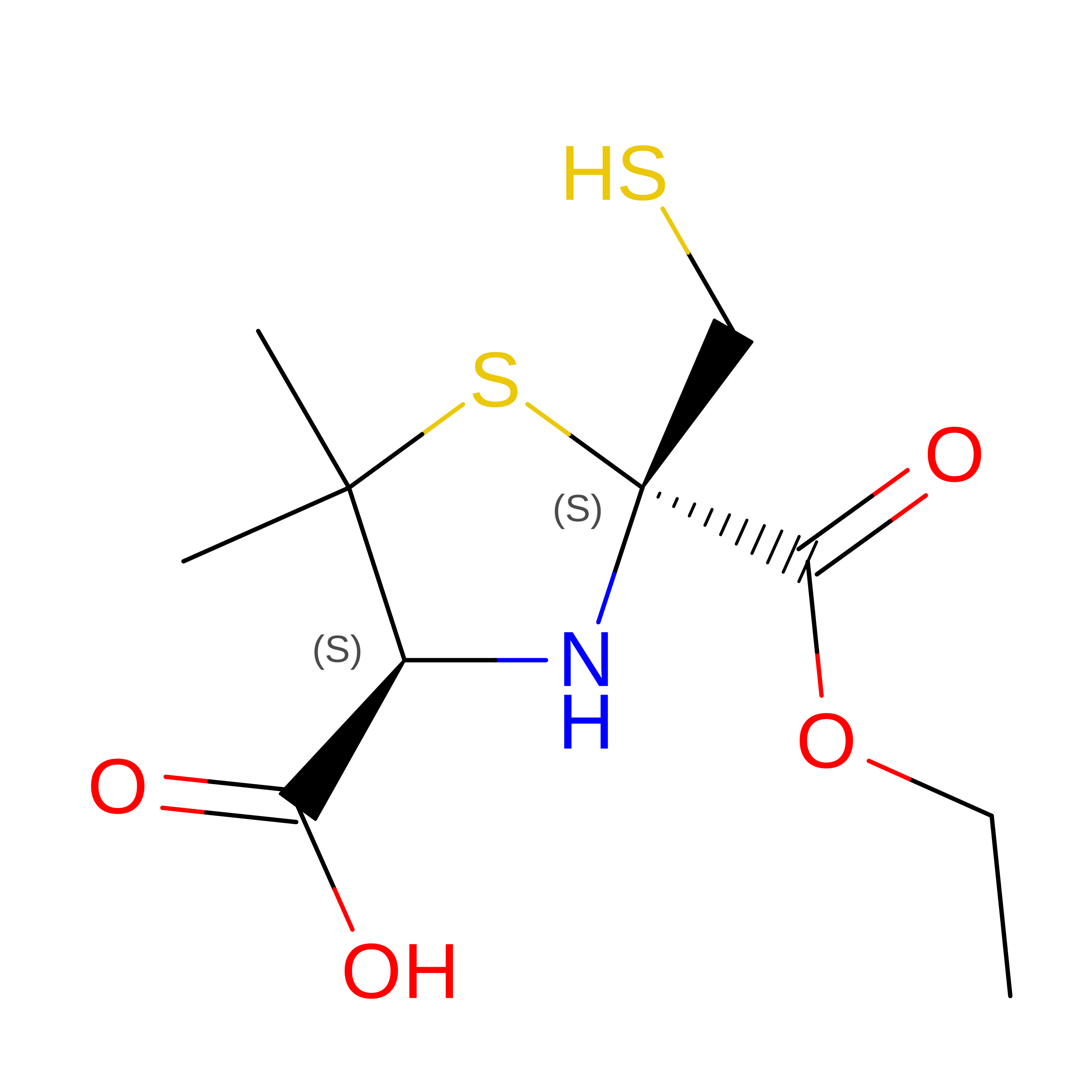
(2~{S},4~{S})-2-ethoxycarbonyl-5,5-dimethyl-2-(sulfanylmethyl)-1,3-thiazolidine-4-carboxylic acid
C10 H17 N O4 S2
PUOMKKVEJFJZFE-QUBYGPBYSA-N
ZN

Query on ZN


Download:Ideal Coordinates CCD File
E [auth A]
F [auth A]
H [auth B]
I [auth B]
M [auth C]
E [auth A],
F [auth A],
H [auth B],
I [auth B],
M [auth C],
N [auth C],
Q [auth D],
R [auth D]
ZINC ION
Zn
PTFCDOFLOPIGGS-UHFFFAOYSA-N
EDO

Query on EDO


Download:Ideal Coordinates CCD File
K [auth B],
L [auth B],
P [auth C]
1,2-ETHANEDIOL
C2 H6 O2
LYCAIKOWRPUZTN-UHFFFAOYSA-N

Experimental Data & Validation

Experimental Data

  • Method: X-RAY DIFFRACTION
  • Resolution: 1.87 Å
  • R-Value Free:  0.201 (Depositor), 0.206 (DCC) 
  • R-Value Work:  0.174 (Depositor), 0.180 (DCC) 
  • R-Value Observed: 0.175 (Depositor) 
Space Group: P 21 21 21
Unit Cell:
Length ( Å )Angle ( ˚ )
a = 48.7824α = 90
b = 77.9686β = 90
c = 261.906γ = 90
Software Package:
Software NamePurpose
PHENIXrefinement
DIALSdata reduction
Aimlessdata scaling
PHASERphasing

Structure Validation

View Full Validation Report


Ligand Structure Quality Assessment 


Entry History 

& Funding Information

Deposition Data


Funding OrganizationLocationGrant Number
National Institutes of Health/National Institute Of Allergy and Infectious Diseases (NIH/NIAID)United StatesR01AI100560

Revision History  (Full details and data files)

  • Version 1.0: 2021-01-20
    Type: Initial release
  • Version 1.1: 2021-07-07
    Changes: Database references
  • Version 1.2: 2024-01-31
    Changes: Data collection, Database references, Refinement description