Download Mendeley
HSP40 proteins use class-specific regulation to drive HSP70 functional diversity.
Faust, O., Abayev-Avraham, M., Wentink, A.S., Maurer, M., Nillegoda, N.B., London, N., Bukau, B., Rosenzweig, R.(2020) Nature 587: 489-494
- PubMed: 33177718 Search on PubMedSearch on PubMed Central
- DOI: https://doi.org/10.1038/s41586-020-2906-4
- Primary Citation Related Structures:
6Z5N - PubMed Abstract:
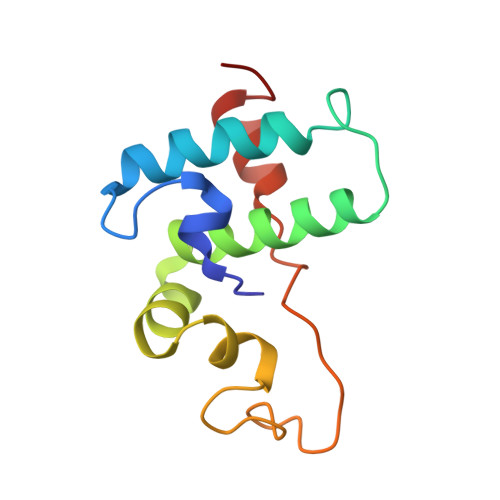
The ubiquitous heat shock protein 70 (HSP70) family consists of ATP-dependent molecular chaperones, which perform numerous cellular functions that affect almost all aspects of the protein life cycle from synthesis to degradation 1-3 . Achieving this broad spectrum of functions requires precise regulation of HSP70 activity. Proteins of the HSP40 family, also known as J-domain proteins (JDPs), have a key role in this process by preselecting substrates for transfer to their HSP70 partners and by stimulating the ATP hydrolysis of HSP70, leading to stable substrate binding 3,4 . In humans, JDPs constitute a large and diverse family with more than 40 different members 2 , which vary in their substrate selectivity and in the nature and number of their client-binding domains 5 . Here we show that JDPs can also differ fundamentally in their interactions with HSP70 chaperones. Using nuclear magnetic resonance spectroscopy 6,7 we find that the major class B JDPs are regulated by an autoinhibitory mechanism that is not present in other classes. Although in all JDPs the interaction of the characteristic J-domain is responsible for the activation of HSP70, in DNAJB1 the HSP70-binding sites in this domain are intrinsically blocked by an adjacent glycine-phenylalanine rich region-an inhibition that can be released upon the interaction of a second site on DNAJB1 with the HSP70 C-terminal tail. This regulation, which controls substrate targeting to HSP70, is essential for the disaggregation of amyloid fibres by HSP70-DNAJB1, illustrating why no other class of JDPs can substitute for class B in this function. Moreover, this regulatory layer, which governs the functional specificities of JDP co-chaperones and their interactions with HSP70s, could be key to the wide range of cellular functions of HSP70.
- Department of Structural Biology, Weizmann Institute of Science, Rehovot, Israel.
Organizational Affiliation: