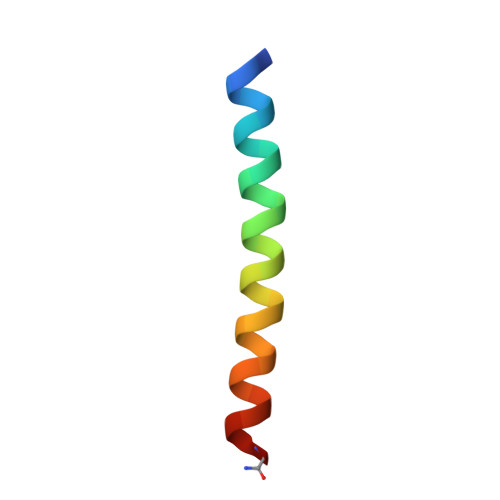
6YB2 | pdb_00006yb2

Crystal structure of a parallel hexameric coiled coil CC-Type2-(TaId)2

  • Classification: DE NOVO PROTEIN
  • Organism(s): synthetic construct
  • Mutation(s): No 

  • Deposited: 2020-03-15 Released: 2021-04-07 
  • Deposition Author(s): Scott, A.J., Brady, R.L., Woolfson, D.N.
  • Funding Organization(s): Engineering and Physical Sciences Research Council, European Research Council (ERC), Biotechnology and Biological Sciences Research Council (BBSRC)

Experimental Data Snapshot

  • Method: X-RAY DIFFRACTION
  • Resolution: 1.18 Å
  • R-Value Free: 
    0.191 (Depositor), 0.193 (DCC) 
  • R-Value Work: 
    0.159 (Depositor), 0.162 (DCC) 
  • R-Value Observed: 
    0.161 (Depositor) 

Starting Model: other
View more details

wwPDB Validation 3D Report Full Report

Validation slider image for 6YB2

This is version 1.4 of the entry. See complete history

Literature

Constructing ion channels from water-soluble alpha-helical barrels.

Scott, A.J.Niitsu, A.Kratochvil, H.T.Lang, E.J.M.Sengel, J.T.Dawson, W.M.Mahendran, K.R.Mravic, M.Thomson, A.R.Brady, R.L.Liu, L.Mulholland, A.J.Bayley, H.DeGrado, W.F.Wallace, M.I.Woolfson, D.N.

(2021) Nat Chem 13: 643-650

  • DOI: https://doi.org/10.1038/s41557-021-00688-0
  • Primary Citation Related Structures: 
    6YAZ, 6YB0, 6YB1, 6YB2

  • PubMed Abstract: 

    The design of peptides that assemble in membranes to form functional ion channels is challenging. Specifically, hydrophobic interactions must be designed between the peptides and at the peptide-lipid interfaces simultaneously. Here, we take a multi-step approach towards this problem. First, we use rational de novo design to generate water-soluble α-helical barrels with polar interiors, and confirm their structures using high-resolution X-ray crystallography. These α-helical barrels have water-filled lumens like those of transmembrane channels. Next, we modify the sequences to facilitate their insertion into lipid bilayers. Single-channel electrical recordings and fluorescent imaging of the peptides in membranes show monodisperse, cation-selective channels of unitary conductance. Surprisingly, however, an X-ray structure solved from the lipidic cubic phase for one peptide reveals an alternative state with tightly packed helices and a constricted channel. To reconcile these observations, we perform computational analyses to compare the properties of possible different states of the peptide.


  • Organizational Affiliation
    • School of Chemistry, University of Bristol, Bristol, UK.

Macromolecule Content 

  • Total Structure Weight: 19.45 kDa 
  • Atom Count: 1,598 
  • Modeled Residue Count: 192 
  • Deposited Residue Count: 192 
  • Unique protein chains: 1

Macromolecules

Find similar proteins by:|  3D Structure
Entity ID: 1
MoleculeChains  Sequence LengthOrganismDetailsImage
CC-Type2-(TaId)2
A, B, C, D, E
A, B, C, D, E, F
32synthetic constructMutation(s): 0 

Experimental Data & Validation

Experimental Data

  • Method: X-RAY DIFFRACTION
  • Resolution: 1.18 Å
  • R-Value Free:  0.191 (Depositor), 0.193 (DCC) 
  • R-Value Work:  0.159 (Depositor), 0.162 (DCC) 
  • R-Value Observed: 0.161 (Depositor) 
Space Group: P 21 21 21
Unit Cell:
Length ( Å )Angle ( ˚ )
a = 31.01α = 90
b = 55.99β = 90
c = 90.63γ = 90
Software Package:
Software NamePurpose
PHENIXrefinement
xia2data reduction
Aimlessdata scaling
DIALSdata reduction
PHENIXphasing

Structure Validation

View Full Validation Report


Entry History 

& Funding Information

Deposition Data


Funding OrganizationLocationGrant Number
Engineering and Physical Sciences Research CouncilUnited KingdomEP/G036764/1
European Research Council (ERC)United Kingdom340764
European Research Council (ERC)United Kingdom787173
Biotechnology and Biological Sciences Research Council (BBSRC)United KingdomBB/J009784/1

Revision History  (Full details and data files)

  • Version 1.0: 2021-04-07
    Type: Initial release
  • Version 1.1: 2021-05-26
    Changes: Database references
  • Version 1.2: 2021-07-14
    Changes: Database references
  • Version 1.3: 2024-05-01
    Changes: Data collection, Database references, Refinement description
  • Version 1.4: 2024-10-09
    Changes: Structure summary