6XTV | pdb_00006xtv

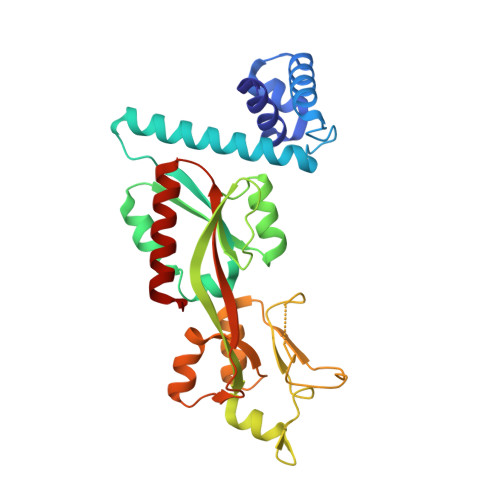
FULL-LENGTH LTTR LYSG FROM CORYNEBACTERIUM GLUTAMICUM WITH BOUND EFFECTOR ARG


Experimental Data Snapshot

  • Method: X-RAY DIFFRACTION
  • Resolution: 3.30 Å
  • R-Value Free: 
    0.251 (Depositor) 
  • R-Value Work: 
    0.206 (Depositor) 

Starting Model: experimental
View more details

wwPDB Validation 3D Report Full Report

Validation slider image for 6XTV

Ligand Structure Quality Assessment 


This is version 1.1 of the entry. See complete history

Literature

Engineering and application of a biosensor with focused ligand specificity.

Della Corte, D.van Beek, H.L.Syberg, F.Schallmey, M.Tobola, F.Cormann, K.U.Schlicker, C.Baumann, P.T.Krumbach, K.Sokolowsky, S.Morris, C.J.Grunberger, A.Hofmann, E.Schroder, G.F.Marienhagen, J.

(2020) Nat Commun 11: 4851-4851

  • DOI: https://doi.org/10.1038/s41467-020-18400-0
  • Primary Citation Related Structures: 
    6XTU, 6XTV

  • PubMed Abstract: 

    Cell factories converting bio-based precursors to chemicals present an attractive avenue to a sustainable economy, yet screening of genetically diverse strain libraries to identify the best-performing whole-cell biocatalysts is a low-throughput endeavor. For this reason, transcriptional biosensors attract attention as they allow the screening of vast libraries when used in combination with fluorescence-activated cell sorting (FACS). However, broad ligand specificity of transcriptional regulators (TRs) often prohibits the development of such ultra-high-throughput screens. Here, we solve the structure of the TR LysG of Corynebacterium glutamicum, which detects all three basic amino acids. Based on this information, we follow a semi-rational engineering approach using a FACS-based screening/counterscreening strategy to generate an L-lysine insensitive LysG-based biosensor. This biosensor can be used to isolate L-histidine-producing strains by FACS, showing that TR engineering towards a more focused ligand spectrum can expand the scope of application of such metabolite sensors.


  • Organizational Affiliation
    • Institute of Biological Information Processing, IBI-7: Structural Biochemistry, Forschungszentrum Jülich, D-52425, Jülich, Germany.

Macromolecule Content 

  • Total Structure Weight: 63.02 kDa 
  • Atom Count: 4,383 
  • Modeled Residue Count: 575 
  • Deposited Residue Count: 580 
  • Unique protein chains: 1

Macromolecules

Find similar proteins by:|  3D Structure
Entity ID: 1
MoleculeChains  Sequence LengthOrganismDetailsImage
Lysine export transcriptional regulatory protein LysG
A, B
290Corynebacterium glutamicum MB001Mutation(s): 0 
Gene Names: lysGCgl1263cg1425
UniProt
Find proteins for P94632 (Corynebacterium glutamicum (strain ATCC 13032 / DSM 20300 / JCM 1318 / BCRC 11384 / CCUG 27702 / LMG 3730 / NBRC 12168 / NCIMB 10025 / NRRL B-2784 / 534))
Explore P94632 
Go to UniProtKB:  P94632
Entity Groups
Sequence Clusters30% Identity50% Identity70% Identity90% Identity95% Identity100% Identity
UniProt GroupP94632
Sequence Annotations
Expand
Reference Sequence

Small Molecules

Ligands 1 Unique
IDChains Name / Formula / InChI Key2D Diagram3D Interactions
ARG
(Subject of Investigation/LOI)

Query on ARG


Download:Ideal Coordinates CCD File
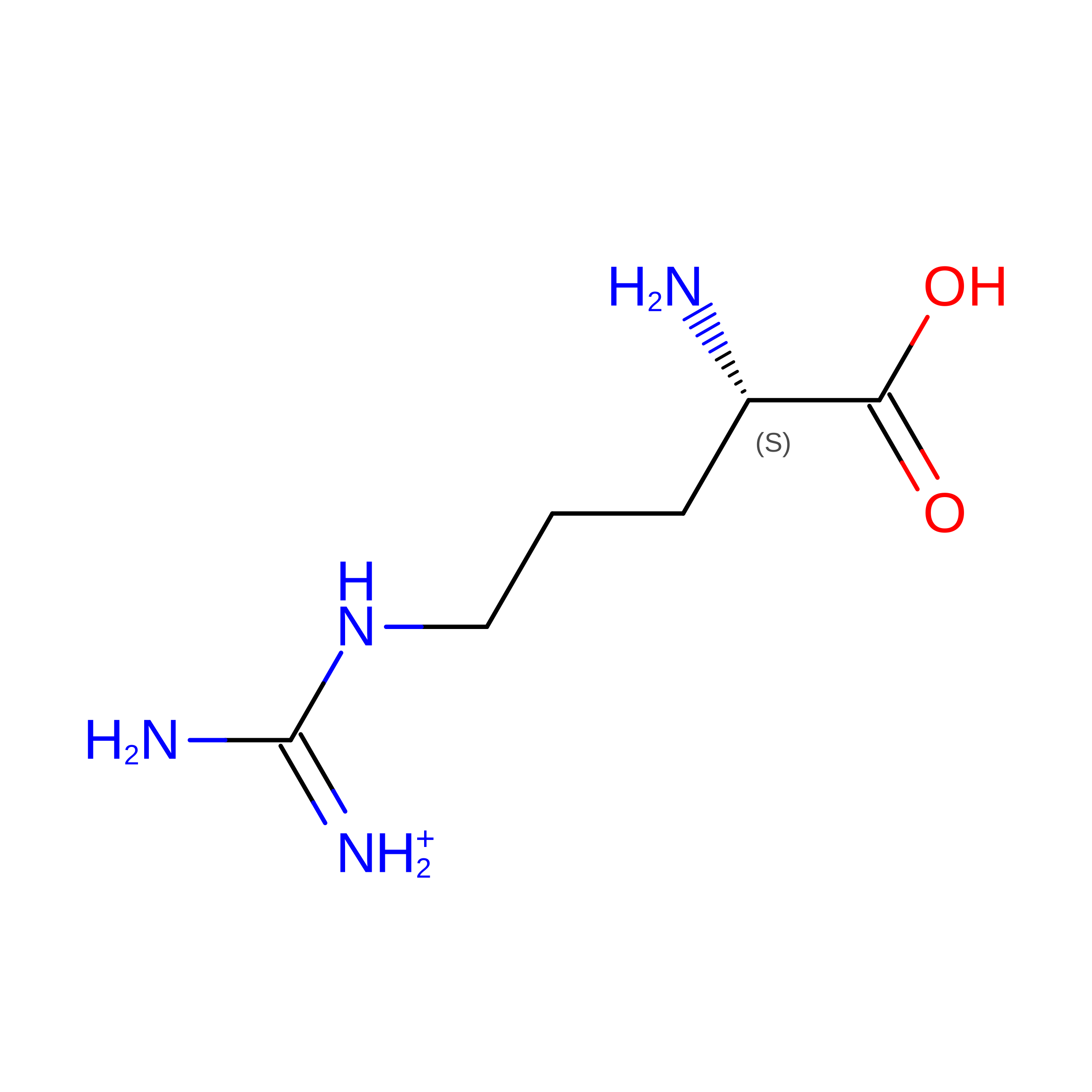
C [auth B]ARGININE
C6 H15 N4 O2
ODKSFYDXXFIFQN-BYPYZUCNSA-O

Experimental Data & Validation

Experimental Data

  • Method: X-RAY DIFFRACTION
  • Resolution: 3.30 Å
  • R-Value Free:  0.251 (Depositor) 
  • R-Value Work:  0.206 (Depositor) 
Space Group: P 41 21 2
Unit Cell:
Length ( Å )Angle ( ˚ )
a = 123.95α = 90
b = 123.95β = 90
c = 111.35γ = 90
Software Package:
Software NamePurpose
PHENIXrefinement
PHENIXrefinement
XDSdata reduction
XSCALEdata scaling
PHENIXphasing

Structure Validation

View Full Validation Report


Ligand Structure Quality Assessment 


Entry History 

& Funding Information

Deposition Data


Funding OrganizationLocationGrant Number
German Federal Ministry for Education and ResearchGermanyFlexFit

Revision History  (Full details and data files)

  • Version 1.0: 2020-10-07
    Type: Initial release
  • Version 1.1: 2024-01-24
    Changes: Data collection, Database references, Refinement description