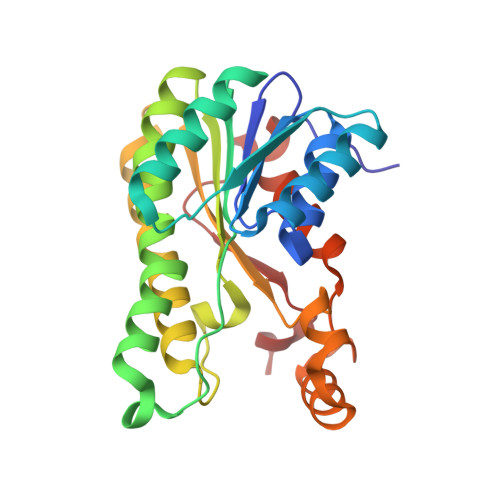
6XNB | pdb_00006xnb

The Crystal Structure of the S154Y Mutant Carbonyl Reductase from Leifsonia xyli Explains Enhanced Activity for 3,5-Bis(trifluoromethyl)acetophenone Reduction


Experimental Data Snapshot

  • Method: X-RAY DIFFRACTION
  • Resolution: 1.16 Å
  • R-Value Free: 
    0.175 (Depositor), 0.172 (DCC) 
  • R-Value Work: 
    0.162 (Depositor), 0.161 (DCC) 
  • R-Value Observed: 
    0.162 (Depositor) 

Starting Model: experimental
View more details

wwPDB Validation 3D Report Full Report

Validation slider image for 6XNB

This is version 1.5 of the entry. See complete history

Literature

The crystal structure of the S154Y mutant carbonyl reductase from Leifsonia xyli explains enhanced activity for 3,5-bis(trifluoromethyl)acetophenone reduction.

Li, J.Dinh, T.Phillips, R.

(2022) Arch Biochem Biophys 720: 109158-109158

  • DOI: https://doi.org/10.1016/j.abb.2022.109158
  • Primary Citation Related Structures: 
    6XNB

  • PubMed Abstract: 

    Carbonyl reductase from Leifsonia xyli (LXCAR, UniProtKB - T2FLN4) can stereoselectively catalyze the reduction of 3,5-bis(trifluoromethyl)acetophenone (BTAP) to its corresponding alcohol, (R)-[3,5-bis(trifluoromethyl)phenyl]ethanol ((R)-BTPE), which is a valuable chiral intermediate for the synthesis of antiemetic drugs, Aprepitant and Fosaprepitant. Moreover, this protein was found to have a broad spectrum of substrate specificity and can asymmetrically catalyze the reduction of a variety of ketones and keto esters. Even though molecular modelling of this protein was done by Wang et al. (2014), a crystal structure has not yet obtained. In this study, a single mutant, S154Y, which was shown to have higher catalytic activity toward BTAP than that of the wild type, was overexpressed in Escherichia coli BL21 (DE3), purified, and crystallized. The crystal structure of LXCAR-S154Y explains how the mutant enzyme can work with BTAP more efficiently than wild type carbonyl reductase. Furthermore, the structure explains why LXCAR-S154Y can use either NADH or NADPH efficiently as a cofactor, as well as elucidates a proton relay system present in the enzyme.


  • Organizational Affiliation
    • School of Pharmacy, Hangzhou Medical College, Hangzhou, Zhejiang, 310053, PR China. Electronic address: lijun@hmc.edu.cn.

Macromolecule Content 

  • Total Structure Weight: 25.14 kDa 
  • Atom Count: 2,133 
  • Modeled Residue Count: 251 
  • Deposited Residue Count: 251 
  • Unique protein chains: 1

Macromolecules

Find similar proteins by:|  3D Structure
Entity ID: 1
MoleculeChains  Sequence LengthOrganismDetailsImage
Short chain alcohol dehydrogenase251Leifsonia xyliMutation(s): 1 
Gene Names: sdr
UniProt
Find proteins for T2FLN4 (Leifsonia xyli)
Explore T2FLN4 
Go to UniProtKB:  T2FLN4
Entity Groups
Sequence Clusters30% Identity50% Identity70% Identity90% Identity95% Identity100% Identity
UniProt GroupT2FLN4
Sequence Annotations
Expand
Reference Sequence

Experimental Data & Validation

Experimental Data

  • Method: X-RAY DIFFRACTION
  • Resolution: 1.16 Å
  • R-Value Free:  0.175 (Depositor), 0.172 (DCC) 
  • R-Value Work:  0.162 (Depositor), 0.161 (DCC) 
  • R-Value Observed: 0.162 (Depositor) 
Space Group: P 42 21 2
Unit Cell:
Length ( Å )Angle ( ˚ )
a = 59.16α = 90
b = 59.16β = 90
c = 118.92γ = 90
Software Package:
Software NamePurpose
PHENIXrefinement
XDSdata reduction
XSCALEdata scaling
PHASERphasing
PDB_EXTRACTdata extraction

Structure Validation

View Full Validation Report


Entry History 

Deposition Data

Revision History  (Full details and data files)

  • Version 1.0: 2020-08-12
    Type: Initial release
  • Version 1.1: 2020-09-02
    Changes: Database references
  • Version 1.2: 2022-03-02
    Changes: Database references
  • Version 1.3: 2022-03-23
    Changes: Database references
  • Version 1.4: 2022-03-30
    Changes: Database references
  • Version 1.5: 2023-10-18
    Changes: Data collection, Refinement description