6XCF | pdb_00006xcf

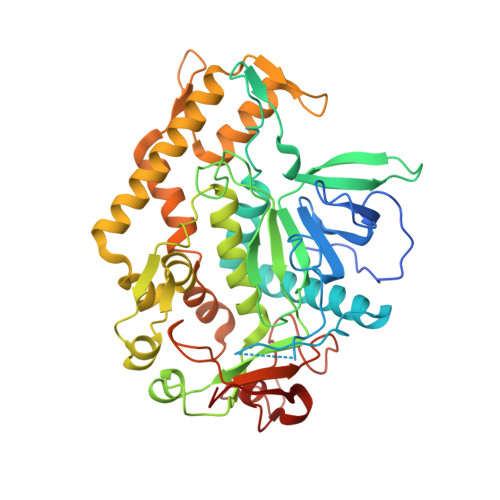
Structure of the C. botulinum neurotoxin serotype A light chain protease in complex with noncovalent inhibitor 59


Experimental Data Snapshot

  • Method: X-RAY DIFFRACTION
  • Resolution: 1.68 Å
  • R-Value Free: 
    0.199 (Depositor), 0.200 (DCC) 
  • R-Value Work: 
    0.159 (Depositor), 0.160 (DCC) 
  • R-Value Observed: 
    0.161 (Depositor) 

Starting Model: experimental
View more details

wwPDB Validation 3D Report Full Report

Validation slider image for 6XCF

Ligand Structure Quality Assessment 


This is version 1.4 of the entry. See complete history

Literature

Catch and Anchor Approach To Combat Both Toxicity and Longevity of Botulinum Toxin A.

Lin, L.Olson, M.E.Sugane, T.Turner, L.D.Tararina, M.A.Nielsen, A.L.Kurbanov, E.K.Pellett, S.Johnson, E.A.Cohen, S.M.Allen, K.N.Janda, K.D.

(2020) J Med Chem 63: 11100-11120

  • DOI: https://doi.org/10.1021/acs.jmedchem.0c01006
  • Primary Citation Related Structures: 
    6XCB, 6XCC, 6XCD, 6XCE, 6XCF

  • PubMed Abstract: 

    Botulinum neurotoxins have remarkable persistence (∼weeks to months in cells), outlasting the small-molecule inhibitors designed to target them. To address this disconnect, inhibitors bearing two pharmacophores-a zinc binding group and a Cys-reactive warhead-were designed to leverage both affinity and reactivity. A series of first-generation bifunctional inhibitors was achieved through structure-based inhibitor design. Through X-ray crystallography, engagement of both the catalytic Zn 2+ and Cys165 was confirmed. A second-generation series improved on affinity by incorporating known reversible inhibitor pharmacophores; the mechanism was confirmed by exhaustive dialysis, mass spectrometry, and in vitro evaluation against the C165S mutant. Finally, a third-generation inhibitor was shown to have good cellular activity and low toxicity. In addition to our findings, an alternative method of modeling time-dependent inhibition that simplifies assay setup and allows comparison of inhibition models is discussed.


  • Organizational Affiliation
    • Program in Biomolecular Pharmacology, Boston University School of Medicine, Boston, Massachusetts 02118, United States.

Macromolecule Content 

  • Total Structure Weight: 50.88 kDa 
  • Atom Count: 3,699 
  • Modeled Residue Count: 417 
  • Deposited Residue Count: 440 
  • Unique protein chains: 1

Macromolecules

Find similar proteins by:|  3D Structure
Entity ID: 1
MoleculeChains  Sequence LengthOrganismDetailsImage
Botulinum neurotoxin type A440Clostridium botulinumMutation(s): 0 
Gene Names: botAatxbonT
EC: 3.4.24.69
UniProt
Find proteins for P0DPI0 (Clostridium botulinum)
Explore P0DPI0 
Go to UniProtKB:  P0DPI0
Entity Groups
Sequence Clusters30% Identity50% Identity70% Identity90% Identity95% Identity100% Identity
UniProt GroupP0DPI0
Sequence Annotations
Expand
Reference Sequence

Small Molecules

Ligands 2 Unique
IDChains Name / Formula / InChI Key2D Diagram3D Interactions
UZP
(Subject of Investigation/LOI)

Query on UZP


Download:Ideal Coordinates CCD File
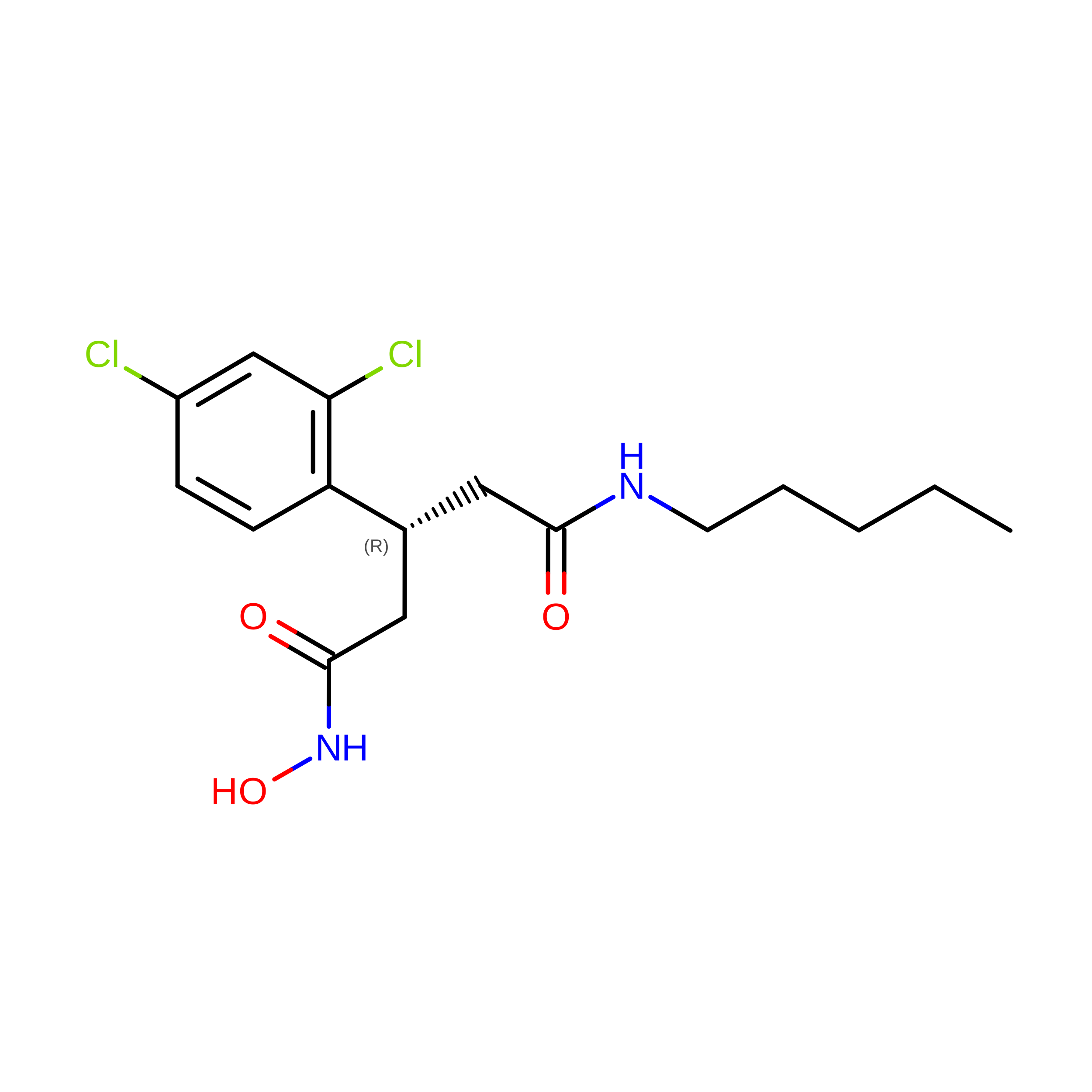
B [auth A](3R)-3-(2,4-dichlorophenyl)-N~1~-hydroxy-N~5~-pentylpentanediamide
C16 H22 Cl2 N2 O3
FHIDAHOTTVOIDA-LLVKDONJSA-N
ZN

Query on ZN


Download:Ideal Coordinates CCD File
C [auth A]ZINC ION
Zn
PTFCDOFLOPIGGS-UHFFFAOYSA-N

Experimental Data & Validation

Experimental Data

  • Method: X-RAY DIFFRACTION
  • Resolution: 1.68 Å
  • R-Value Free:  0.199 (Depositor), 0.200 (DCC) 
  • R-Value Work:  0.159 (Depositor), 0.160 (DCC) 
  • R-Value Observed: 0.161 (Depositor) 
Space Group: P 1 21 1
Unit Cell:
Length ( Å )Angle ( ˚ )
a = 49.339α = 90
b = 66.245β = 98.524
c = 64.057γ = 90
Software Package:
Software NamePurpose
PHENIXrefinement
HKL-2000data reduction
HKL-2000data scaling
PHENIXphasing

Structure Validation

View Full Validation Report


Ligand Structure Quality Assessment 


Entry History 

& Funding Information

Deposition Data


Funding OrganizationLocationGrant Number
National Institutes of Health/National Institute Of Allergy and Infectious Diseases (NIH/NIAID)United StatesR01AI119564

Revision History  (Full details and data files)

  • Version 1.0: 2020-09-23
    Type: Initial release
  • Version 1.1: 2020-09-30
    Changes: Database references
  • Version 1.2: 2020-10-21
    Changes: Database references
  • Version 1.3: 2021-06-09
    Changes: Database references
  • Version 1.4: 2023-10-18
    Changes: Advisory, Data collection, Database references, Refinement description