6WZM | pdb_00006wzm

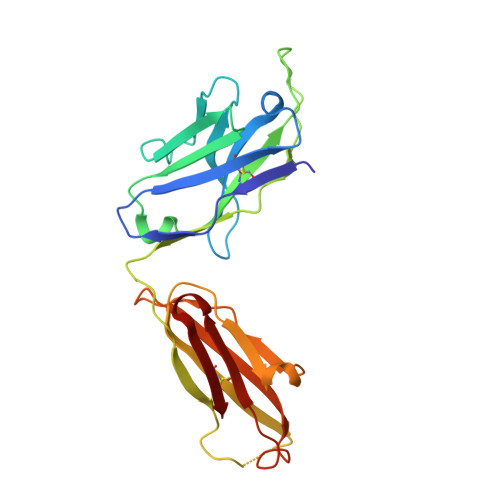
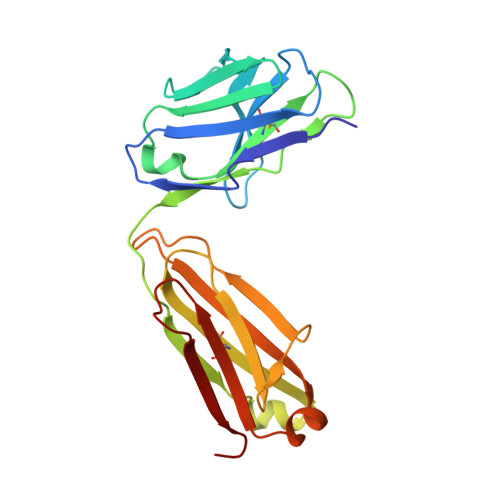
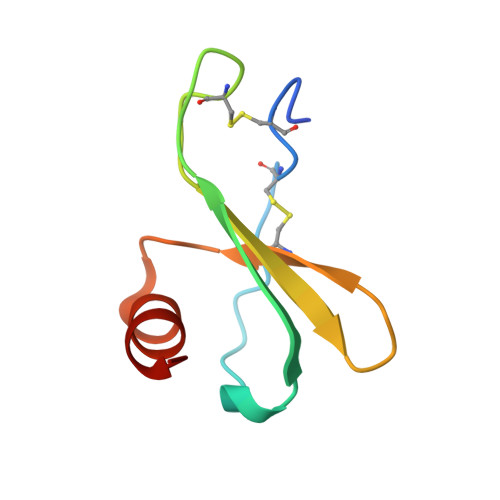
LY3041658 Fab bound to CXCL8


Experimental Data Snapshot

  • Method: X-RAY DIFFRACTION
  • Resolution: 2.28 Å
  • R-Value Free: 
    0.229 (Depositor), 0.232 (DCC) 
  • R-Value Work: 
    0.187 (Depositor) 
  • R-Value Observed: 
    0.189 (Depositor) 

Starting Model: other
View more details

wwPDB Validation 3D Report Full Report

Validation slider image for 6WZM

This is version 1.2 of the entry. See complete history

Literature

Discovery and characterization of a neutralizing pan-ELR+CXC chemokine monoclonal antibody.

Boyles, J.S.Beidler, C.B.Strifler, B.A.Girard, D.S.Druzina, Z.Durbin, J.D.Swearingen, M.L.Lee, L.N.Kikly, K.Chintharlapalli, S.Witcher, D.R.

(null) MAbs 12: 1831880-1831880

  • DOI: https://doi.org/10.1080/19420862.2020.1831880
  • Primary Citation Related Structures: 
    6WZJ, 6WZK, 6WZL, 6WZM

  • PubMed Abstract: 

    CXCR1 and CXCR2 signaling play a critical role in neutrophil migration, angiogenesis, and tumorigenesis and are therefore an attractive signaling axis to target in a variety of indications. In human, a total of seven chemokines signal through these receptors and comprise the ELR + CXC chemokine family, so named because of the conserved ELRCXC N-terminal motif. To fully antagonize CXCR1 and CXCR2 signaling, an effective therapeutic should block either both receptors or all seven ligands, yet neither approach has been fully realized clinically. In this work, we describe the generation and characterization of LY3041658, a humanized monoclonal antibody that binds and neutralizes all seven human and cynomolgus monkey ELR + CXC chemokines and three of five mouse and rat ELR + CXC chemokines with high affinity. LY3041658 is able to block ELR + CXC chemokine-induced Ca 2+ mobilization, CXCR2 internalization, and chemotaxis in vitro as well as neutrophil mobilization in vivo without affecting other neutrophil functions. In addition to the in vitro and in vivo activity, we characterized the epitope and structural basis for binding in detail through alanine scanning, crystallography, and mutagenesis. Together, these data provide a robust preclinical characterization of LY3041658 for which the efficacy and safety is being evaluated in human clinical trials for neutrophilic skin diseases.


  • Organizational Affiliation
    • Biotechnology Discovery Research, Lilly Research Laboratories, Eli Lilly and Company , Indianapolis, IN, USA.

Macromolecule Content 

  • Total Structure Weight: 111.06 kDa 
  • Atom Count: 8,171 
  • Modeled Residue Count: 1,001 
  • Deposited Residue Count: 1,008 
  • Unique protein chains: 3

Macromolecules

Find similar proteins by:|  3D Structure
Entity ID: 1
MoleculeChains  Sequence LengthOrganismDetailsImage
LY3041658 Fab heavy chain
A, C
224Homo sapiensMutation(s): 0 
Find similar proteins by:|  3D Structure
Entity ID: 2
MoleculeChains  Sequence LengthOrganismDetailsImage
LY3041658 Fab light chain
B, D
214Homo sapiensMutation(s): 0 
Find similar proteins by:|  3D Structure
Entity ID: 3
MoleculeChains  Sequence LengthOrganismDetailsImage
Interleukin-8
E, F
66Homo sapiensMutation(s): 0 
Gene Names: CXCL8IL8
UniProt & NIH Common Fund Data Resources
Find proteins for P10145 (Homo sapiens)
Explore P10145 
Go to UniProtKB:  P10145
PHAROS:  P10145
GTEx:  ENSG00000169429 
Entity Groups
Sequence Clusters30% Identity50% Identity70% Identity90% Identity95% Identity100% Identity
UniProt GroupP10145
Sequence Annotations
Expand
Reference Sequence

Experimental Data & Validation

Experimental Data

  • Method: X-RAY DIFFRACTION
  • Resolution: 2.28 Å
  • R-Value Free:  0.229 (Depositor), 0.232 (DCC) 
  • R-Value Work:  0.187 (Depositor) 
  • R-Value Observed: 0.189 (Depositor) 
Space Group: P 21 21 21
Unit Cell:
Length ( Å )Angle ( ˚ )
a = 65.012α = 90
b = 103.629β = 90
c = 193.289γ = 90
Software Package:
Software NamePurpose
BUSTERrefinement
PDB_EXTRACTdata extraction
MOSFLMdata reduction
SCALAdata scaling
PHASERphasing

Structure Validation

View Full Validation Report


Entry History 

Deposition Data

Revision History  (Full details and data files)

  • Version 1.0: 2020-11-25
    Type: Initial release
  • Version 1.1: 2024-04-03
    Changes: Data collection, Database references, Refinement description
  • Version 1.2: 2024-10-30
    Changes: Structure summary