6WX6 | pdb_00006wx6

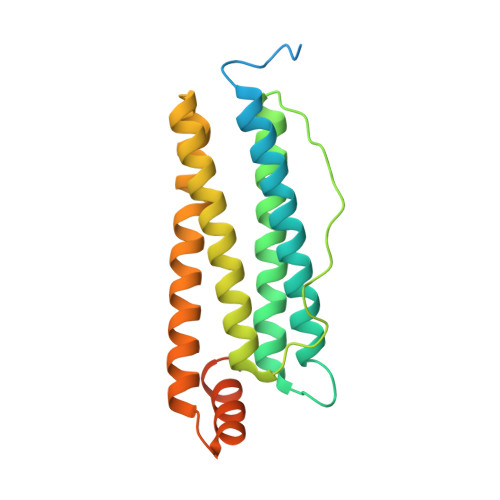
Cryo-EM Structure of Human Apoferritin Light Chain Vitrified Using Back-it-up

  • Classification: METAL BINDING PROTEIN
  • Organism(s): Homo sapiens
  • Expression System: Homo sapiens
  • Mutation(s): Yes 

  • Deposited: 2020-05-09 Released: 2020-05-20 
  • Deposition Author(s): Tan, Y.Z., Rubinstein, J.L.
  • Funding Organization(s): Canadian Institutes of Health Research (CIHR), Natural Sciences and Engineering Research Council (NSERC, Canada), Canada Excellence Research Chair Award

Experimental Data Snapshot

  • Method: ELECTRON MICROSCOPY
  • Resolution: 2.00 Å
  • Aggregation State: PARTICLE 
  • Reconstruction Method: SINGLE PARTICLE 

Starting Model: experimental
View more details

wwPDB Validation 3D Report Full Report

Validation slider image for 6WX6

This is version 1.3 of the entry. See complete history

Literature

Through-grid wicking enables high-speed cryoEM specimen preparation.

Tan, Y.Z.Rubinstein, J.L.

(2020) Acta Crystallogr D Struct Biol 76: 1092-1103

  • DOI: https://doi.org/10.1107/S2059798320012474
  • Primary Citation Related Structures: 
    6WX6, 6WXB

  • PubMed Abstract: 

    Blotting times for conventional cryoEM specimen preparation complicate time-resolved studies and lead to some specimens adopting preferred orientations or denaturing at the air-water interface. Here, it is shown that solution sprayed onto one side of a holey cryoEM grid can be wicked through the grid by a glass-fiber filter held against the opposite side, often called the `back', of the grid, producing a film suitable for vitrification. This process can be completed in tens of milliseconds. Ultrasonic specimen application and through-grid wicking were combined in a high-speed specimen-preparation device that was named `Back-it-up' or BIU. The high liquid-absorption capacity of the glass fiber compared with self-wicking grids makes the method relatively insensitive to the amount of sample applied. Consequently, through-grid wicking produces large areas of ice that are suitable for cryoEM for both soluble and detergent-solubilized protein complexes. The speed of the device increases the number of views for a specimen that suffers from preferred orientations.


  • Organizational Affiliation
    • Molecular Medicine Program, The Hospital for Sick Children, Toronto, Ontario, Canada.

Macromolecule Content 

  • Total Structure Weight: 582.94 kDa 
  • Atom Count: 35,668 
  • Modeled Residue Count: 4,128 
  • Deposited Residue Count: 5,448 
  • Unique protein chains: 1

Macromolecules

Find similar proteins by:|  3D Structure
Entity ID: 1
MoleculeChains  Sequence LengthOrganismDetailsImage
Ferritin light chain
A, B, C, D, E
A, B, C, D, E, F, G, H, I, J, K, L, M, N, O, P, Q, R, S, T, U, V, W, X
227Homo sapiensMutation(s): 1 
Gene Names: FTL
UniProt & NIH Common Fund Data Resources
Find proteins for P02792 (Homo sapiens)
Explore P02792 
Go to UniProtKB:  P02792
PHAROS:  P02792
GTEx:  ENSG00000087086 
Entity Groups
Sequence Clusters30% Identity50% Identity70% Identity90% Identity95% Identity100% Identity
UniProt GroupP02792
Sequence Annotations
Expand
Reference Sequence

Experimental Data & Validation

Experimental Data

  • Method: ELECTRON MICROSCOPY
  • Resolution: 2.00 Å
  • Aggregation State: PARTICLE 
  • Reconstruction Method: SINGLE PARTICLE 
EM Software:
TaskSoftware PackageVersion
RECONSTRUCTIONcryoSPARC2
MODEL REFINEMENTCoot0.8
MODEL REFINEMENTPHENIX1.17

Structure Validation

View Full Validation Report


Entry History 

& Funding Information

Deposition Data


Funding OrganizationLocationGrant Number
Canadian Institutes of Health Research (CIHR)Canada--
Natural Sciences and Engineering Research Council (NSERC, Canada)Canada--
Canada Excellence Research Chair AwardCanada--

Revision History  (Full details and data files)

  • Version 1.0: 2020-05-20
    Type: Initial release
  • Version 1.1: 2020-10-28
    Changes: Database references, Derived calculations
  • Version 1.2: 2020-11-18
    Changes: Database references
  • Version 1.3: 2024-03-06
    Changes: Data collection, Database references, Refinement description