6WQW | pdb_00006wqw

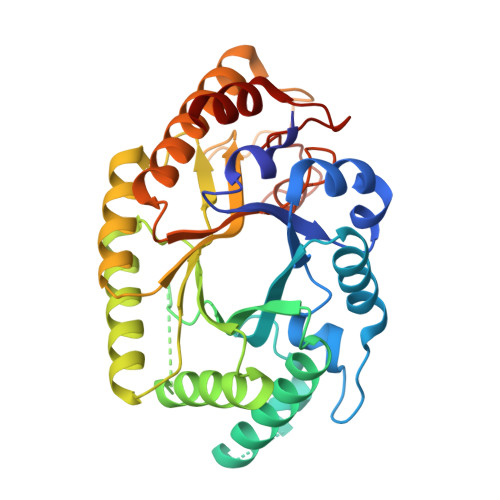
Thermobacillus composti GH10 xylanase


Experimental Data Snapshot

  • Method: X-RAY DIFFRACTION
  • Resolution: 2.10 Å
  • R-Value Free: 
    0.267 (Depositor), 0.267 (DCC) 
  • R-Value Work: 
    0.235 (Depositor), 0.238 (DCC) 
  • R-Value Observed: 
    0.236 (Depositor) 

Starting Model: experimental
View more details

wwPDB Validation 3D Report Full Report

Validation slider image for 6WQW

Ligand Structure Quality Assessment 


This is version 1.1 of the entry. See complete history

Literature

Transformation of xylan into value-added biocommodities using Thermobacillus composti GH10 xylanase.

Sepulchro, A.G.V.Pellegrini, V.O.A.Briganti, L.de Araujo, E.A.de Araujo, S.S.Polikarpov, I.

(2020) Carbohydr Polym 247: 116714-116714

  • DOI: https://doi.org/10.1016/j.carbpol.2020.116714
  • Primary Citation Related Structures: 
    6WQW

  • PubMed Abstract: 

    Enzymatic transformation of xylans into renewable fuels and value-added products is mediated by xylanases. Here we describe the biochemical and X-ray structural characterization of Thermobacillus composti GH10 xylanase (TcXyn10A) at 2.1 Å resolution aiming to unravel details of its recognition of glucurono- and arabinoxylan at a molecular level. TcXyn10A improves the efficiency of pretreated lignocellulosic biomass hydrolysis by a commercial enzyme cocktail causing a 15.35 % increase in xylose release and 4.38 % glucose release after 24 h of reaction. The enzyme releases predominantly xylobiose and xylotriose, as well as MeGlcA3 × 3 (from beechwood glucuronoxylan) and a range of decorated xylooligosaccharides (XOS) from rye arabinoxylan, with Ara2 × 2 being the major product. The enzyme liberates XOS with the yields of 29.09 % for beechwood glucuronoxylan and 16.98 % for rye arabinoxylan. Finally, TcXyn10A has a high thermal stability, halotolerance, and resistance to ethanol, biochemical properties that can be desirable for a number of industrial applications.


  • Organizational Affiliation
    • Instituto de Física de São Carlos, Universidade de São Paulo, Avenida Trabalhador São-carlense 400, 13566-590, São Carlos, SP, Brazil.

Macromolecule Content 

  • Total Structure Weight: 38.74 kDa 
  • Atom Count: 2,630 
  • Modeled Residue Count: 305 
  • Deposited Residue Count: 334 
  • Unique protein chains: 1

Macromolecules

Find similar proteins by:|  3D Structure
Entity ID: 1
MoleculeChains  Sequence LengthOrganismDetailsImage
Beta-xylanase334Thermobacillus compostiMutation(s): 0 
EC: 3.2.1.8
UniProt
Find proteins for L0EGW1 (Thermobacillus composti (strain DSM 18247 / JCM 13945 / KWC4))
Explore L0EGW1 
Go to UniProtKB:  L0EGW1
Entity Groups
Sequence Clusters30% Identity50% Identity70% Identity90% Identity95% Identity100% Identity
UniProt GroupL0EGW1
Sequence Annotations
Expand
Reference Sequence

Small Molecules

Ligands 1 Unique
IDChains Name / Formula / InChI Key2D Diagram3D Interactions
XYP
(Subject of Investigation/LOI)

Query on XYP


Download:Ideal Coordinates CCD File
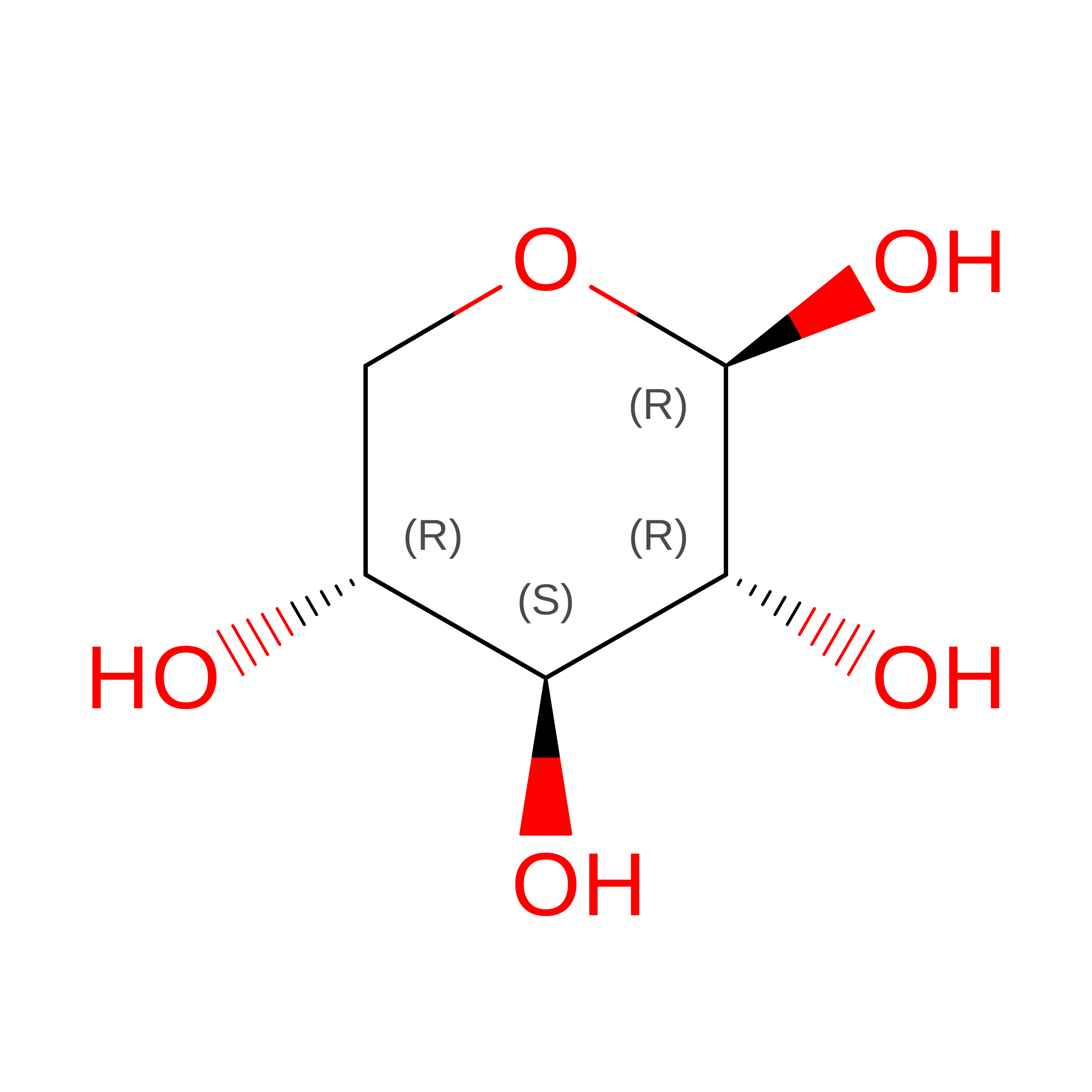
B [auth A]beta-D-xylopyranose
C5 H10 O5
SRBFZHDQGSBBOR-KKQCNMDGSA-N

Experimental Data & Validation

Experimental Data

  • Method: X-RAY DIFFRACTION
  • Resolution: 2.10 Å
  • R-Value Free:  0.267 (Depositor), 0.267 (DCC) 
  • R-Value Work:  0.235 (Depositor), 0.238 (DCC) 
  • R-Value Observed: 0.236 (Depositor) 
Space Group: P 43 21 2
Unit Cell:
Length ( Å )Angle ( ˚ )
a = 81.264α = 90
b = 81.264β = 90
c = 92.363γ = 90
Software Package:
Software NamePurpose
PHENIXrefinement
XDSdata reduction
Aimlessdata scaling
PHASERphasing
PDB_EXTRACTdata extraction

Structure Validation

View Full Validation Report


Ligand Structure Quality Assessment 


Entry History 

& Funding Information

Deposition Data


Funding OrganizationLocationGrant Number
Brazilian National Council for Scientific and Technological Development (CNPq)Brazil423693/2016-6
Brazilian National Council for Scientific and Technological Development (CNPq)Brazil303988/2016-9
Sao Paulo Research Foundation (FAPESP)Brazil2015/13684-0

Revision History  (Full details and data files)

  • Version 1.0: 2021-04-28
    Type: Initial release
  • Version 1.1: 2023-10-18
    Changes: Data collection, Database references, Refinement description