Download Mendeley
Structure-function relationships of CldA: a unique functional intermediate between starch hydrolases and cyclomaltodextrin glucanotransferases.
Velazquez-Cruz, B., Romero-Jimenez, M., Guerra, Y., Magana-Cuevas, E., Espinosa-Barrera, L., Aranda-Caraballo, J., Lopez-Munguia, A., Rudino-Pinera, E., Cardenas-Conejo, Y., Valencia-Cruz, G., Osuna-Castro, J.A., Serrano-Posada, H., Centeno-Leija, S.(2026) FEBS J
- PubMed: 42584032 Search on PubMed
- DOI: https://doi.org/10.1111/febs.70684
- Primary Citation Related Structures:
6WNI, 6WNU - PubMed Abstract:
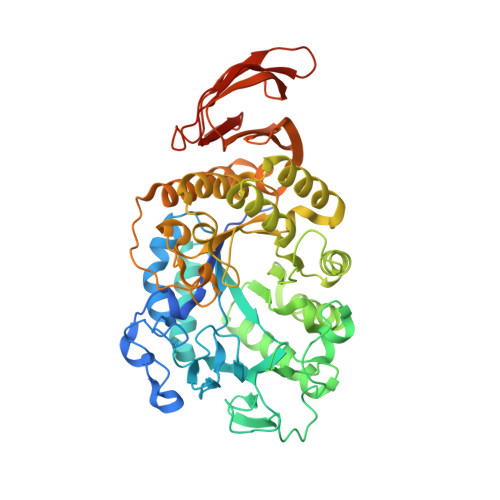
The CldA enzyme is an unprecedented functional intermediate exhibiting the dual hydrolytic specificity of starch hydrolases and the intramolecular transglycosylation capacity of cyclomaltodextrin glucanotransferases (CGTases) from subfamily 2 of family 13 of glycoside hydrolases (GH13_2). Here, the crystallographic structure of CldA was determined at 1.66 Å resolution. Structural and kinetic studies revealed that the thermophilic CldA has a three-domain ABC architecture similar to that of starch hydrolases from GH13_1, and it contains three calcium-dependent folding centers (Ca +2 1-3 ) essential for thermostability. However, it simultaneously features nine expanded subsites (-7 to +2) defining the active site cleft of the canonical five-domain ABCDE CBM20 CGTases from GH13_2. Structural comparisons revealed three evolutionary adaptations in CldA: (a) the absence of the substrate-guiding DE CBM20 domains; (b) an unusual hydrophobic pair, Trp204/Met281, whose hydrophobicity was critical for stabilizing the cyclodextrin (CD) ring at the acceptor subsite +2; and (c) an unexpected hydrogen bond of 2.60 Å between Ser200 at subsite -6 and the key central aromatic residue, Phe216, involved in starch circularization for CD formation. Characterization of two mutants, CldA M281F and CldA S200G , and a five-domain chimera, CldA-DE CBM20 , provided insights into the boundary between starch hydrolases and CGTases. CldA provides the first experimental structural evidence for a native GH13_2 enzyme where hydrolytic and cyclization activities coexist at a presculpted CGTase active site. Overall, structural and functional analysis of CldA showed that it diverges from canonical GH13_2 CGTases by lacking C-terminal DE domains, shifting its intramolecular transglycosylation specificity toward hydrolysis through an intriguing starch concentration-dependent product-length mechanism.
- Laboratorio de Biología Sintética, Estructural y Molecular, Facultad de Ingeniería Mecánica y Eléctrica, Universidad de Colima, Mexico.
Organizational Affiliation: