6VQN | pdb_00006vqn

Co-crystal structure of human PD-L1 complexed with Compound A


Experimental Data Snapshot

  • Method: X-RAY DIFFRACTION
  • Resolution: 2.49 Å
  • R-Value Free: 
    0.228 (Depositor), 0.227 (DCC) 
  • R-Value Work: 
    0.177 (Depositor), 0.185 (DCC) 
  • R-Value Observed: 
    0.179 (Depositor) 

Starting Model: experimental
View more details

wwPDB Validation 3D Report Full Report

Validation slider image for 6VQN

Ligand Structure Quality Assessment 


This is version 1.3 of the entry. See complete history

Literature

Checkpoint inhibition through small molecule-induced internalization of programmed death-ligand 1.

Park, J.J.Thi, E.P.Carpio, V.H.Bi, Y.Cole, A.G.Dorsey, B.D.Fan, K.Harasym, T.Iott, C.L.Kadhim, S.Kim, J.H.Lee, A.C.H.Nguyen, D.Paratala, B.S.Qiu, R.White, A.Lakshminarasimhan, D.Leo, C.Suto, R.K.Rijnbrand, R.Tang, S.Sofia, M.J.Moore, C.B.

(2021) Nat Commun 12: 1222-1222

  • DOI: https://doi.org/10.1038/s41467-021-21410-1
  • Primary Citation Related Structures: 
    6VQN

  • PubMed Abstract: 

    Programmed death-ligand 1 is a glycoprotein expressed on antigen presenting cells, hepatocytes, and tumors which upon interaction with programmed death-1, results in inhibition of antigen-specific T cell responses. Here, we report a mechanism of inhibiting programmed death-ligand 1 through small molecule-induced dimerization and internalization. This represents a mechanism of checkpoint inhibition, which differentiates from anti-programmed death-ligand 1 antibodies which function through molecular disruption of the programmed death 1 interaction. Testing of programmed death ligand 1 small molecule inhibition in a humanized mouse model of colorectal cancer results in a significant reduction in tumor size and promotes T cell proliferation. In addition, antigen-specific T and B cell responses from patients with chronic hepatitis B infection are significantly elevated upon programmed death ligand 1 small molecule inhibitor treatment. Taken together, these data identify a mechanism of small molecule-induced programmed death ligand 1 internalization with potential therapeutic implications in oncology and chronic viral infections.


  • Organizational Affiliation
    • Arbutus Biopharma Inc, Warminster, PA, USA.

Macromolecule Content 

  • Total Structure Weight: 45.57 kDa 
  • Atom Count: 3,114 
  • Modeled Residue Count: 365 
  • Deposited Residue Count: 387 
  • Unique protein chains: 1

Macromolecules

Find similar proteins by:|  3D Structure
Entity ID: 1
MoleculeChains  Sequence LengthOrganismDetailsImage
Programmed cell death 1 ligand 1
A, B, C
129Homo sapiensMutation(s): 0 
Gene Names: CD274B7H1PDCD1L1PDCD1LG1PDL1
UniProt & NIH Common Fund Data Resources
Find proteins for Q9NZQ7 (Homo sapiens)
Explore Q9NZQ7 
Go to UniProtKB:  Q9NZQ7
PHAROS:  Q9NZQ7
GTEx:  ENSG00000120217 
Entity Groups
Sequence Clusters30% Identity50% Identity70% Identity90% Identity95% Identity100% Identity
UniProt GroupQ9NZQ7
Sequence Annotations
Expand
Reference Sequence

Small Molecules

Ligands 1 Unique
IDChains Name / Formula / InChI Key2D Diagram3D Interactions
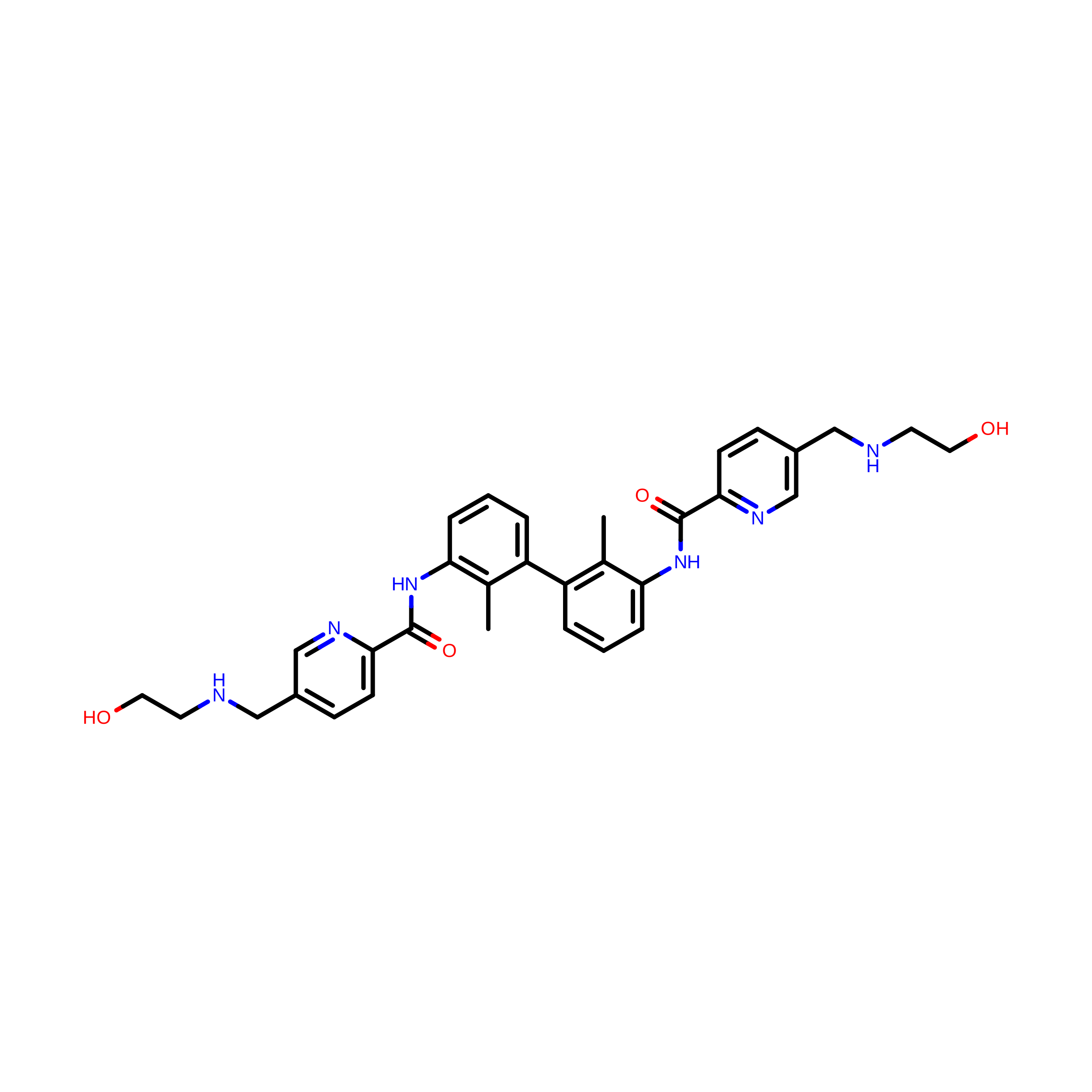
R81
(Subject of Investigation/LOI)

Query on R81


Download:Ideal Coordinates CCD File
D [auth B],
E [auth C]
N,N'-(2,2'-dimethyl[1,1'-biphenyl]-3,3'-diyl)bis(5-{[(2-hydroxyethyl)amino]methyl}pyridine-2-carboxamide)
C32 H36 N6 O4
FZEPAZRIEAMJFE-UHFFFAOYSA-N

Experimental Data & Validation

Experimental Data

  • Method: X-RAY DIFFRACTION
  • Resolution: 2.49 Å
  • R-Value Free:  0.228 (Depositor), 0.227 (DCC) 
  • R-Value Work:  0.177 (Depositor), 0.185 (DCC) 
  • R-Value Observed: 0.179 (Depositor) 
Space Group: C 2 2 21
Unit Cell:
Length ( Å )Angle ( ˚ )
a = 99.003α = 90
b = 172.173β = 90
c = 80.585γ = 90
Software Package:
Software NamePurpose
Aimlessdata scaling
REFMACrefinement
PDB_EXTRACTdata extraction
XDSdata reduction
MOLREPphasing

Structure Validation

View Full Validation Report


Ligand Structure Quality Assessment 


Entry History 

Deposition Data

Revision History  (Full details and data files)

  • Version 1.0: 2021-01-20
    Type: Initial release
  • Version 1.1: 2021-03-10
    Changes: Database references
  • Version 1.2: 2023-10-11
    Changes: Data collection, Database references, Refinement description
  • Version 1.3: 2024-10-16
    Changes: Structure summary