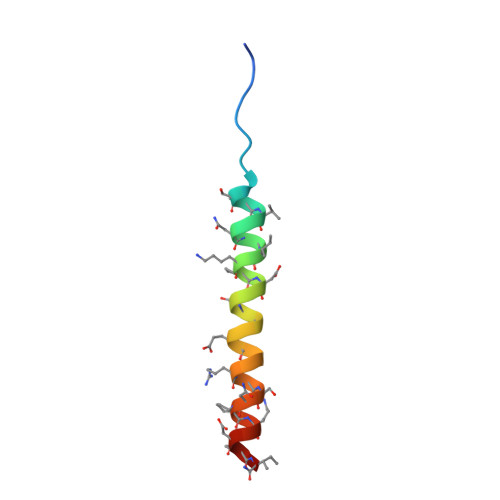
6VJO | pdb_00006vjo

Human parainfluenza virus type 3 fusion glycoprotein N-terminal heptad repeat domain+alpha/beta-VI

  • Classification: ANTIVIRAL PROTEIN
  • Organism(s): Human respirovirus 3
  • Mutation(s): Yes 

  • Deposited: 2020-01-16 Released: 2021-04-21 
  • Deposition Author(s): Outlaw, V.K., Kreitler, D.F., Gellman, S.H.
  • Funding Organization(s): National Institutes of Health/National Institute of General Medical Sciences (NIH/NIGMS), National Institutes of Health/National Institute Of Allergy and Infectious Diseases (NIH/NIAID)

Experimental Data Snapshot

  • Method: X-RAY DIFFRACTION
  • Resolution: 2.00 Å
  • R-Value Free: 
    0.226 (Depositor), 0.226 (DCC) 
  • R-Value Work: 
    0.200 (Depositor), 0.199 (DCC) 
  • R-Value Observed: 
    0.202 (Depositor) 

Starting Model: experimental
View more details

wwPDB Validation 3D Report Full Report

Validation slider image for 6VJO

This is version 2.0 of the entry. See complete history. 

Literature

Engineering Protease-Resistant Peptides to Inhibit Human Parainfluenza Viral Respiratory Infection.

Outlaw, V.K., Cheloha, R.W., Jurgens, E.M., Bovier, F.T., Zhu, Y., Kreitler, D.F., Harder, O., Niewiesk, S., Porotto, M., Gellman, S.H., Moscona, A.

(2021) J Am Chem Soc 143: 5958-5966

  • DOI: https://doi.org/10.1021/jacs.1c01565
  • Primary Citation Related Structures: 
    6VJO

  • PubMed Abstract: 

    The lower respiratory tract infections affecting children worldwide are in large part caused by the parainfluenza viruses (HPIVs), particularly HPIV3, along with human metapneumovirus and respiratory syncytial virus, enveloped negative-strand RNA viruses. There are no vaccines for these important human pathogens, and existing treatments have limited or no efficacy. Infection by HPIV is initiated by viral glycoprotein-mediated fusion between viral and host cell membranes. A viral fusion protein (F), once activated in proximity to a target cell, undergoes a series of conformational changes that first extend the trimer subunits to allow insertion of the hydrophobic domains into the target cell membrane and then refold the trimer into a stable postfusion state, driving the merger of the viral and host cell membranes. Lipopeptides derived from the C-terminal heptad repeat (HRC) domain of HPIV3 F inhibit infection by interfering with the structural transitions of the trimeric F assembly. Clinical application of this strategy, however, requires improving the in vivo stability of antiviral peptides. We show that the HRC peptide backbone can be modified via partial replacement of α-amino acid residues with β-amino acid residues to generate α/β-peptides that retain antiviral activity but are poor protease substrates. Relative to a conventional α-lipopeptide, our best α/β-lipopeptide exhibits improved persistence in vivo and improved anti-HPIV3 antiviral activity in animals.


  • Organizational Affiliation: 
    • Department of Chemistry, University of Wisconsin, Madison, Wisconsin 53706, United States.

Macromolecule Content 

  • Total Structure Weight: 9.85 kDa 
  • Atom Count: 700 
  • Modeled Residue Count: 87 
  • Deposited Residue Count: 91 
  • Unique protein chains: 2

Macromolecules

Find similar proteins by:|  3D Structure
Entity ID: 1
MoleculeChains  Sequence LengthOrganismDetailsImage
Fusion glycoprotein F038Human respirovirus 3Mutation(s): 10 
UniProt
Find proteins for P06828 (Human parainfluenza 3 virus (strain Wash/47885/57))
Explore P06828 
Go to UniProtKB:  P06828
Entity Groups
Sequence Clusters30% Identity50% Identity70% Identity90% Identity95% Identity100% Identity
UniProt GroupP06828
Sequence Annotations
Expand
Reference Sequence
Find similar proteins by:|  3D Structure
Entity ID: 2
MoleculeChains  Sequence LengthOrganismDetailsImage
Fusion glycoprotein F053Human respirovirus 3Mutation(s): 2 
UniProt
Find proteins for P06828 (Human parainfluenza 3 virus (strain Wash/47885/57))
Explore P06828 
Go to UniProtKB:  P06828
Entity Groups
Sequence Clusters30% Identity50% Identity70% Identity90% Identity95% Identity100% Identity
UniProt GroupP06828
Sequence Annotations
Expand
Reference Sequence

Small Molecules

Non-standard Monomers  3 Unique
IDChains TypeFormula2D Diagram
B3E
Query on B3E
L-PEPTIDE LINKINGC6 H11 N O4
XCP
Query on XCP
PEPTIDE-LIKEC6 H11 N O2
XPC
Query on XPC
PEPTIDE-LIKEC5 H10 N2 O2

Experimental Data & Validation

Experimental Data

  • Method: X-RAY DIFFRACTION
  • Resolution: 2.00 Å
  • R-Value Free:  0.226 (Depositor), 0.226 (DCC) 
  • R-Value Work:  0.200 (Depositor), 0.199 (DCC) 
  • R-Value Observed: 0.202 (Depositor) 
Space Group: H 3
Unit Cell:
Length ( Å )Angle ( ˚ )
a = 48.345α = 90
b = 48.345β = 90
c = 134.546γ = 120
Software Package:
Software NamePurpose
PHENIXrefinement
XDSdata reduction
XSCALEdata scaling
PHASERphasing

Structure Validation

View Full Validation Report


Entry History 

& Funding Information

Deposition Data


Funding OrganizationLocationGrant Number
National Institutes of Health/National Institute of General Medical Sciences (NIH/NIGMS)United States1F32GM122263
National Institutes of Health/National Institute Of Allergy and Infectious Diseases (NIH/NIAID)United States1R01AI114736

Revision History  (Full details and data files)

  • Version 1.0: 2021-04-21
    Type: Initial release
  • Version 1.1: 2021-05-05
    Changes: Database references
  • Version 1.2: 2023-10-11
    Changes: Data collection, Database references, Refinement description
  • Version 2.0: 2023-11-15
    Changes: Atomic model, Data collection