6VC2 | pdb_00006vc2

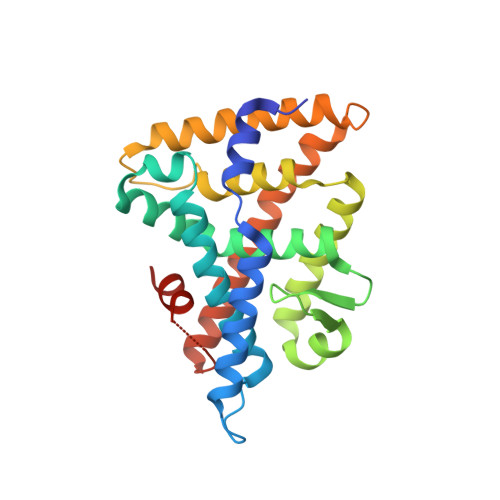
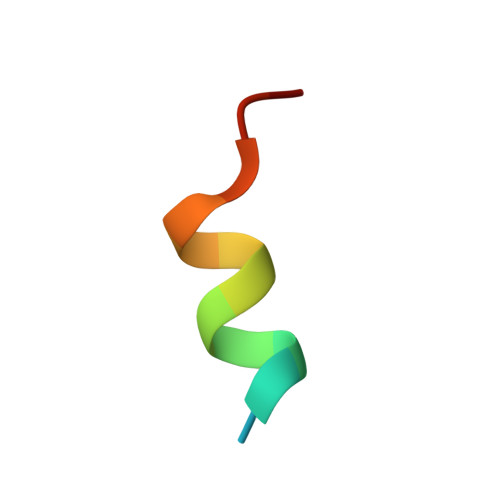
LRH-1 bound to SS-RJW100 and a fragment of the Tif2 Coactivator

  • Classification: TRANSCRIPTION
  • Organism(s): Homo sapiens
  • Expression System: Escherichia coli
  • Mutation(s): No 

  • Deposited: 2019-12-20 Released: 2020-12-23 
  • Deposition Author(s): Mays, S.G., Ortlund, E.A.
  • Funding Organization(s): National Institutes of Health/National Institute of Diabetes and Digestive and Kidney Disease (NIH/NIDDK), National Institutes of Health/National Institute of General Medical Sciences (NIH/NIGMS), National Science Foundation (NSF, United States)

Experimental Data Snapshot

  • Method: X-RAY DIFFRACTION
  • Resolution: 1.70 Å
  • R-Value Free: 
    0.228 (Depositor), 0.230 (DCC) 
  • R-Value Work: 
    0.210 (Depositor), 0.212 (DCC) 
  • R-Value Observed: 
    0.210 (Depositor) 

Starting Model: experimental
View more details

wwPDB Validation 3D Report Full Report

Validation slider image for 6VC2

Ligand Structure Quality Assessment 


This is version 1.2 of the entry. See complete history

Literature

Enantiomer-specific activities of an LRH-1 and SF-1 dual agonist.

Mays, S.G.Stec, J.Liu, X.D'Agostino, E.H.Whitby, R.J.Ortlund, E.A.

(2020) Sci Rep 10: 22279-22279

  • DOI: https://doi.org/10.1038/s41598-020-79251-9
  • Primary Citation Related Structures: 
    6VC2

  • PubMed Abstract: 

    Chirality is an important consideration in drug development: it can influence recognition of the intended target, pharmacokinetics, and off-target effects. Here, we investigate how chirality affects the activity and mechanism of action of RJW100, a racemic agonist of the nuclear receptors liver receptor homolog-1 (LRH-1) and steroidogenic factor-1 (SF-1). LRH-1 and SF-1 modulators are highly sought as treatments for metabolic and neoplastic diseases, and RJW100 has one of the few scaffolds shown to activate them. However, enantiomer-specific effects on receptor activation are poorly understood. We show that the enantiomers have similar binding affinities, but RR-RJW100 stabilizes both receptors and is 46% more active than SS-RJW100 in LRH-1 luciferase reporter assays. We present an LRH-1 crystal structure that illuminates striking mechanistic differences: SS-RJW100 adopts multiple configurations in the pocket and fails to make an interaction critical for activation by RR-RJW100. In molecular dynamics simulations, SS-RJW100 attenuates intramolecular signalling important for coregulator recruitment, consistent with previous observations that it weakly recruits coregulators in vitro. These studies provide a rationale for pursuing enantiomerically pure RJW100 derivatives: they establish RR-RJW100 as the stronger LRH-1 agonist and identify a potential for optimizing the SS-RJW100 scaffold for antagonist design.


  • Organizational Affiliation
    • Department of Biochemistry, Emory University, Atlanta, GA, 30322, USA.

Macromolecule Content 

  • Total Structure Weight: 30.53 kDa 
  • Atom Count: 2,207 
  • Modeled Residue Count: 248 
  • Deposited Residue Count: 260 
  • Unique protein chains: 2

Macromolecules

Find similar proteins by:|  3D Structure
Entity ID: 1
MoleculeChains  Sequence LengthOrganismDetailsImage
Nuclear receptor subfamily 5 group A member 2245Homo sapiensMutation(s): 0 
Gene Names: NR5A2B1FCPFFTF
UniProt & NIH Common Fund Data Resources
Find proteins for O00482 (Homo sapiens)
Explore O00482 
Go to UniProtKB:  O00482
PHAROS:  O00482
GTEx:  ENSG00000116833 
Entity Groups
Sequence Clusters30% Identity50% Identity70% Identity90% Identity95% Identity100% Identity
UniProt GroupO00482
Sequence Annotations
Expand
Reference Sequence
Find similar proteins by:  Sequence   |   3D Structure  
Entity ID: 2
MoleculeChains  Sequence LengthOrganismDetailsImage
Nuclear receptor coactivator 2B [auth C]15Homo sapiensMutation(s): 0 
UniProt & NIH Common Fund Data Resources
Find proteins for Q15596 (Homo sapiens)
Explore Q15596 
Go to UniProtKB:  Q15596
PHAROS:  Q15596
GTEx:  ENSG00000140396 
Entity Groups
Sequence Clusters30% Identity50% Identity70% Identity90% Identity95% Identity100% Identity
UniProt GroupQ15596
Sequence Annotations
Expand
Reference Sequence

Small Molecules

Ligands 1 Unique
IDChains Name / Formula / InChI Key2D Diagram3D Interactions
QU7
(Subject of Investigation/LOI)

Query on QU7


Download:Ideal Coordinates CCD File
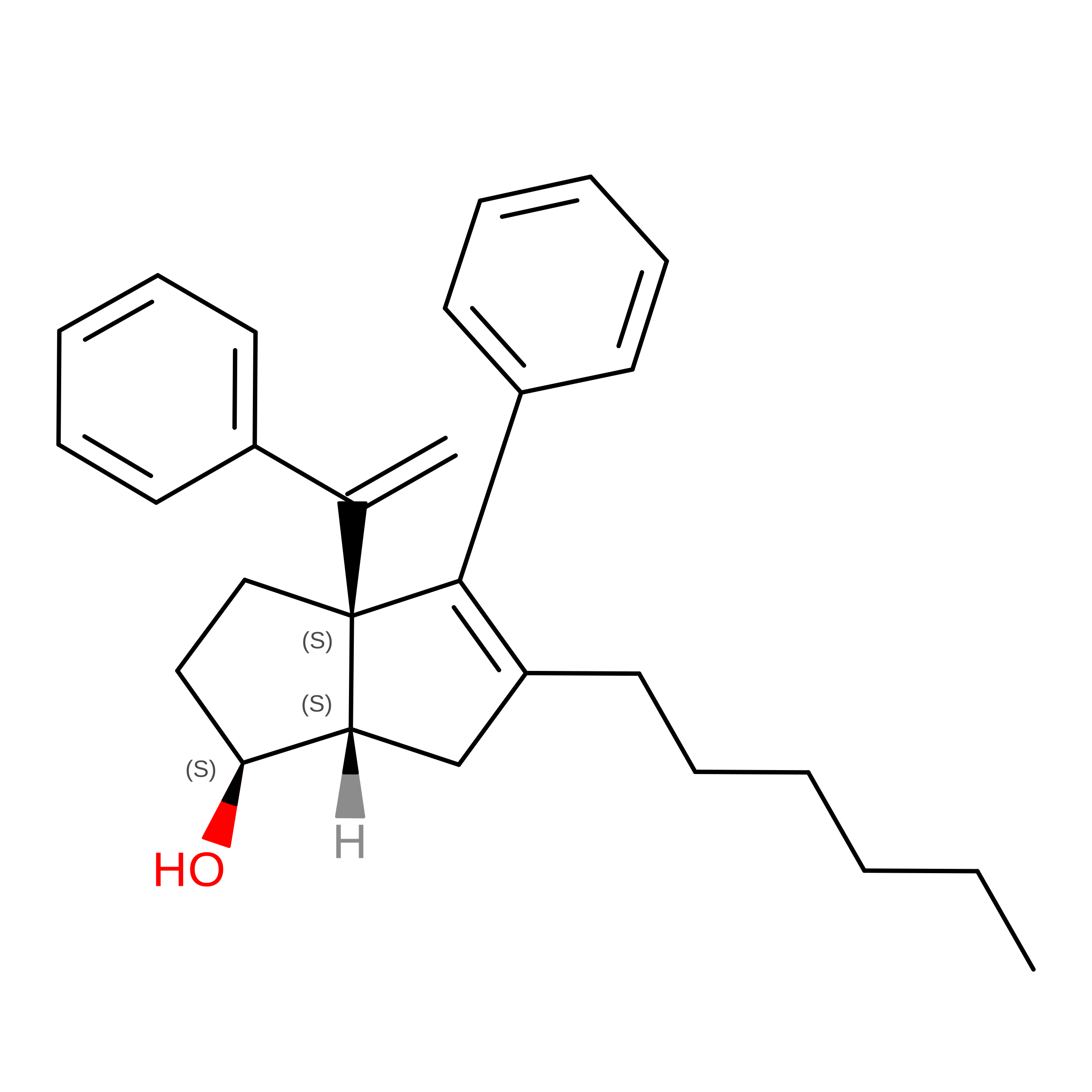
C [auth A](1S,3aS,6aS)-5-hexyl-4-phenyl-3a-(1-phenylethenyl)-1,2,3,3a,6,6a-hexahydropentalen-1-ol
C28 H34 O
ZFXMYHPLTQTTFW-FULLSBAXSA-N
Binding Affinity Annotations 
IDSourceBinding Affinity
QU7 BindingDB:  6VC2 Ki: 1200 (nM) from 1 assay(s)

Experimental Data & Validation

Experimental Data

  • Method: X-RAY DIFFRACTION
  • Resolution: 1.70 Å
  • R-Value Free:  0.228 (Depositor), 0.230 (DCC) 
  • R-Value Work:  0.210 (Depositor), 0.212 (DCC) 
  • R-Value Observed: 0.210 (Depositor) 
Space Group: P 43 21 2
Unit Cell:
Length ( Å )Angle ( ˚ )
a = 46.608α = 90
b = 46.608β = 90
c = 220.89γ = 90
Software Package:
Software NamePurpose
HKL-2000data scaling
PHENIXrefinement
PDB_EXTRACTdata extraction
HKL-2000data reduction
PHASERphasing

Structure Validation

View Full Validation Report


Ligand Structure Quality Assessment 


Entry History 

& Funding Information

Deposition Data


Funding OrganizationLocationGrant Number
National Institutes of Health/National Institute of Diabetes and Digestive and Kidney Disease (NIH/NIDDK)United StatesR01-DK114213
National Institutes of Health/National Institute of Diabetes and Digestive and Kidney Disease (NIH/NIDDK)United StatesNIH F31-DK111171
National Institutes of Health/National Institute of Diabetes and Digestive and Kidney Disease (NIH/NIDDK)United StatesR01-DK095750
National Institutes of Health/National Institute of General Medical Sciences (NIH/NIGMS)United StatesT32-GM008602
National Science Foundation (NSF, United States)United States--

Revision History  (Full details and data files)

  • Version 1.0: 2020-12-23
    Type: Initial release
  • Version 1.1: 2020-12-30
    Changes: Database references
  • Version 1.2: 2023-10-11
    Changes: Data collection, Database references, Refinement description