6UKN | pdb_00006ukn

Cryo-EM structure of the potassium-chloride cotransporter KCC4 in lipid nanodiscs


Experimental Data Snapshot

  • Method: ELECTRON MICROSCOPY
  • Resolution: 3.65 Å
  • Aggregation State: PARTICLE 
  • Reconstruction Method: SINGLE PARTICLE 

wwPDB Validation 3D Report Full Report

Validation slider image for 6UKN

This is version 2.1 of the entry. See complete history

Literature

Cryo-EM structure of the potassium-chloride cotransporter KCC4 in lipid nanodiscs.

Reid, M.S.Kern, D.M.Brohawn, S.G.

(2020) Elife 9

  • DOI: https://doi.org/10.7554/eLife.52505
  • Primary Citation Related Structures: 
    6UKN

  • PubMed Abstract: 

    Cation-chloride-cotransporters (CCCs) catalyze transport of Cl - with K + and/or Na + across cellular membranes. CCCs play roles in cellular volume regulation, neural development and function, audition, regulation of blood pressure, and renal function. CCCs are targets of clinically important drugs including loop diuretics and their disruption has been implicated in pathophysiology including epilepsy, hearing loss, and the genetic disorders Andermann, Gitelman, and Bartter syndromes. Here we present the structure of a CCC, the Mus musculus K + -Cl - cotransporter (KCC) KCC4, in lipid nanodiscs determined by cryo-EM. The structure, captured in an inside-open conformation, reveals the architecture of KCCs including an extracellular domain poised to regulate transport activity through an outer gate. We identify binding sites for substrate K + and Cl - ions, demonstrate the importance of key coordinating residues for transporter activity, and provide a structural explanation for varied substrate specificity and ion transport ratio among CCCs. These results provide mechanistic insight into the function and regulation of a physiologically important transporter family.


  • Organizational Affiliation
    • Department of Molecular and Cell Biology, University of California Berkeley, Berkeley, United States.

Macromolecule Content 

  • Total Structure Weight: 121.86 kDa 
  • Atom Count: 4,109 
  • Modeled Residue Count: 536 
  • Deposited Residue Count: 1,092 
  • Unique protein chains: 1

Macromolecules

Find similar proteins by:|  3D Structure
Entity ID: 1
MoleculeChains  Sequence LengthOrganismDetailsImage
Solute carrier family 12 member 71,092Mus musculusMutation(s): 0 
Gene Names: Slc12a7Kcc4
Membrane Entity: Yes 
UniProt & NIH Common Fund Data Resources
Find proteins for Q9WVL3 (Mus musculus)
Explore Q9WVL3 
Go to UniProtKB:  Q9WVL3
IMPC:  MGI:1342283
Entity Groups
Sequence Clusters30% Identity50% Identity70% Identity90% Identity95% Identity100% Identity
UniProt GroupQ9WVL3
Glycosylation
Glycosylation Sites: 2Go to GlyGen: Q9WVL3-1
Sequence Annotations
Expand
Reference Sequence

Oligosaccharides

Help  
Entity ID: 2
MoleculeChains Length2D Diagram GlycosylationD Interactions
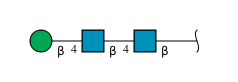
beta-D-mannopyranose-(1-4)-2-acetamido-2-deoxy-beta-D-glucopyranose-(1-4)-2-acetamido-2-deoxy-beta-D-glucopyranose
B, C
3N-Glycosylation
Glycosylation Resources
GlyTouCan: G15407YE
GlyCosmos: G15407YE
GlyGen: G15407YE

Experimental Data & Validation

Experimental Data

  • Method: ELECTRON MICROSCOPY
  • Resolution: 3.65 Å
  • Aggregation State: PARTICLE 
  • Reconstruction Method: SINGLE PARTICLE 
EM Software:
TaskSoftware PackageVersion
RECONSTRUCTIONRELION3.0.7
MODEL REFINEMENTPHENIX

Structure Validation

View Full Validation Report


Entry History 

& Funding Information

Deposition Data


Funding OrganizationLocationGrant Number
National Institutes of Health/National Institute of General Medical Sciences (NIH/NIGMS)United StatesGM123496
National Institutes of Health/National Institute of General Medical Sciences (NIH/NIGMS)United StatesGM128263

Revision History  (Full details and data files)

  • Version 1.0: 2020-06-10
    Type: Initial release
  • Version 2.0: 2020-07-29
    Type: Remediation
    Reason: Carbohydrate remediation
    Changes: Advisory, Atomic model, Data collection, Derived calculations, Structure summary
  • Version 2.1: 2024-10-23
    Changes: Data collection, Database references, Structure summary