6UG8 | pdb_00006ug8

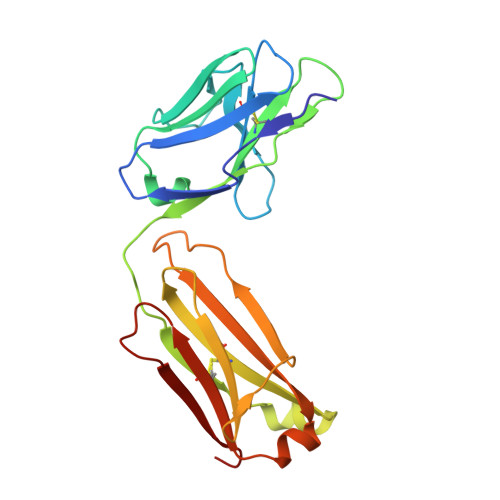
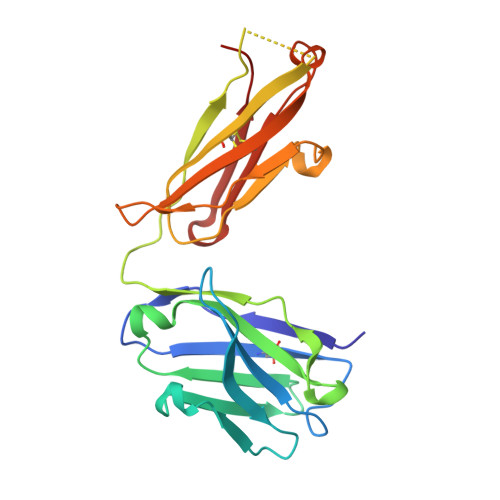
Complex of ch28/11 Fab and SSEA-4 (monoclinic form)


Experimental Data Snapshot

  • Method: X-RAY DIFFRACTION
  • Resolution: 1.89 Å
  • R-Value Free: 
    0.230 (Depositor), 0.234 (DCC) 
  • R-Value Work: 
    0.176 (Depositor), 0.184 (DCC) 
  • R-Value Observed: 
    0.179 (Depositor) 

Starting Model: experimental
View more details

wwPDB Validation 3D Report Full Report

Validation slider image for 6UG8

This is version 2.2 of the entry. See complete history

Literature

The terminal sialic acid of stage-specific embryonic antigen-4 has a crucial role in binding to a cancer-targeting antibody.

Soliman, C.Chua, J.X.Vankemmelbeke, M.McIntosh, R.S.Guy, A.J.Spendlove, I.Durrant, L.G.Ramsland, P.A.

(2020) J Biological Chem 295: 1009-1020

  • DOI: https://doi.org/10.1074/jbc.RA119.011518
  • Primary Citation Related Structures: 
    6UG7, 6UG8, 6UG9, 6UGA

  • PubMed Abstract: 

    Cancer remains a leading cause of morbidity and mortality worldwide, requiring ongoing development of targeted therapeutics such as monoclonal antibodies. Carbohydrates on embryonic cells are often highly expressed in cancer and are therefore attractive targets for antibodies. Stage-specific embryonic antigen-4 (SSEA-4) is one such glycolipid target expressed in many cancers, including breast and ovarian carcinomas. Here, we defined the structural basis for recognition of SSEA-4 by a novel monospecific chimeric antibody (ch28/11). Five X-ray structures of ch28/11 Fab complexes with the SSEA-4 glycan headgroup, determined at 1.5-2.7 Å resolutions, displayed highly similar three-dimensional structures indicating a stable binding mode. The structures also revealed that by adopting a horseshoe-shaped conformation in a deep groove, the glycan headgroup likely sits flat against the membrane to allow the antibody to interact with SSEA-4 on cancer cells. Moreover, we found that the terminal sialic acid of SSEA-4 plays a dominant role in dictating the exquisite specificity of the ch28/11 antibody. This observation was further supported by molecular dynamics simulations of the ch28/11-glycan complex, which show that SSEA-4 is stabilized by its terminal sialic acid, unlike SSEA-3, which lacks this sialic acid modification. These high-resolution views of how a glycolipid interacts with an antibody may help to advance a new class of cancer-targeting immunotherapy.


  • Organizational Affiliation
    • School of Science, RMIT University, Melbourne, Victoria 3083, Australia.

Macromolecule Content 

  • Total Structure Weight: 47.34 kDa 
  • Atom Count: 3,605 
  • Modeled Residue Count: 425 
  • Deposited Residue Count: 431 
  • Unique protein chains: 2

Macromolecules

Find similar proteins by:|  3D Structure
Entity ID: 1
MoleculeChains  Sequence LengthOrganismDetailsImage
ch28/11 Fab light chainA [auth L]213Mus musculusMutation(s): 0 
Find similar proteins by:|  3D Structure
Entity ID: 2
MoleculeChains  Sequence LengthOrganismDetailsImage
ch28/11 Fab heavy chainB [auth H]218Mus musculusMutation(s): 0 

Oligosaccharides

Help  
Entity ID: 3
MoleculeChains Length2D Diagram GlycosylationD Interactions
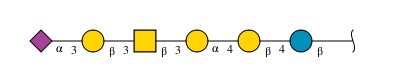
N-acetyl-alpha-neuraminic acid-(2-3)-beta-D-galactopyranose-(1-3)-2-acetamido-2-deoxy-beta-D-galactopyranose-(1-3)-alpha-D-galactopyranose-(1-4)-beta-D-galactopyranose-(1-4)-beta-D-glucopyranoseC [auth A]6N/A
Glycosylation Resources
GlyTouCan: G32254QI
GlyCosmos: G32254QI
GlyGen: G32254QI

Experimental Data & Validation

Experimental Data

  • Method: X-RAY DIFFRACTION
  • Resolution: 1.89 Å
  • R-Value Free:  0.230 (Depositor), 0.234 (DCC) 
  • R-Value Work:  0.176 (Depositor), 0.184 (DCC) 
  • R-Value Observed: 0.179 (Depositor) 
Space Group: P 1 21 1
Unit Cell:
Length ( Å )Angle ( ˚ )
a = 37.464α = 90
b = 69.167β = 94.46
c = 97.55γ = 90
Software Package:
Software NamePurpose
REFMACrefinement
PDB_EXTRACTdata extraction
XDSdata reduction
XSCALEdata scaling
PHENIXphasing

Structure Validation

View Full Validation Report


Entry History 

Deposition Data

Revision History  (Full details and data files)

  • Version 1.0: 2019-12-18
    Type: Initial release
  • Version 1.1: 2020-01-01
    Changes: Database references
  • Version 1.2: 2020-02-05
    Changes: Data collection, Database references
  • Version 2.0: 2020-07-29
    Type: Remediation
    Reason: Carbohydrate remediation
    Changes: Advisory, Atomic model, Data collection, Derived calculations, Structure summary
  • Version 2.1: 2023-10-11
    Changes: Data collection, Database references, Derived calculations, Refinement description, Structure summary
  • Version 2.2: 2024-10-23
    Changes: Structure summary