6TFP | pdb_00006tfp

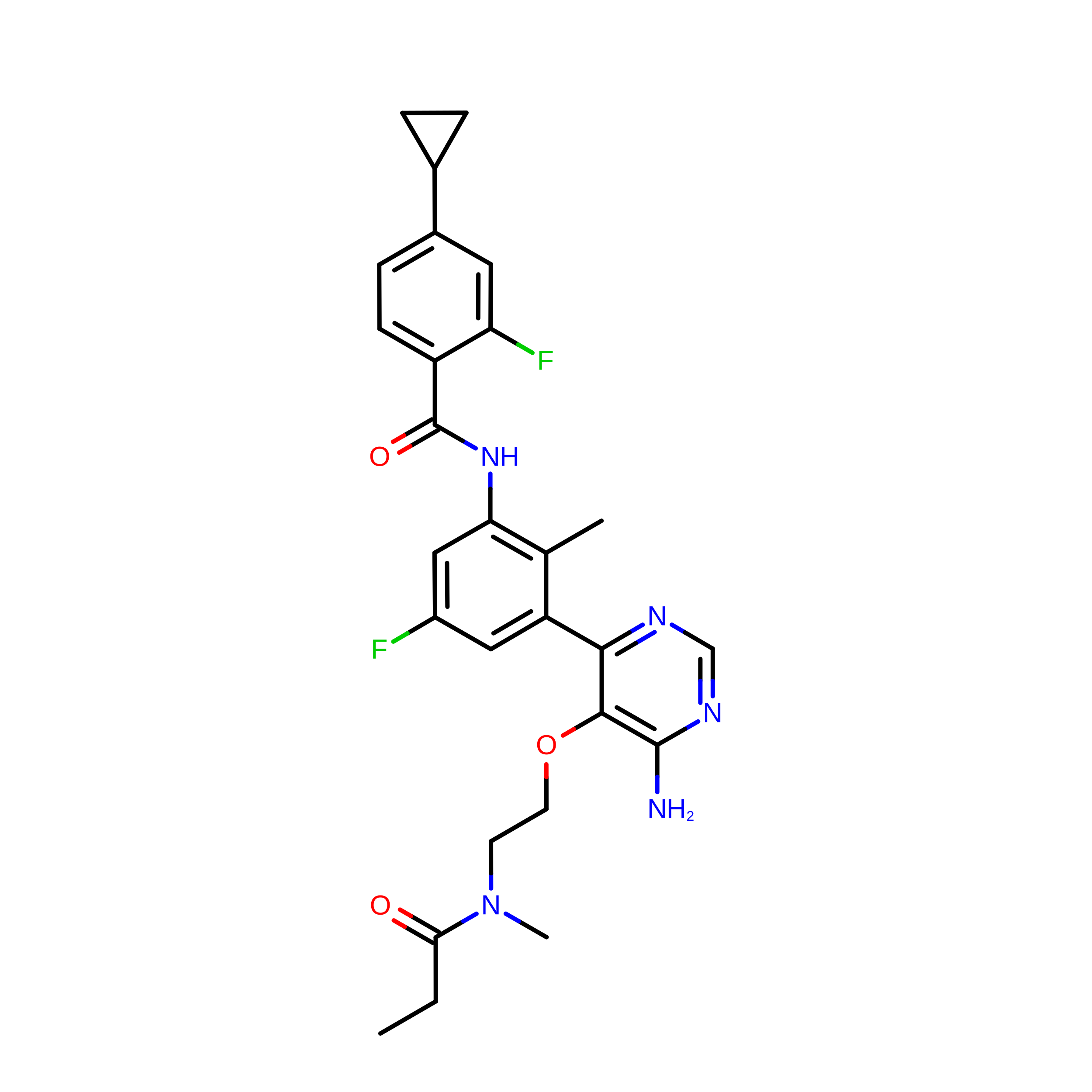
BTK in complex with LOU064, a potent and highly selective covalent inhibitor


Experimental Data Snapshot

  • Method: X-RAY DIFFRACTION
  • Resolution: 2.00 Å
  • R-Value Free: 
    0.204 (Depositor), 0.210 (DCC) 
  • R-Value Work: 
    0.186 (Depositor), 0.190 (DCC) 
  • R-Value Observed: 
    0.187 (Depositor) 

Starting Model: other
View more details

wwPDB Validation 3D Report Full Report

Validation slider image for 6TFP

Ligand Structure Quality Assessment 


This is version 1.3 of the entry. See complete history

Literature

Discovery of LOU064 (Remibrutinib), a Potent and Highly Selective Covalent Inhibitor of Bruton's Tyrosine Kinase.

Angst, D.Gessier, F.Janser, P.Vulpetti, A.Walchli, R.Beerli, C.Littlewood-Evans, A.Dawson, J.Nuesslein-Hildesheim, B.Wieczorek, G.Gutmann, S.Scheufler, C.Hinniger, A.Zimmerlin, A.Funhoff, E.G.Pulz, R.Cenni, B.

(2020) J Med Chem 63: 5102-5118

  • DOI: https://doi.org/10.1021/acs.jmedchem.9b01916
  • Primary Citation Related Structures: 
    6TFP

  • PubMed Abstract: 

    Bruton's tyrosine kinase (BTK), a cytoplasmic tyrosine kinase, plays a central role in immunity and is considered an attractive target for treating autoimmune diseases. The use of currently marketed covalent BTK inhibitors is limited to oncology indications based on their suboptimal kinase selectivity. We describe the discovery and preclinical profile of LOU064 (remibrutinib, 25 ), a potent, highly selective covalent BTK inhibitor. LOU064 exhibits an exquisite kinase selectivity due to binding to an inactive conformation of BTK and has the potential for a best-in-class covalent BTK inhibitor for the treatment of autoimmune diseases. It demonstrates potent in vivo target occupancy with an EC 90 of 1.6 mg/kg and dose-dependent efficacy in rat collagen-induced arthritis. LOU064 is currently being tested in phase 2 clinical studies for chronic spontaneous urticaria and Sjoegren's syndrome.

Macromolecule Content 

  • Total Structure Weight: 162.65 kDa 
  • Atom Count: 11,545 
  • Modeled Residue Count: 1,335 
  • Deposited Residue Count: 1,380 
  • Unique protein chains: 1

Macromolecules

Find similar proteins by:|  3D Structure
Entity ID: 1
MoleculeChains  Sequence LengthOrganismDetailsImage
Tyrosine-protein kinase BTK
A, B, C, D, E
276Homo sapiensMutation(s): 0 
Gene Names: BTKAGMX1ATKBPK
EC: 2.7.10.2
UniProt & NIH Common Fund Data Resources
Find proteins for Q06187 (Homo sapiens)
Explore Q06187 
Go to UniProtKB:  Q06187
PHAROS:  Q06187
GTEx:  ENSG00000010671 
Entity Groups
Sequence Clusters30% Identity50% Identity70% Identity90% Identity95% Identity100% Identity
UniProt GroupQ06187
Sequence Annotations
Expand
Reference Sequence

Small Molecules

Ligands 2 Unique
IDChains Name / Formula / InChI Key2D Diagram3D Interactions
N6Z
(Subject of Investigation/LOI)

Query on N6Z


Download:Ideal Coordinates CCD File
G [auth A],
H [auth B],
J [auth C],
K [auth D],
L [auth E]
~{N}-[3-[6-azanyl-5-[2-[methyl(propanoyl)amino]ethoxy]pyrimidin-4-yl]-5-fluoranyl-2-methyl-phenyl]-4-cyclopropyl-2-fluoranyl-benzamide
C27 H29 F2 N5 O3
CTBIYDHGUMTQNM-UHFFFAOYSA-N
NA

Query on NA


Download:Ideal Coordinates CCD File
F [auth A],
I [auth C]
SODIUM ION
Na
FKNQFGJONOIPTF-UHFFFAOYSA-N

Experimental Data & Validation

Experimental Data

  • Method: X-RAY DIFFRACTION
  • Resolution: 2.00 Å
  • R-Value Free:  0.204 (Depositor), 0.210 (DCC) 
  • R-Value Work:  0.186 (Depositor), 0.190 (DCC) 
  • R-Value Observed: 0.187 (Depositor) 
Space Group: C 1 2 1
Unit Cell:
Length ( Å )Angle ( ˚ )
a = 206.82α = 90
b = 86.48β = 129.84
c = 160.65γ = 90
Software Package:
Software NamePurpose
XSCALEdata scaling
BUSTERrefinement
PDB_EXTRACTdata extraction
XDSdata reduction
PHASERphasing

Structure Validation

View Full Validation Report


Ligand Structure Quality Assessment 


Entry History 

Deposition Data

Revision History  (Full details and data files)

  • Version 1.0: 2020-03-04
    Type: Initial release
  • Version 1.1: 2020-06-10
    Changes: Database references
  • Version 1.2: 2024-05-01
    Changes: Data collection, Database references, Derived calculations, Refinement description
  • Version 1.3: 2024-11-06
    Changes: Structure summary