6T42 | pdb_00006t42

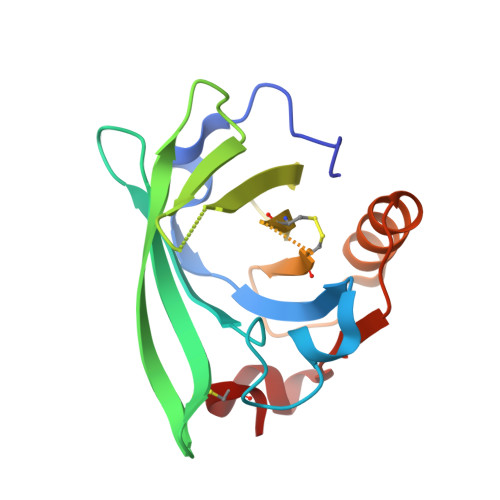
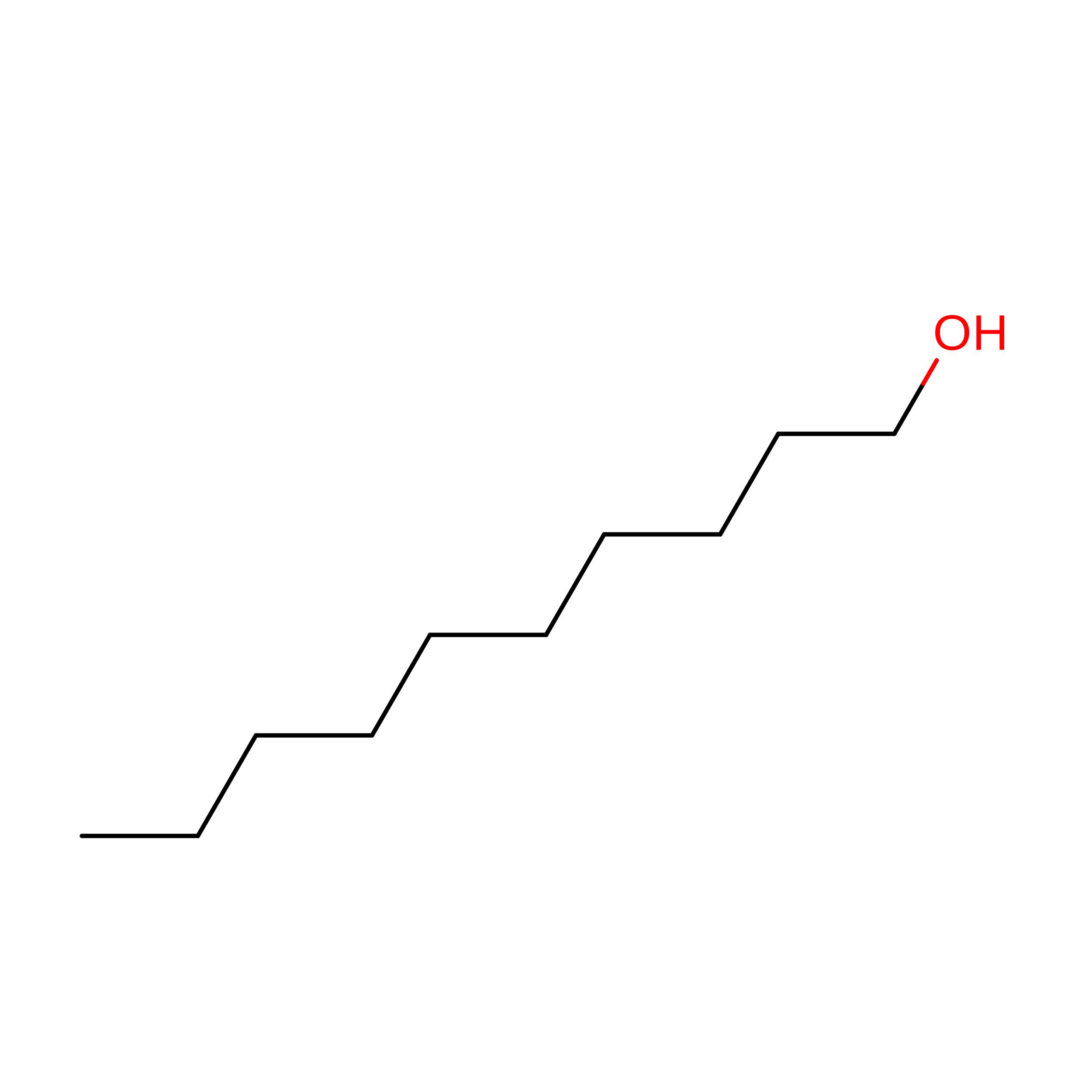
Bovine lactoglobulin complex with decanol


Experimental Data Snapshot

  • Method: X-RAY DIFFRACTION
  • Resolution: 1.95 Å
  • R-Value Free: 
    0.229 (Depositor), 0.234 (DCC) 
  • R-Value Work: 
    0.174 (Depositor), 0.183 (DCC) 
  • R-Value Observed: 
    0.179 (Depositor) 

Starting Model: experimental
View more details

wwPDB Validation 3D Report Full Report

Validation slider image for 6T42

Ligand Structure Quality Assessment 


This is version 1.4 of the entry. See complete history

Literature

Conformational flexibility and ligand binding properties of ovine beta-lactoglobulin.

Loch, J.Bonarek, P.Lewinski, K.

(2019) Acta Biochim Pol 66: 577-584

  • DOI: https://doi.org/10.18388/abp.2019_2883
  • Primary Citation Related Structures: 
    6T42, 6T44

  • PubMed Abstract: 

    Ovine β‑lactoglobulin was characterized by spectroscopic (CD), calorimetric (ITC) and X-ray structural studies. The structure of ovine β‑lactoglobulin complex with decanol showed that tight packing of molecules in the crystalline phase enforces a distortion of protein flexible loops resulting in the formation of an asymmetric dimer. The loops surrounding β-barrel in ovine lactoglobulin possessed the same conformational flexibility as observed previously in other lactoglobulins and the change of their conformation regulates the access to the binding pocket. The structure of asymmetric dimer revealed a new region in β-barrel where ligand polar group can be located. These findings indicated protein adaptability to ligand dimensions and inter- and intramolecular interactions in the crystalline phase. Calorimetric and crystallographic studies provided the experimental evidence that ovine lactoglobulin is able to bind aliphatic ligands. Thermodynamic parameters of sodium dodecyl sulfate binding determined by ITC at pH 7.5 had Ka, ΔH, TΔS and ΔG values similar to those observed for bovine and caprine protein indicating the same mechanism of ligand binding.


  • Organizational Affiliation
    • Department of Crystal Chemistry and Crystal Physics, Faculty of Chemistry, Jagiellonian University, Kraków, Poland.

Macromolecule Content 

  • Total Structure Weight: 18.46 kDa 
  • Atom Count: 1,278 
  • Modeled Residue Count: 154 
  • Deposited Residue Count: 162 
  • Unique protein chains: 1

Macromolecules

Find similar proteins by:|  3D Structure
Entity ID: 1
MoleculeChains  Sequence LengthOrganismDetailsImage
Beta-lactoglobulinA [auth AAA]162Bos taurusMutation(s): 0 
Gene Names: LGB
UniProt
Find proteins for P02754 (Bos taurus)
Explore P02754 
Go to UniProtKB:  P02754
Entity Groups
Sequence Clusters30% Identity50% Identity70% Identity90% Identity95% Identity100% Identity
UniProt GroupP02754
Sequence Annotations
Expand
Reference Sequence

Small Molecules

Experimental Data & Validation

Experimental Data

  • Method: X-RAY DIFFRACTION
  • Resolution: 1.95 Å
  • R-Value Free:  0.229 (Depositor), 0.234 (DCC) 
  • R-Value Work:  0.174 (Depositor), 0.183 (DCC) 
  • R-Value Observed: 0.179 (Depositor) 
Space Group: P 32 2 1
Unit Cell:
Length ( Å )Angle ( ˚ )
a = 53.145α = 90
b = 53.145β = 90
c = 111.41γ = 120
Software Package:
Software NamePurpose
REFMACrefinement
CrysalisProdata reduction
Aimlessdata scaling
PHASERphasing

Structure Validation

View Full Validation Report


Ligand Structure Quality Assessment 


Entry History 

& Funding Information

Deposition Data


Funding OrganizationLocationGrant Number
Polish National Science CentrePoland2012/05/B/ST5/00278

Revision History  (Full details and data files)

  • Version 1.0: 2019-10-23
    Type: Initial release
  • Version 1.1: 2020-01-08
    Changes: Database references
  • Version 1.2: 2020-01-15
    Changes: Database references
  • Version 1.3: 2024-01-24
    Changes: Data collection, Database references, Derived calculations, Refinement description
  • Version 1.4: 2024-10-23
    Changes: Structure summary