6S5C | pdb_00006s5c

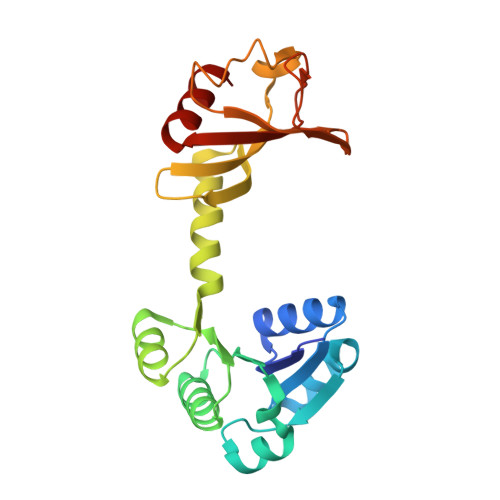
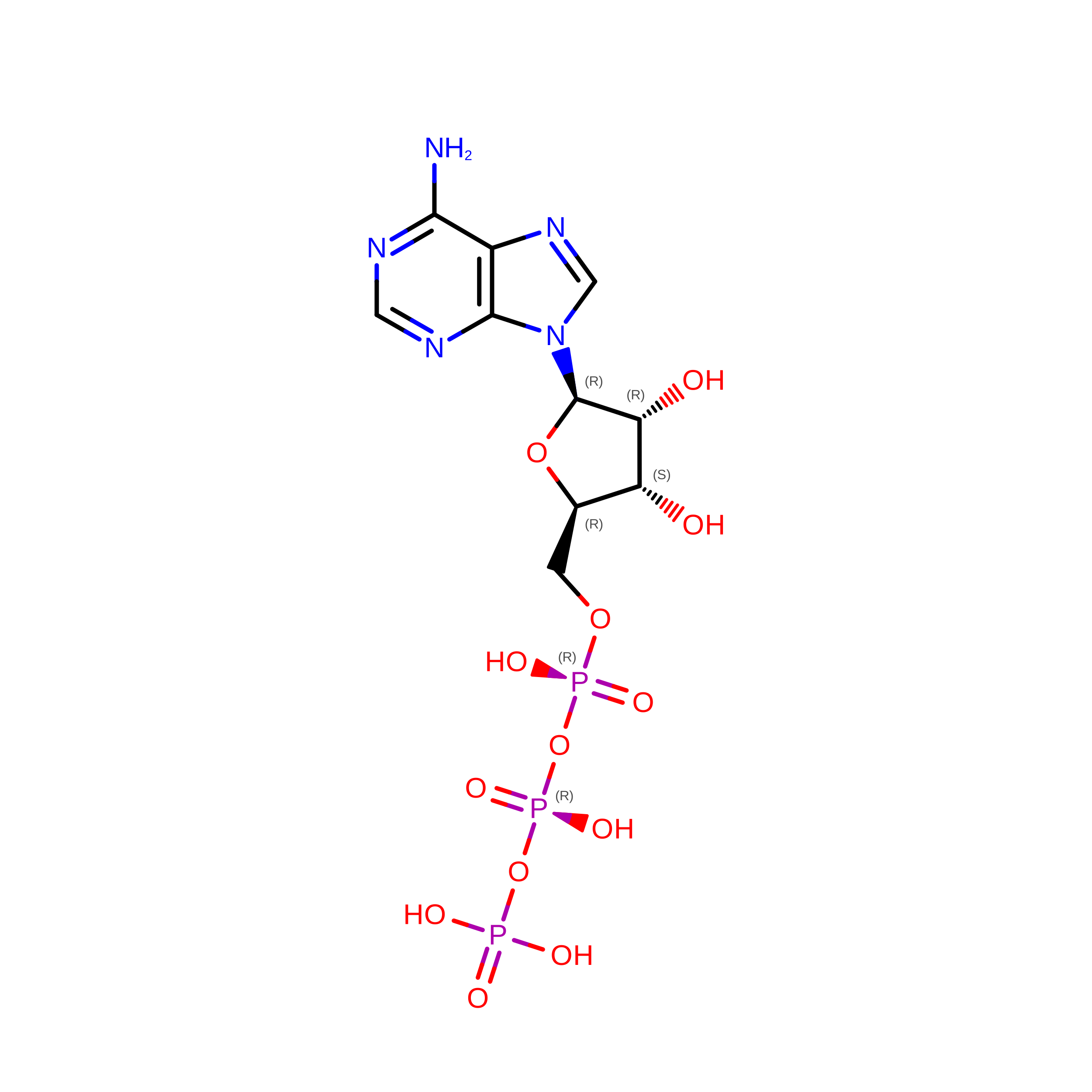
Square conformation of KtrA WT ring with bound ATP and calcium


Experimental Data Snapshot

  • Method: X-RAY DIFFRACTION
  • Resolution: 3.00 Å
  • R-Value Free: 
    0.259 (Depositor), 0.263 (DCC) 
  • R-Value Work: 
    0.207 (Depositor), 0.215 (DCC) 
  • R-Value Observed: 
    0.211 (Depositor) 

Starting Model: experimental
View more details

wwPDB Validation 3D Report Full Report

Validation slider image for 6S5C

Ligand Structure Quality Assessment 


This is version 1.1 of the entry. See complete history

Literature

Activation of a nucleotide-dependent RCK domain requires binding of a cation cofactor to a conserved site.

Teixeira-Duarte, C.M.Fonseca, F.Morais Cabral, J.H.

(2019) Elife 8

  • DOI: https://doi.org/10.7554/eLife.50661
  • Primary Citation Related Structures: 
    6S2J, 6S5B, 6S5C, 6S5D, 6S5E, 6S5G, 6S5N, 6S5O, 6S7R

  • PubMed Abstract: 

    RCK domains regulate the activity of K + channels and transporters in eukaryotic and prokaryotic organisms by responding to ions or nucleotides. The mechanisms of RCK activation by Ca 2+ in the eukaryotic BK and bacterial MthK K + channels are well understood. However, the molecular details of activation in nucleotide-dependent RCK domains are not clear. Through a functional and structural analysis of the mechanism of ATP activation in KtrA, a RCK domain from the B. subtilis KtrAB cation channel, we have found that activation by nucleotide requires binding of cations to an intra-dimer interface site in the RCK dimer. In particular, divalent cations are coordinated by the γ-phosphates of bound-ATP, tethering the two subunits and stabilizing the active state conformation. Strikingly, the binding site residues are highly conserved in many different nucleotide-dependent RCK domains, indicating that divalent cations are a general cofactor in the regulatory mechanism of many nucleotide-dependent RCK domains.


  • Organizational Affiliation
    • Instituto de Investigação e Inovação em Saúde (i3S), Universidade do Porto, Porto, Portugal.

Macromolecule Content 

  • Total Structure Weight: 50.89 kDa 
  • Atom Count: 3,475 
  • Modeled Residue Count: 434 
  • Deposited Residue Count: 444 
  • Unique protein chains: 1

Macromolecules

Find similar proteins by:|  3D Structure
Entity ID: 1
MoleculeChains  Sequence LengthOrganismDetailsImage
Ktr system potassium uptake protein A
A, B
222Bacillus subtilis subsp. subtilis str. 168Mutation(s): 0 
Gene Names: ktrAyuaABSU31090
UniProt
Find proteins for O32080 (Bacillus subtilis (strain 168))
Explore O32080 
Go to UniProtKB:  O32080
Entity Groups
Sequence Clusters30% Identity50% Identity70% Identity90% Identity95% Identity100% Identity
UniProt GroupO32080
Sequence Annotations
Expand
Reference Sequence

Experimental Data & Validation

Experimental Data

  • Method: X-RAY DIFFRACTION
  • Resolution: 3.00 Å
  • R-Value Free:  0.259 (Depositor), 0.263 (DCC) 
  • R-Value Work:  0.207 (Depositor), 0.215 (DCC) 
  • R-Value Observed: 0.211 (Depositor) 
Space Group: I 4
Unit Cell:
Length ( Å )Angle ( ˚ )
a = 122.693α = 90
b = 122.693β = 90
c = 84.012γ = 90
Software Package:
Software NamePurpose
PHENIXrefinement
XDSdata reduction
XDSdata scaling
PHASERphasing

Structure Validation

View Full Validation Report


Ligand Structure Quality Assessment 


Entry History 

& Funding Information

Deposition Data


Funding OrganizationLocationGrant Number
Fundacao para a Ciencia e a TecnologiaPortugalPTDC/BIA-BQM/29863/2017
Fundacao para a Ciencia e a TecnologiaPortugalPOCI-01-0145-FEDER-007274

Revision History  (Full details and data files)

  • Version 1.0: 2020-01-08
    Type: Initial release
  • Version 1.1: 2024-01-24
    Changes: Advisory, Data collection, Database references, Derived calculations, Refinement description