6S51 | pdb_00006s51

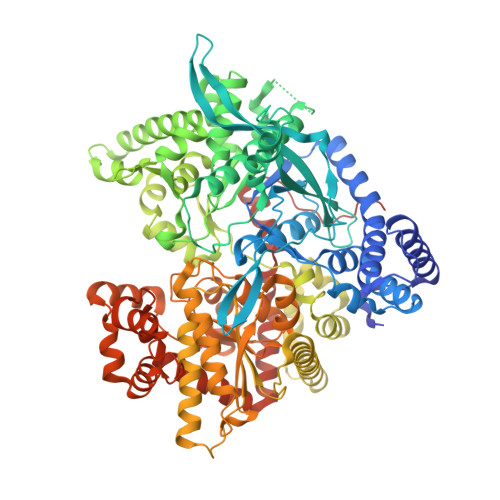
The crystal structure of glycogen phosphorylase in complex with 10


Experimental Data Snapshot

  • Method: X-RAY DIFFRACTION
  • Resolution: 2.37 Å
  • R-Value Free: 
    0.205 (Depositor), 0.172 (DCC) 
  • R-Value Work: 
    0.153 (Depositor) 
  • R-Value Observed: 
    0.155 (Depositor) 

wwPDB Validation 3D Report Full Report

Validation slider image for 6S51

Ligand Structure Quality Assessment 


This is version 1.1 of the entry. See complete history

Literature

The architecture of hydrogen and sulfur sigma-hole interactions explain differences in the inhibitory potency of C-beta-d-glucopyranosyl thiazoles, imidazoles and an N-beta-d glucopyranosyl tetrazole for human liver glycogen phosphorylase and offer new insights to structure-based design.

Kyriakis, E.Karra, A.G.Papaioannou, O.Solovou, T.Skamnaki, V.T.Liggri, P.G.V.Zographos, S.E.Szennyes, E.Bokor, E.Kun, S.Psarra, A.G.Somsak, L.Leonidas, D.D.

(2020) Bioorg Med Chem 28: 115196-115196

  • DOI: https://doi.org/10.1016/j.bmc.2019.115196
  • Primary Citation Related Structures: 
    6S4H, 6S4K, 6S4O, 6S4P, 6S4R, 6S51, 6S52

  • PubMed Abstract: 

    C-Glucopyranosyl imidazoles, thiazoles, and an N-glucopyranosyl tetrazole were assessed in vitro and ex vivo for their inhibitory efficiency against isoforms of glycogen phosphorylase (GP; a validated pharmacological target for the development of anti-hyperglycaemic agents). Imidazoles proved to be more potent inhibitors than the corresponding thiazoles or the tetrazole. The most potent derivative has a 2-naphthyl substituent, a K i value of 3.2 µM for hepatic glycogen phosphorylase, displaying also 60% inhibition of GP activity in HepG2 cells, compared to control vehicle treated cells, at 100 μM. X-Ray crystallography studies of the protein - inhibitor complexes revealed the importance of the architecture of inhibitor associated hydrogen bonds or sulfur σ-hole bond interactions to Asn284 OD1, offering new insights to structure-based design efforts. Moreover, while the 2-glucopyranosyl-tetrazole seems to bind differently from the corresponding 1,2,3-triazole compound, the two inhibitors are equipotent.


  • Organizational Affiliation
    • Department of Biochemistry and Biotechnology, University of Thessaly, Biopolis, 41500 Larissa, Greece.

Macromolecule Content 

  • Total Structure Weight: 97.99 kDa 
  • Atom Count: 6,797 
  • Modeled Residue Count: 810 
  • Deposited Residue Count: 843 
  • Unique protein chains: 1

Macromolecules

Find similar proteins by:|  3D Structure
Entity ID: 1
MoleculeChains  Sequence LengthOrganismDetailsImage
Glycogen phosphorylase, muscle form843Oryctolagus cuniculusMutation(s): 0 
EC: 2.4.1.1
UniProt
Find proteins for P00489 (Oryctolagus cuniculus)
Explore P00489 
Go to UniProtKB:  P00489
Entity Groups
Sequence Clusters30% Identity50% Identity70% Identity90% Identity95% Identity100% Identity
UniProt GroupP00489
Sequence Annotations
Expand
Reference Sequence

Small Molecules

Ligands 2 Unique
IDChains Name / Formula / InChI Key2D Diagram3D Interactions
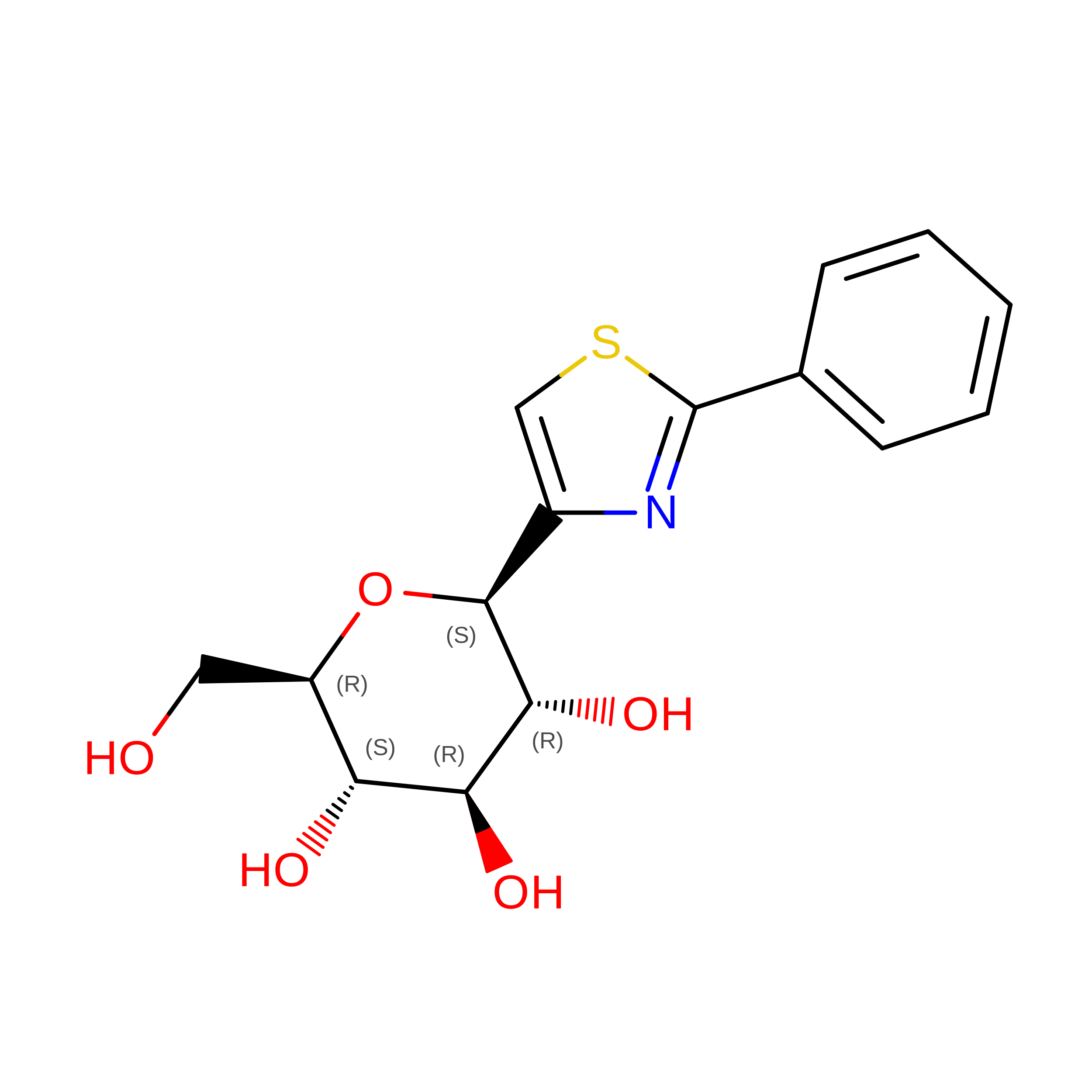
KVQ
(Subject of Investigation/LOI)

Query on KVQ


Download:Ideal Coordinates CCD File
B [auth A](2~{R},3~{S},4~{R},5~{R},6~{S})-2-(hydroxymethyl)-6-(2-phenyl-1,3-thiazol-4-yl)oxane-3,4,5-triol
C15 H17 N O5 S
PFYRBHFULSKLRW-RGDJUOJXSA-N
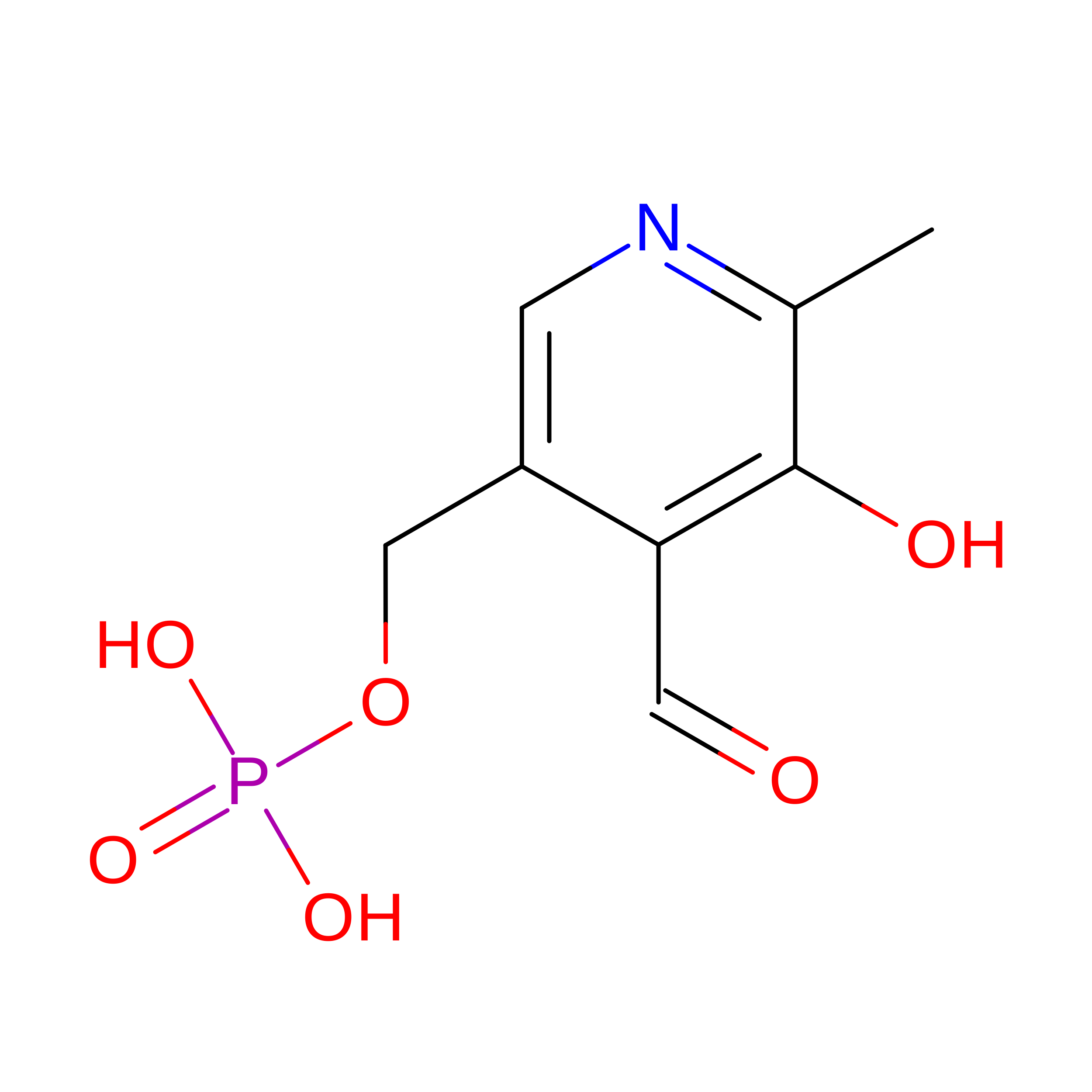
PLP

Query on PLP


Download:Ideal Coordinates CCD File
C [auth A]PYRIDOXAL-5'-PHOSPHATE
C8 H10 N O6 P
NGVDGCNFYWLIFO-UHFFFAOYSA-N

Experimental Data & Validation

Experimental Data

  • Method: X-RAY DIFFRACTION
  • Resolution: 2.37 Å
  • R-Value Free:  0.205 (Depositor), 0.172 (DCC) 
  • R-Value Work:  0.153 (Depositor) 
  • R-Value Observed: 0.155 (Depositor) 
Space Group: P 43 21 2
Unit Cell:
Length ( Å )Angle ( ˚ )
a = 128.077α = 90
b = 128.077β = 90
c = 115.801γ = 90
Software Package:
Software NamePurpose
REFMACrefinement
CrysalisProdata reduction
Aimlessdata scaling
REFMACphasing

Structure Validation

View Full Validation Report


Ligand Structure Quality Assessment 


Entry History 

Deposition Data

Revision History  (Full details and data files)

  • Version 1.0: 2020-02-19
    Type: Initial release
  • Version 1.1: 2025-04-09
    Changes: Data collection, Database references, Structure summary