6ROI | pdb_00006roi

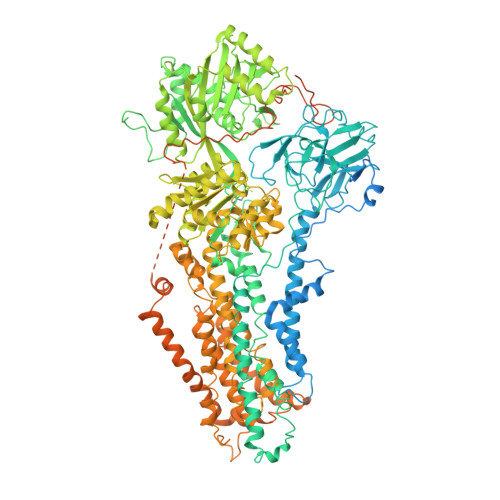
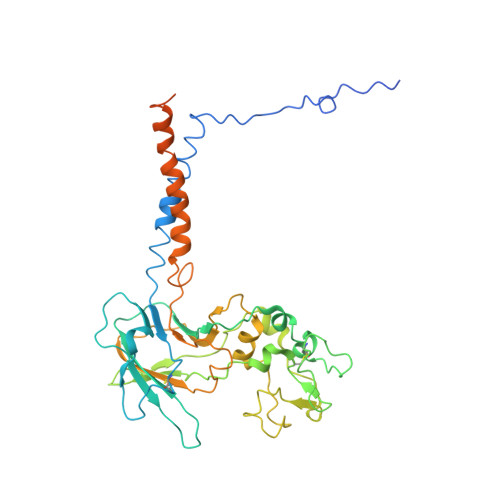
Cryo-EM structure of the partially activated Drs2p-Cdc50p


Experimental Data Snapshot

  • Method: ELECTRON MICROSCOPY
  • Resolution: 3.70 Å
  • Aggregation State: PARTICLE 
  • Reconstruction Method: SINGLE PARTICLE 

wwPDB Validation 3D Report Full Report

Validation slider image for 6ROI

This is version 3.0 of the entry. See complete history

Literature

Structure and autoregulation of a P4-ATPase lipid flippase.

Timcenko, M.Lyons, J.A.Januliene, D.Ulstrup, J.J.Dieudonne, T.Montigny, C.Ash, M.R.Karlsen, J.L.Boesen, T.Kuhlbrandt, W.Lenoir, G.Moeller, A.Nissen, P.

(2019) Nature 571: 366-370

  • DOI: https://doi.org/10.1038/s41586-019-1344-7
  • Primary Citation Related Structures: 
    6ROH, 6ROI, 6ROJ

  • PubMed Abstract: 

    Type 4 P-type ATPases (P4-ATPases) are lipid flippases that drive the active transport of phospholipids from exoplasmic or luminal leaflets to cytosolic leaflets of eukaryotic membranes. The molecular architecture of P4-ATPases and the mechanism through which they recognize and transport lipids have remained unknown. Here we describe the cryo-electron microscopy structure of the P4-ATPase Drs2p-Cdc50p, a Saccharomyces cerevisiae lipid flippase that is specific to phosphatidylserine and phosphatidylethanolamine. Drs2p-Cdc50p is autoinhibited by the C-terminal tail of Drs2p, and activated by the lipid phosphatidylinositol-4-phosphate (PtdIns4P or PI4P). We present three structures that represent the complex in an autoinhibited, an intermediate and a fully activated state. The analysis highlights specific features of P4-ATPases and reveals sites of autoinhibition and PI4P-dependent activation. We also observe a putative lipid translocation pathway in this flippase that involves a conserved PISL motif in transmembrane segment 4 and polar residues of transmembrane segments 2 and 5, in particular Lys1018, in the centre of the lipid bilayer.


  • Organizational Affiliation
    • DANDRITE, Nordic EMBL Partnership for Molecular Medicine, Department of Molecular Biology and Genetics, Aarhus University, Aarhus, Denmark.

Macromolecule Content 

  • Total Structure Weight: 213.49 kDa 
  • Atom Count: 11,775 
  • Modeled Residue Count: 1,447 
  • Deposited Residue Count: 1,873 
  • Unique protein chains: 2

Macromolecules

Find similar proteins by:|  3D Structure
Entity ID: 1
MoleculeChains  Sequence LengthOrganismDetailsImage
Probable phospholipid-transporting ATPase DRS21,460Saccharomyces cerevisiae S288CMutation(s): 0 
Gene Names: DRS2YAL026CFUN38
EC: 7.6.2.1
Membrane Entity: Yes 
UniProt
Find proteins for P39524 (Saccharomyces cerevisiae (strain ATCC 204508 / S288c))
Explore P39524 
Go to UniProtKB:  P39524
Entity Groups
Sequence Clusters30% Identity50% Identity70% Identity90% Identity95% Identity100% Identity
UniProt GroupP39524
Sequence Annotations
Expand
Reference Sequence
Find similar proteins by:|  3D Structure
Entity ID: 2
MoleculeChains  Sequence LengthOrganismDetailsImage
Cell division control protein 50B [auth C]413Saccharomyces cerevisiae S288CMutation(s): 0 
Gene Names: CDC50YCR094WYCR94W
Membrane Entity: Yes 
UniProt
Find proteins for P25656 (Saccharomyces cerevisiae (strain ATCC 204508 / S288c))
Explore P25656 
Go to UniProtKB:  P25656
Entity Groups
Sequence Clusters30% Identity50% Identity70% Identity90% Identity95% Identity100% Identity
UniProt GroupP25656
Glycosylation
Glycosylation Sites: 3Go to GlyGen: P25656-1
Sequence Annotations
Expand
Reference Sequence

Oligosaccharides

Help  
Entity ID: 3
MoleculeChains Length2D Diagram GlycosylationD Interactions
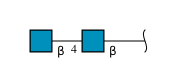
2-acetamido-2-deoxy-beta-D-glucopyranose-(1-4)-2-acetamido-2-deoxy-beta-D-glucopyranoseC [auth B]2N-Glycosylation
Glycosylation Resources
GlyTouCan: G42666HT
GlyCosmos: G42666HT
GlyGen: G42666HT
Entity ID: 4
MoleculeChains Length2D Diagram GlycosylationD Interactions
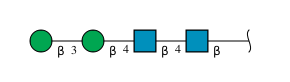
beta-D-mannopyranose-(1-3)-beta-D-mannopyranose-(1-4)-2-acetamido-2-deoxy-beta-D-glucopyranose-(1-4)-2-acetamido-2-deoxy-beta-D-glucopyranose
D
4N-Glycosylation
Glycosylation Resources
GlyTouCan: G31886NL
GlyCosmos: G31886NL
GlyGen: G31886NL

Small Molecules

Ligands 3 Unique
IDChains Name / Formula / InChI Key2D Diagram3D Interactions
2Y5
(Subject of Investigation/LOI)

Query on 2Y5


Download:Ideal Coordinates CCD File
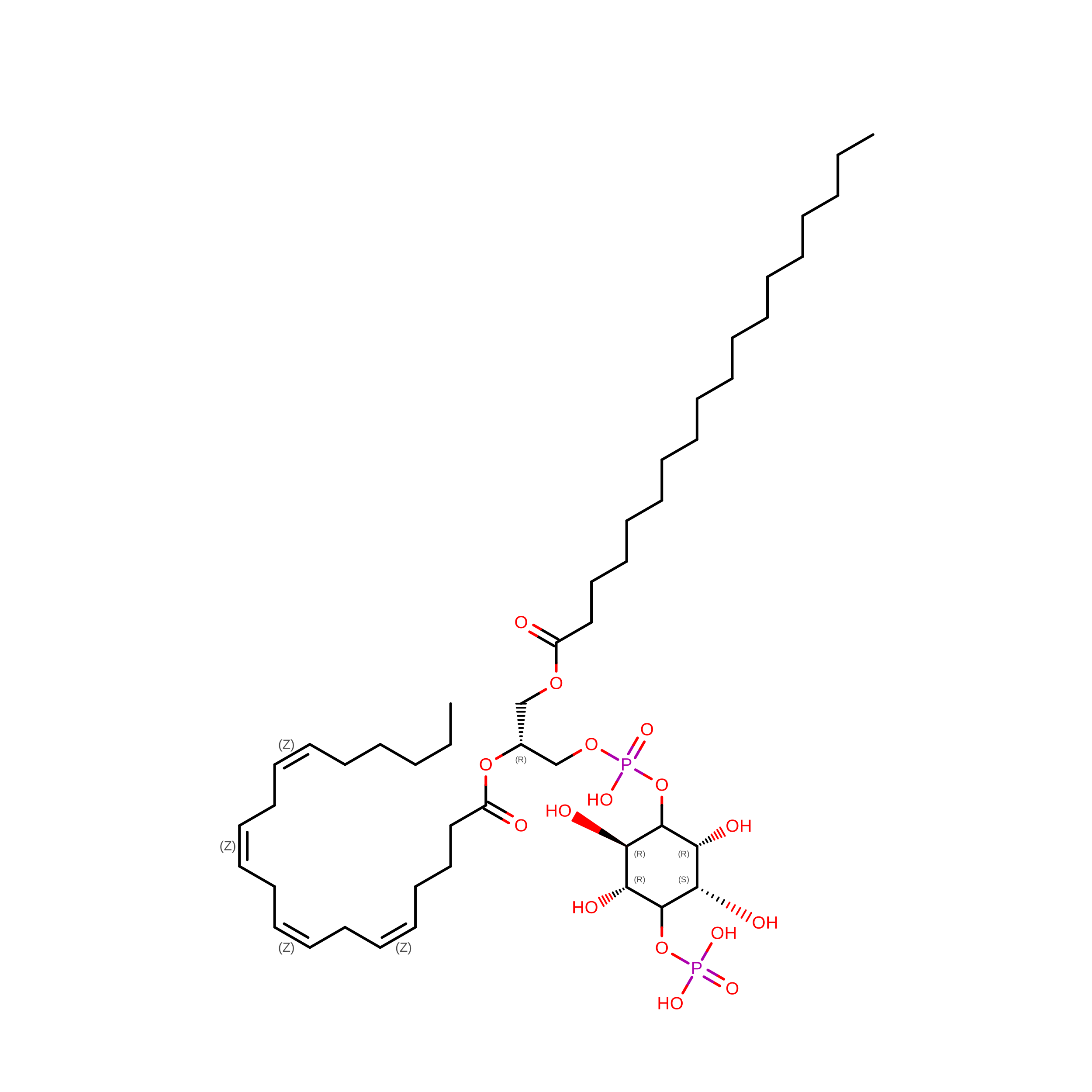
F [auth A](2R)-1-{[(R)-hydroxy{[(1R,2R,3R,4R,5S,6R)-2,3,5,6-tetrahydroxy-4-(phosphonooxy)cyclohexyl]oxy}phosphoryl]oxy}-3-(octadecanoyloxy)propan-2-yl (5Z,8Z,11Z,14Z)-icosa-5,8,11,14-tetraenoate
C47 H84 O16 P2
ROKMWIUSHIHOGI-BWTMTLBLSA-N
NAG

Query on NAG


Download:Ideal Coordinates CCD File
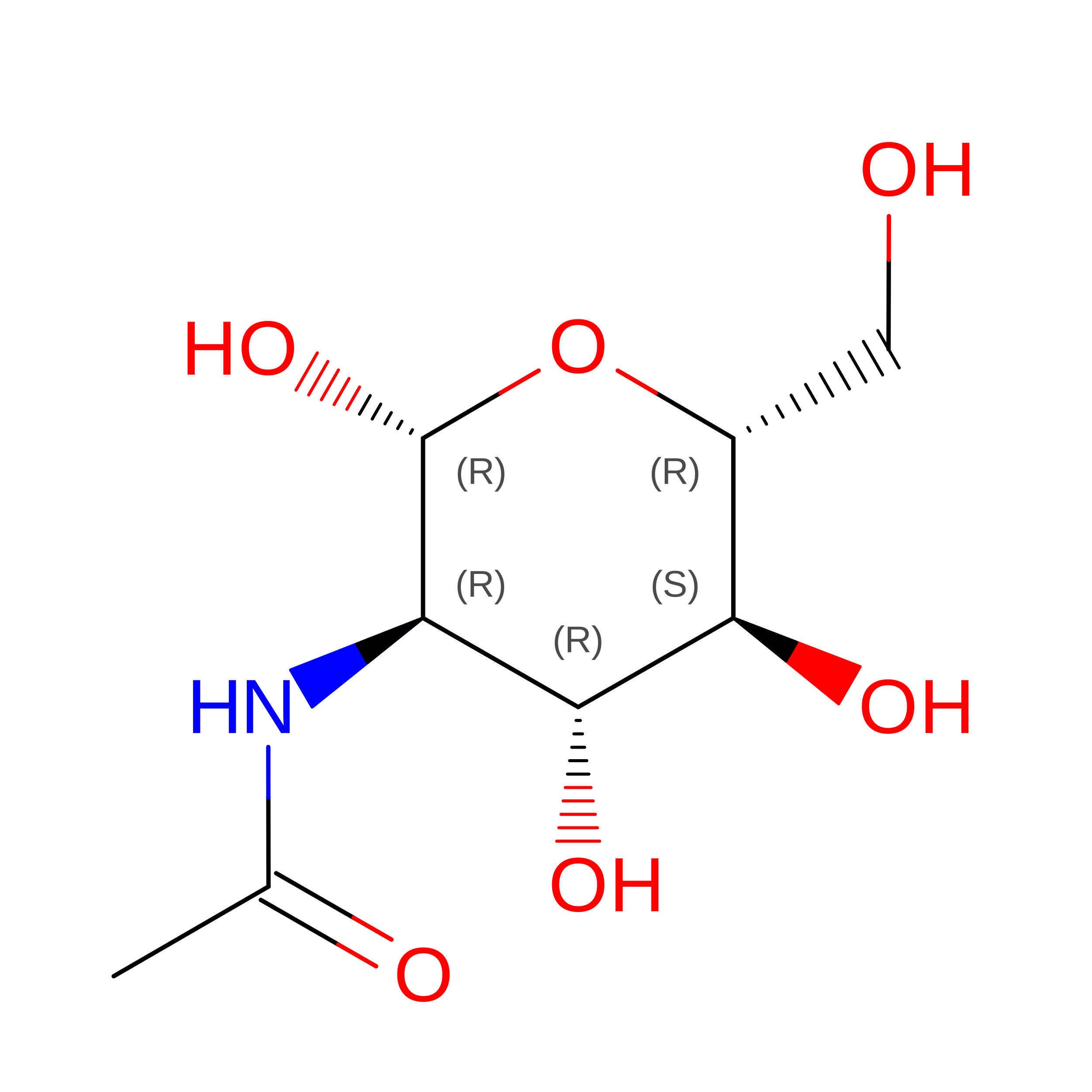
G [auth C]2-acetamido-2-deoxy-beta-D-glucopyranose
C8 H15 N O6
OVRNDRQMDRJTHS-FMDGEEDCSA-N
MG
(Subject of Investigation/LOI)

Query on MG


Download:Ideal Coordinates CCD File
E [auth A]MAGNESIUM ION
Mg
JLVVSXFLKOJNIY-UHFFFAOYSA-N
Modified Residues  1 Unique
IDChains TypeFormula2D DiagramParent
BFD
Query on BFD
A
L-PEPTIDE LINKINGC4 H6 Be F3 N O4ASP

Experimental Data & Validation

Experimental Data

  • Method: ELECTRON MICROSCOPY
  • Resolution: 3.70 Å
  • Aggregation State: PARTICLE 
  • Reconstruction Method: SINGLE PARTICLE 
EM Software:
TaskSoftware PackageVersion
RECONSTRUCTIONRELION
MODEL REFINEMENTPHENIX

Structure Validation

View Full Validation Report


Entry History 

& Funding Information

Deposition Data


Funding OrganizationLocationGrant Number
Danish Council for Independent ResearchDenmark0602-02912B
LundbeckfondenDenmarkR171-2014-663
LundbeckfondenDenmarkR209-2015-2704
LundbeckfondenDenmark2015-2666
French National Research AgencyFranceANR-14-CE09-0022
French Infrastructure for Integrated Structural BiologyFranceANR-10-INSB-05

Revision History  (Full details and data files)

  • Version 1.0: 2019-07-03
    Type: Initial release
  • Version 1.1: 2019-07-10
    Changes: Data collection, Database references
  • Version 1.2: 2019-07-31
    Changes: Data collection, Database references
  • Version 1.3: 2019-12-18
    Changes: Other
  • Version 2.0: 2020-07-29
    Type: Remediation
    Reason: Carbohydrate remediation
    Changes: Atomic model, Data collection, Derived calculations, Structure summary
  • Version 2.1: 2025-04-09
    Changes: Data collection, Database references, Structure summary
  • Version 3.0: 2025-10-01
    Changes: Advisory, Atomic model, Data collection, Derived calculations, Structure summary