6R5Y | pdb_00006r5y

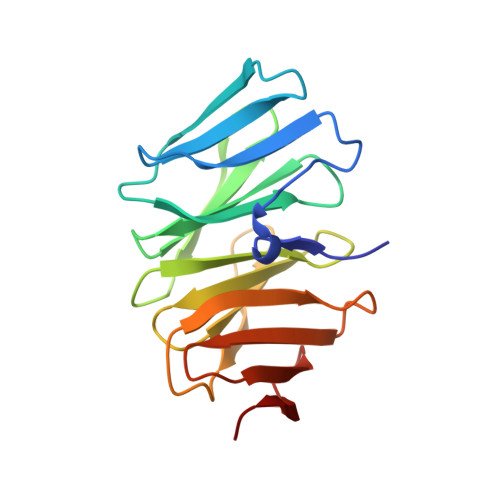
8-bladed beta-propeller formed by two 4-bladed fragments


Experimental Data Snapshot

  • Method: X-RAY DIFFRACTION
  • Resolution: 2.15 Å
  • R-Value Free: 
    0.254 (Depositor), 0.254 (DCC) 
  • R-Value Work: 
    0.223 (Depositor), 0.227 (DCC) 
  • R-Value Observed: 
    0.224 (Depositor) 

Starting Model: experimental
View more details

wwPDB Validation 3D Report Full Report

Validation slider image for 6R5Y

This is version 1.1 of the entry. See complete history

Literature

Structural diversity of oligomeric beta-propellers with different numbers of identical blades.

Afanasieva, E.Chaudhuri, I.Martin, J.Hertle, E.Ursinus, A.Alva, V.Hartmann, M.D.Lupas, A.N.

(2019) Elife 8

  • DOI: https://doi.org/10.7554/eLife.49853
  • Primary Citation Related Structures: 
    6R5X, 6R5Y, 6R5Z, 6R60

  • PubMed Abstract: 

    β-Propellers arise through the amplification of a supersecondary structure element called a blade. This process produces toroids of between four and twelve repeats, which are almost always arranged sequentially in a single polypeptide chain. We found that new propellers evolve continuously by amplification from single blades. We therefore investigated whether such nascent propellers can fold as homo-oligomers before they have been fully amplified within a single chain. One- to six-bladed building blocks derived from two seven-bladed WD40 propellers yielded stable homo-oligomers with six to nine blades, depending on the size of the building block. High-resolution structures for tetramers of two blades, trimers of three blades, and dimers of four and five blades, respectively, show structurally diverse propellers and include a novel fold, highlighting the inherent flexibility of the WD40 blade. Our data support the hypothesis that subdomain-sized fragments can provide structural versatility in the evolution of new proteins.


  • Organizational Affiliation
    • Department of Protein Evolution, Max Planck Institute for Developmental Biology, Tübingen, Germany.

Macromolecule Content 

  • Total Structure Weight: 107.03 kDa 
  • Atom Count: 7,686 
  • Modeled Residue Count: 978 
  • Deposited Residue Count: 1,008 
  • Unique protein chains: 1

Macromolecules

Find similar proteins by:|  3D Structure
Entity ID: 1
MoleculeChains  Sequence LengthOrganismDetailsImage
WD-40 repeat protein
A, B, C, D, E
A, B, C, D, E, F
168Nostoc punctiformeMutation(s): 0 
Gene Names: Npun_R6612
UniProt
Find proteins for B2J0I0 (Nostoc punctiforme (strain ATCC 29133 / PCC 73102))
Explore B2J0I0 
Go to UniProtKB:  B2J0I0
Entity Groups
Sequence Clusters30% Identity50% Identity70% Identity90% Identity95% Identity100% Identity
UniProt GroupB2J0I0
Sequence Annotations
Expand
Reference Sequence

Experimental Data & Validation

Experimental Data

  • Method: X-RAY DIFFRACTION
  • Resolution: 2.15 Å
  • R-Value Free:  0.254 (Depositor), 0.254 (DCC) 
  • R-Value Work:  0.223 (Depositor), 0.227 (DCC) 
  • R-Value Observed: 0.224 (Depositor) 
Space Group: P 21 21 2
Unit Cell:
Length ( Å )Angle ( ˚ )
a = 97.721α = 90
b = 127.167β = 90
c = 72.958γ = 90
Software Package:
Software NamePurpose
REFMACrefinement
XDSdata reduction
XDSdata scaling
MOLREPphasing

Structure Validation

View Full Validation Report


Entry History 

Deposition Data

Revision History  (Full details and data files)

  • Version 1.0: 2019-11-13
    Type: Initial release
  • Version 1.1: 2024-01-24
    Changes: Data collection, Database references, Derived calculations, Refinement description