6R11 | pdb_00006r11

Cereblon isoform 4 from Magnetospirillum gryphiswaldense in complex with compound 5b


Experimental Data Snapshot

  • Method: X-RAY DIFFRACTION
  • Resolution: 1.75 Å
  • R-Value Free: 
    0.227 (Depositor), 0.234 (DCC) 
  • R-Value Work: 
    0.188 (Depositor), 0.202 (DCC) 
  • R-Value Observed: 
    0.190 (Depositor) 

Starting Model: experimental
View more details

wwPDB Validation 3D Report Full Report

Validation slider image for 6R11

Ligand Structure Quality Assessment 


This is version 1.1 of the entry. See complete history

Literature

De-Novo Design of Cereblon (CRBN) Effectors Guided by Natural Hydrolysis Products of Thalidomide Derivatives.

Heim, C.Pliatsika, D.Mousavizadeh, F.Bar, K.Hernandez Alvarez, B.Giannis, A.Hartmann, M.D.

(2019) J Med Chem 62: 6615-6629

  • DOI: https://doi.org/10.1021/acs.jmedchem.9b00454
  • Primary Citation Related Structures: 
    6R0Q, 6R0S, 6R0U, 6R0V, 6R11, 6R12, 6R13, 6R18, 6R19, 6R1A, 6R1C, 6R1D, 6R1K, 6R1W, 6R1X

  • PubMed Abstract: 

    Targeted protein degradation via cereblon (CRBN), a substrate receptor of an E3 ubiquitin ligase complex, is an increasingly important strategy in various clinical settings, in which the substrate specificity of CRBN is altered via the binding of small-molecule effectors. To date, such effectors are derived from thalidomide and confer a broad substrate spectrum that is far from being fully characterized. Here, we employed a rational and modular approach to design novel and minimalistic CRBN effectors. In this approach, we took advantage of the binding modes of hydrolyzed metabolites of several thalidomide-derived effectors, which we elucidated via crystallography. These yielded key insights for the optimization of the minimal core binding moiety and its linkage to a chemical moiety that imparts substrate specificity. Based on this scaffold, we present a first active de-novo CRBN effector that is able to degrade the neo-substrate IKZF3 in the cell culture.


  • Organizational Affiliation
    • Department of Protein Evolution , Max Planck Institute for Developmental Biology , Max-Planck-Ring 5 , 72076 Tübingen , Germany.

Macromolecule Content 

  • Total Structure Weight: 42.05 kDa 
  • Atom Count: 2,709 
  • Modeled Residue Count: 321 
  • Deposited Residue Count: 375 
  • Unique protein chains: 1

Macromolecules

Find similar proteins by:|  3D Structure
Entity ID: 1
MoleculeChains  Sequence LengthOrganismDetailsImage
Cereblon isoform 4
A, B, C
125Magnetospirillum gryphiswaldense MSR-1Mutation(s): 0 
Gene Names: MGR_0879
UniProt
Find proteins for A4TVL0 (Magnetospirillum gryphiswaldense)
Explore A4TVL0 
Go to UniProtKB:  A4TVL0
Entity Groups
Sequence Clusters30% Identity50% Identity70% Identity90% Identity95% Identity100% Identity
UniProt GroupA4TVL0
Sequence Annotations
Expand
Reference Sequence

Small Molecules

Ligands 4 Unique
IDChains Name / Formula / InChI Key2D Diagram3D Interactions
JOB

Query on JOB


Download:Ideal Coordinates CCD File
E [auth A],
H [auth B]
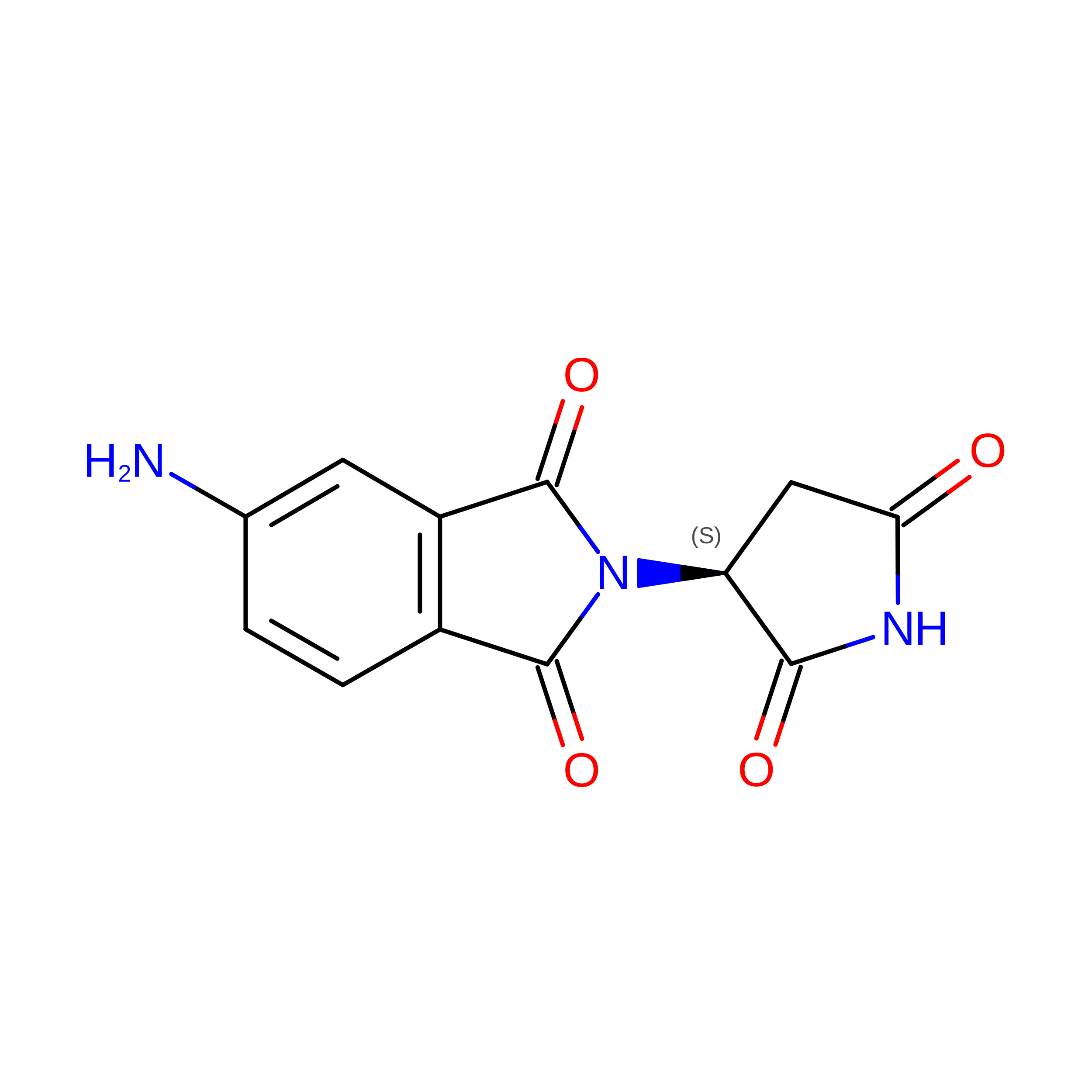
5-azanyl-2-[(3~{S})-2,5-bis(oxidanylidene)pyrrolidin-3-yl]isoindole-1,3-dione
C12 H9 N3 O4
ZQAUOFWDVHCTPN-QMMMGPOBSA-N
PO4

Query on PO4


Download:Ideal Coordinates CCD File
F [auth A],
I [auth B]
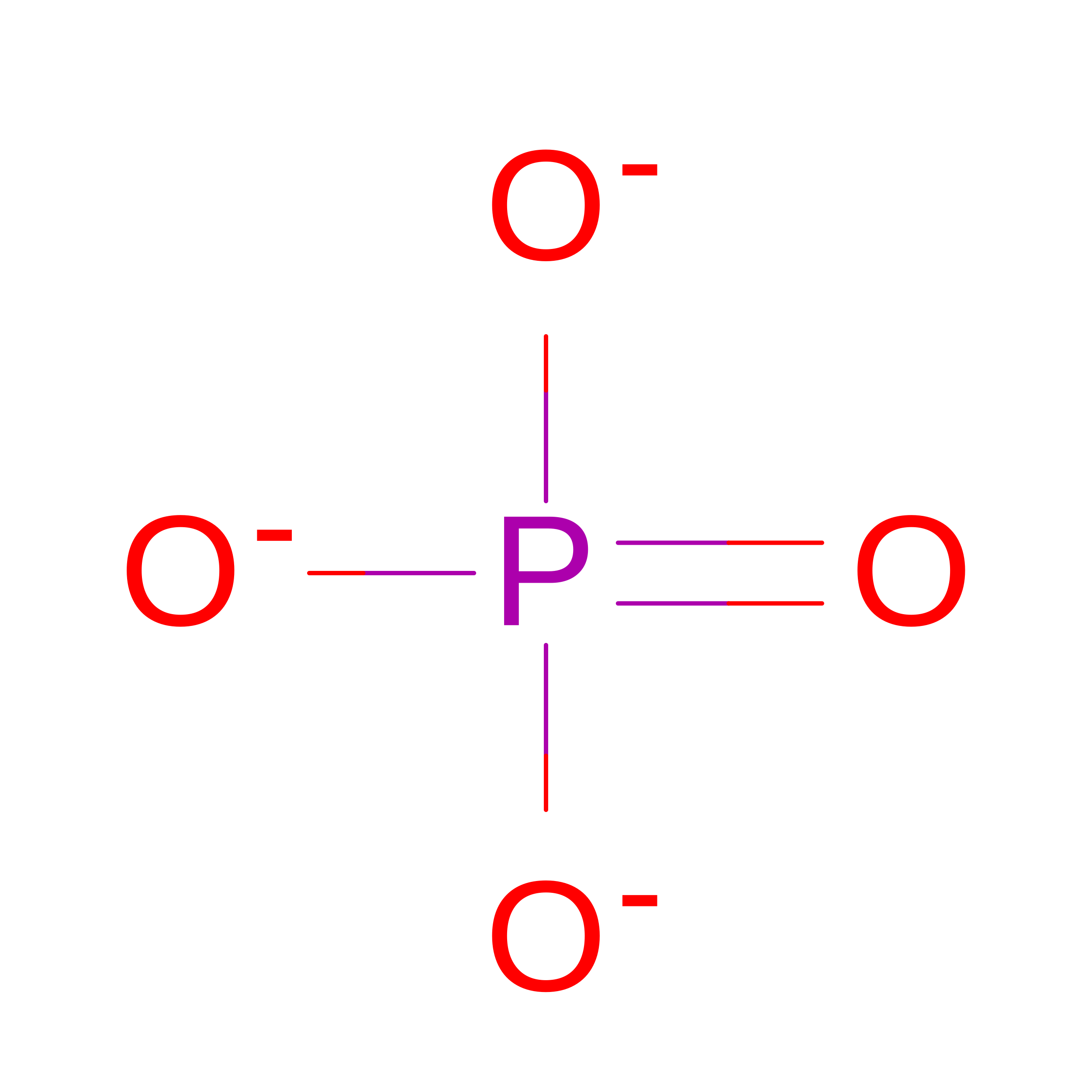
PHOSPHATE ION
O4 P
NBIIXXVUZAFLBC-UHFFFAOYSA-K
ZN

Query on ZN


Download:Ideal Coordinates CCD File
D [auth A],
G [auth B],
K [auth C]
ZINC ION
Zn
PTFCDOFLOPIGGS-UHFFFAOYSA-N
CL

Query on CL


Download:Ideal Coordinates CCD File
J [auth B]CHLORIDE ION
Cl
VEXZGXHMUGYJMC-UHFFFAOYSA-M

Experimental Data & Validation

Experimental Data

  • Method: X-RAY DIFFRACTION
  • Resolution: 1.75 Å
  • R-Value Free:  0.227 (Depositor), 0.234 (DCC) 
  • R-Value Work:  0.188 (Depositor), 0.202 (DCC) 
  • R-Value Observed: 0.190 (Depositor) 
Space Group: P 21 21 21
Unit Cell:
Length ( Å )Angle ( ˚ )
a = 56.66α = 90
b = 58.709β = 90
c = 88.013γ = 90
Software Package:
Software NamePurpose
REFMACrefinement
XDSdata reduction
XDSdata scaling
MOLREPphasing

Structure Validation

View Full Validation Report


Ligand Structure Quality Assessment 


Entry History 

Deposition Data

Revision History  (Full details and data files)

  • Version 1.0: 2019-08-07
    Type: Initial release
  • Version 1.1: 2024-01-24
    Changes: Data collection, Database references, Refinement description